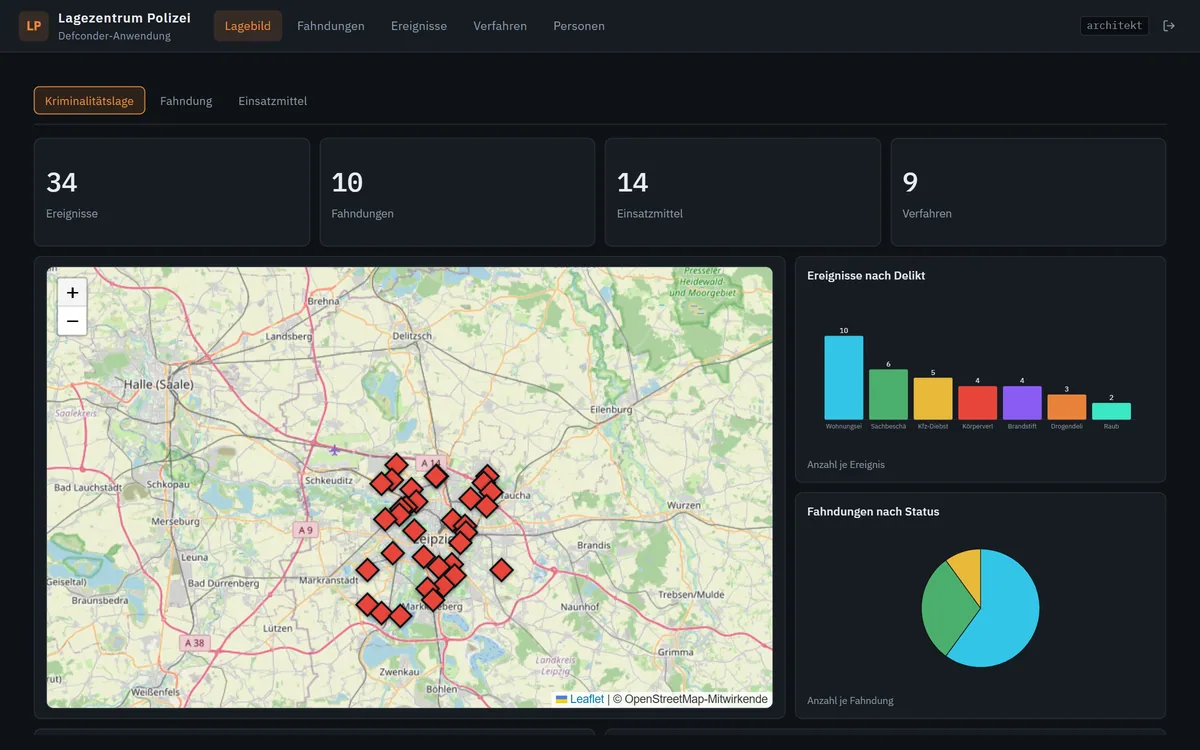
When it gets serious, you see the situation, check the plan beforehand and can later prove who decided what, and when. Defconder belongs to you and runs on your own infrastructure.
Everything you see on this page belongs to one of these six tasks. Pick yours and you jump to the parts that work together for it. Everything runs on your own infrastructure.
See the situation
Data, sensors, map and airspace become one situational picture, including the critical surroundings next to your site.
Backed by Every entry carries a check value in the tamper-evident log. Aerial imagery is available for all sixteen federal states.
The AI runs with you, learns with you and does not act without approval. As context it receives the object type and the attributes of the record concerned. A lock and a log are part of it.
Backed by The default is level 0, meaning no learning. On failure or an unclear value, the AI gate refuses.
Choose your role. You jump to the parts that matter for your task. In the full view of the ecosystem, the same parts light up when you pick your role there.
Control rooms and incident command
You need a situational picture that does not fail, and orders whose arrival can be proven.
Everything connects: situation, data, model, command and proof.
Defconder is not a single tool but an ecosystem of connected capabilities on your own infrastructure. The system map shows them, how they link and where each one honestly stands.
What is part of the Defconder ecosystem?
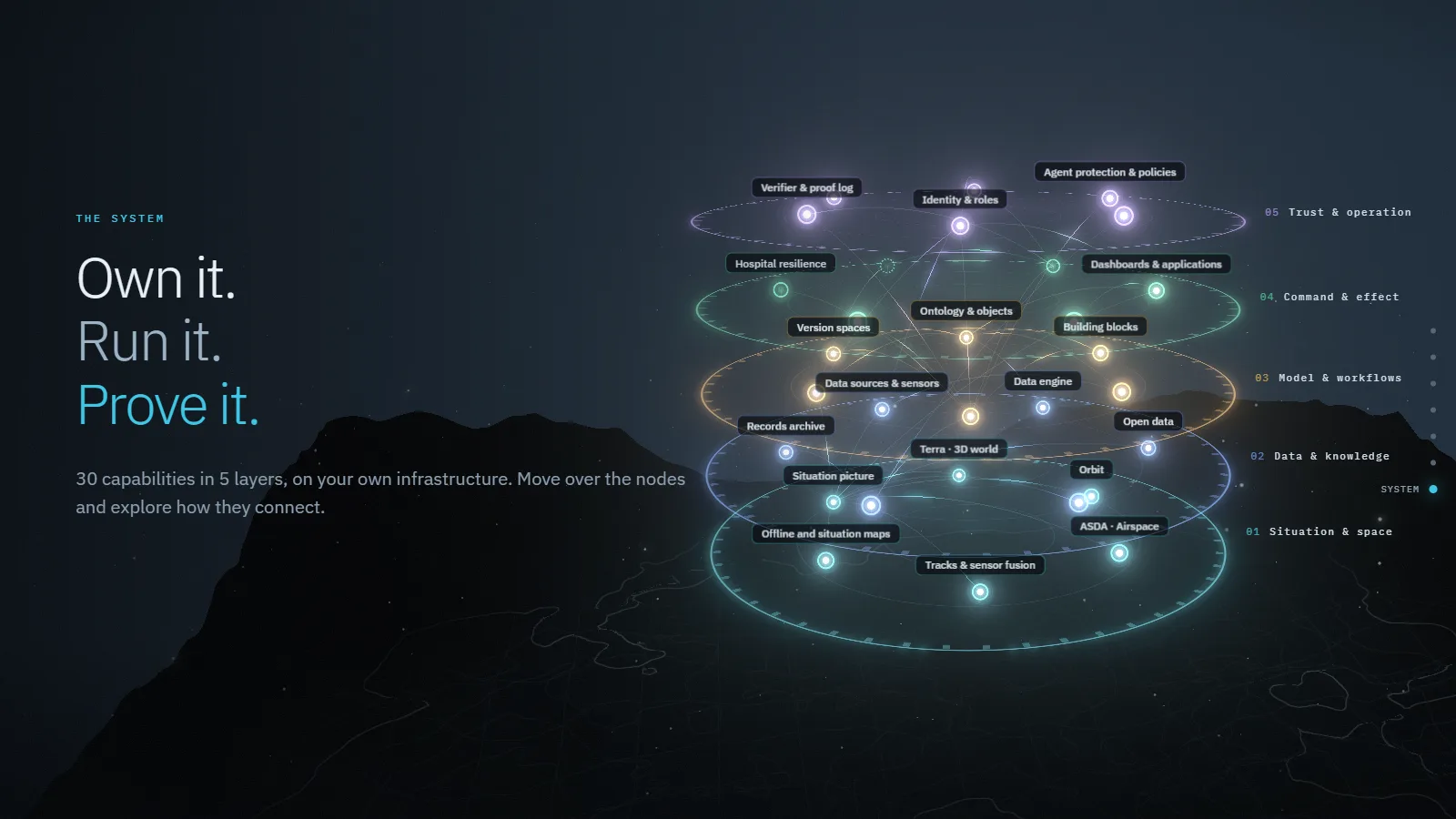
The Defconder ecosystem has 34 capabilities in 5 layers: situation and space, data and knowledge, model and workflows, command and effect, and trust and operation. They share one object model, one chained event log and one permission system, and run on your own infrastructure. 29 of them are in the product, 4 are in development and 1 is described as a concept.
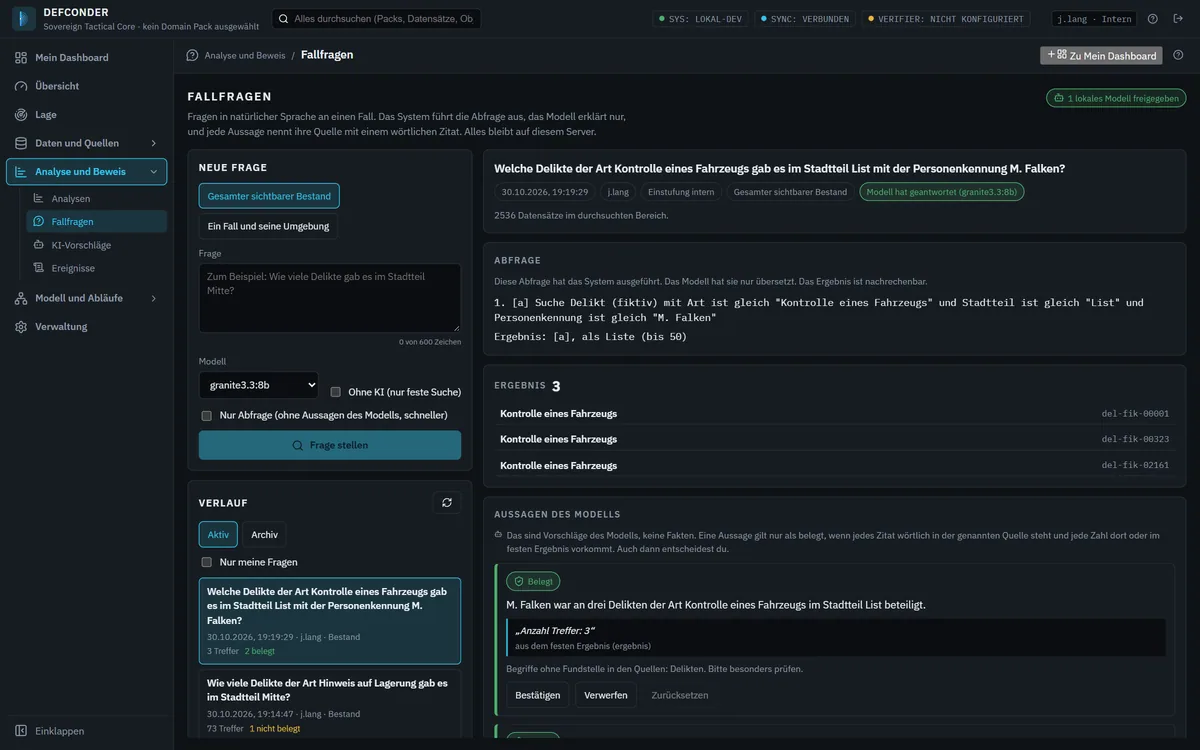
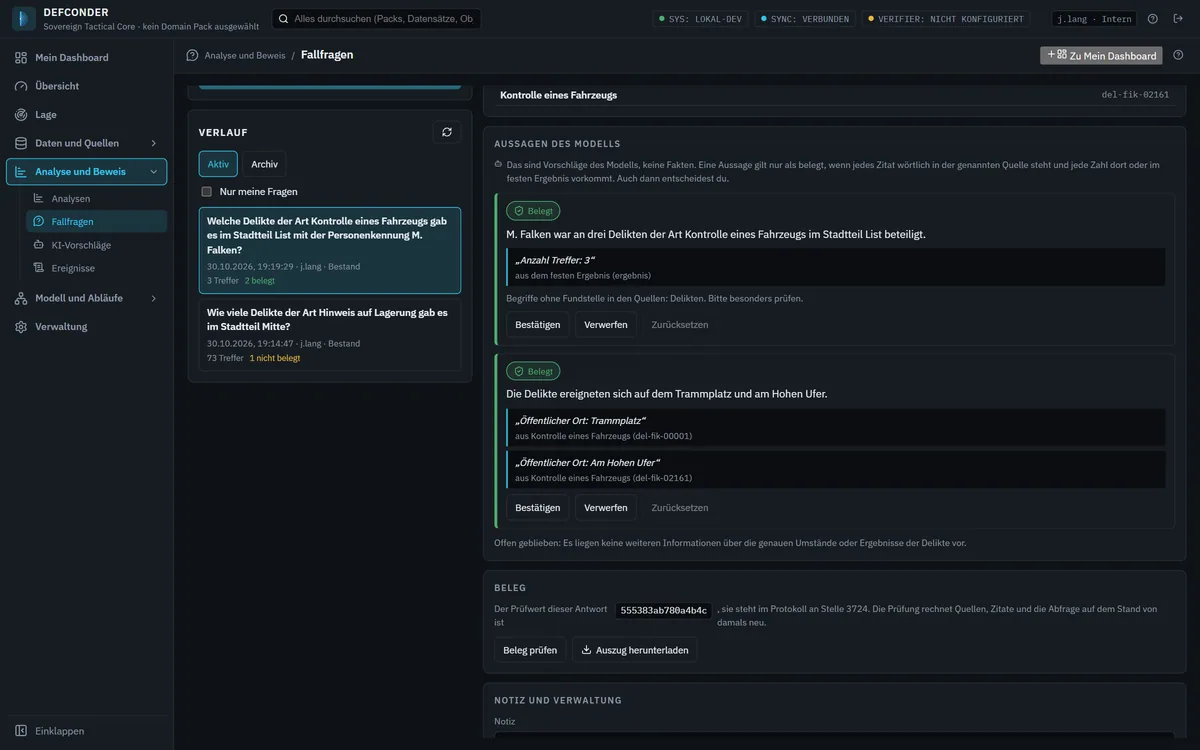
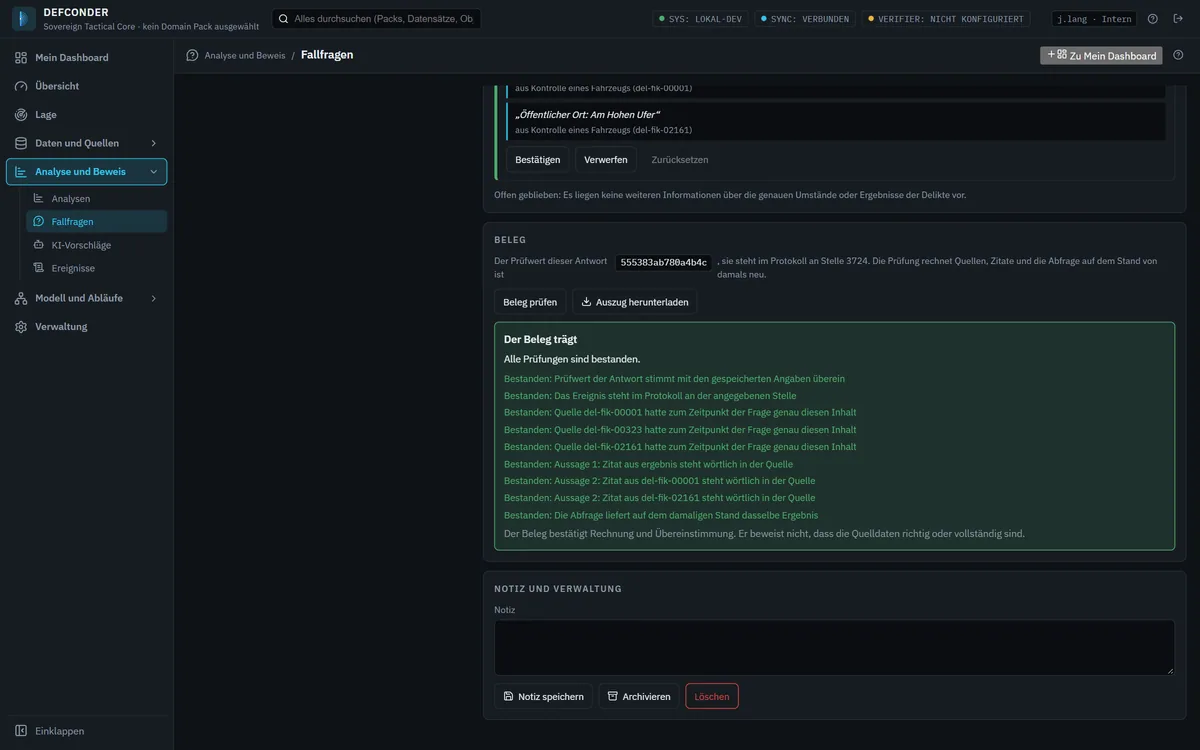
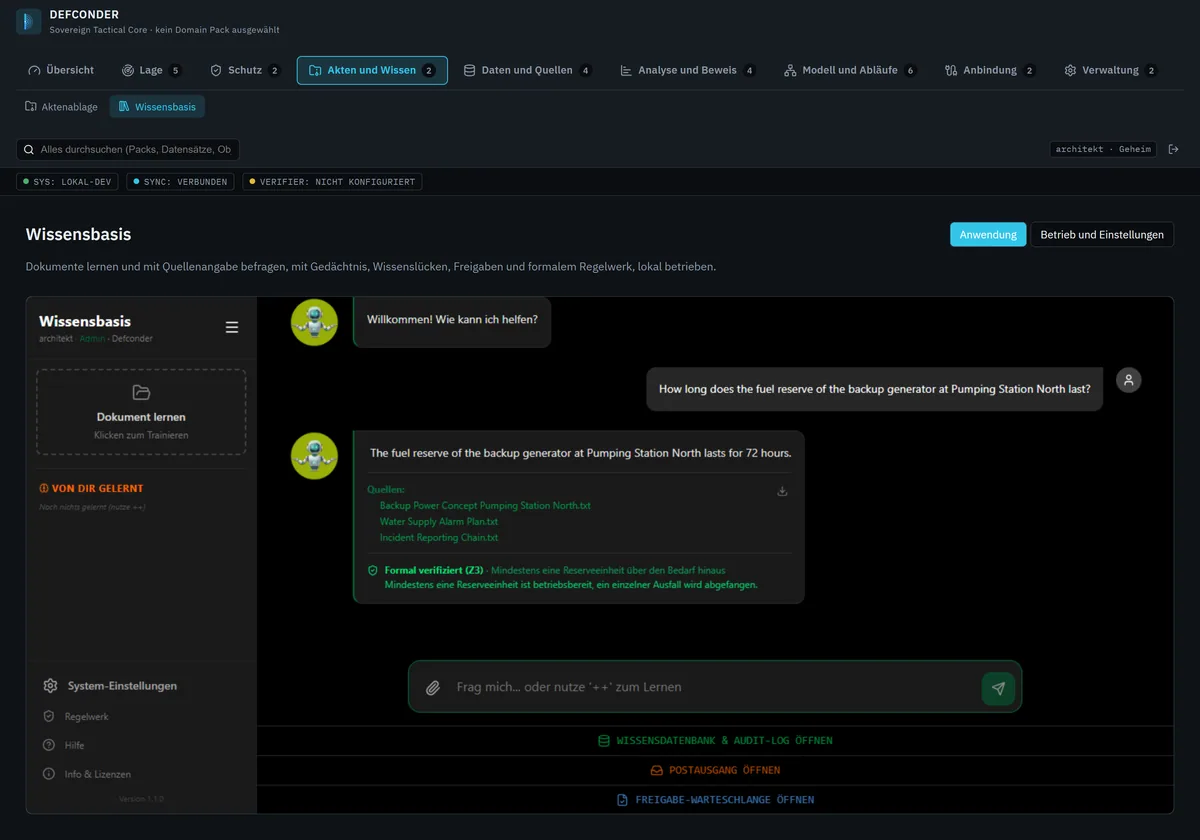
Questions to the case in full sentences. Defconder runs the query itself, every statement names its source and a verbatim quote, the answer carries a check value. Built and proven in test. Limit: on machines without a graphics card an answer with a model takes minutes.
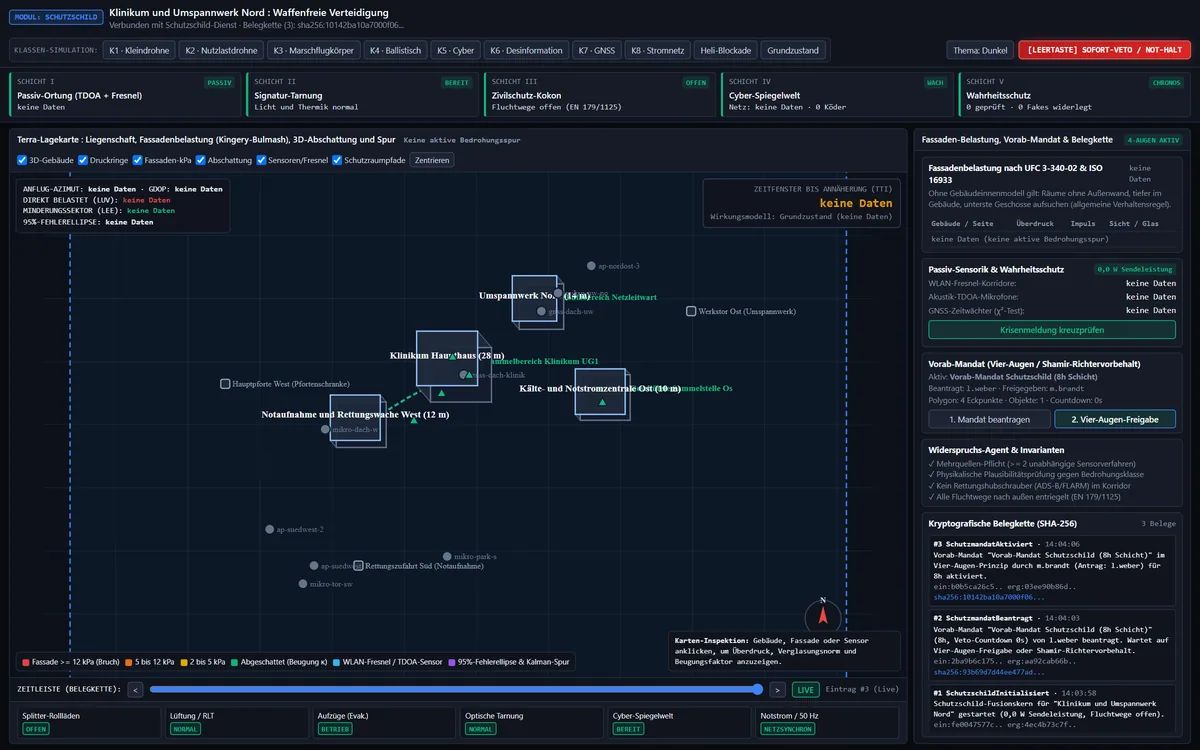
Weapon-free protection layers on existing building and network technology: passive detection, building cocoon, mirror world, truth protection. Advance mandate with two people, objection agent and immediate veto. Prototype with proof run, sensor and actuator connections under construction.
Signed messages to the other side that contain only provable truth from your own data. Counter-argument, two approvals, signed extract and CAP export. Built and proven in test. Limit: people hand messages over open channels, the effect is not measured.
Operation on your own infrastructure and managed interfaces; connectors and operating limits depend on the installation.
The status follows the actual state of the project. Anything marked as a concept is described but not yet built.
Text version of the film
A situation is not a picture. It is a connection.
Defconder connects what is usually kept apart: signals, data, models, decisions and evidence. On your own infrastructure.
Every signal has a place, a time and a source.
Sensors, maps, airspace and the 3D world fill one shared situation picture. Nothing stands without a source.
Raw data becomes a shared understanding.
Data sources, data engine, knowledge base and media analysis put what comes in in order and record where it comes from.
The AI proposes. A person decides.
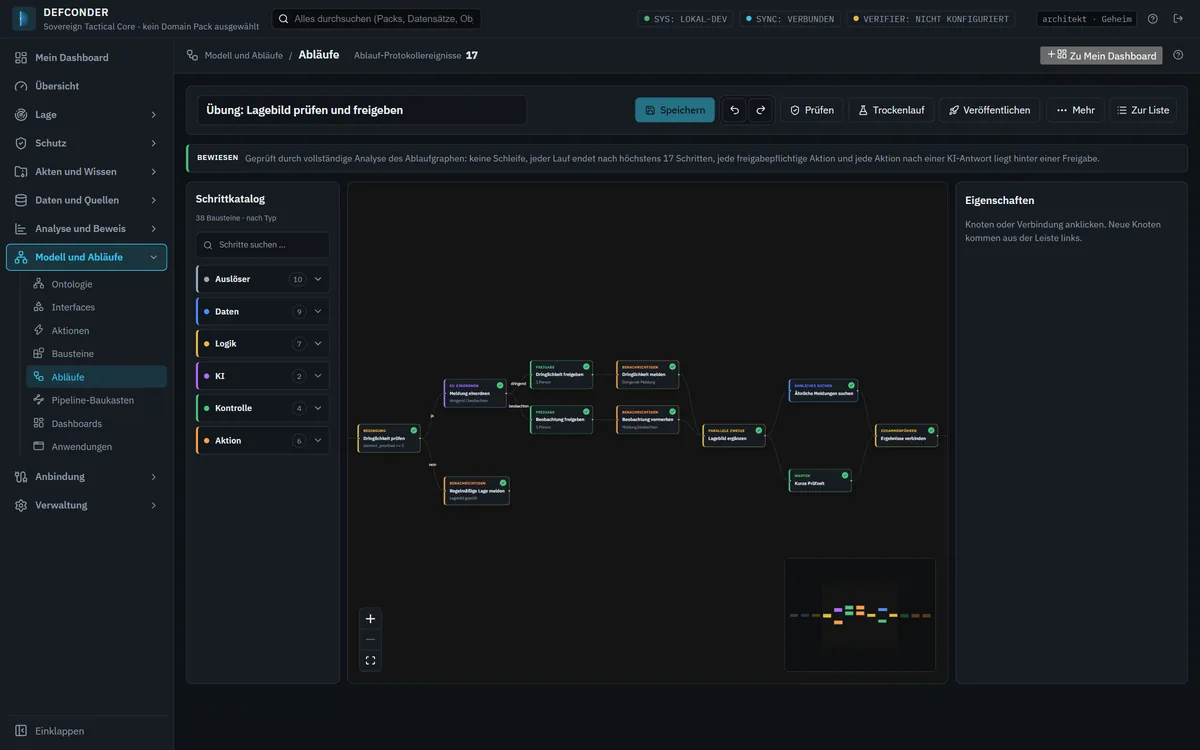
The model knows objects, relations and rules. Workflows connect triggers, checks and approvals, and the check proves before the start: no action runs past a person.
Decisions reach the right places.
Orders, alerts, acknowledgements and escalation carry the decision into command, into warnings and into the domain scenarios.
Every change is an event. Every chain can be verified.
Chained logs, an independent verifier and the version spaces make it traceable who changed what and when. Access follows identity, role and classification.
Own it. Run it. Prove it.
34 capabilities in 5 layers, on your own infrastructure. Move over the nodes and explore how they connect.
The product screens in the film come from Defconder. All names and data in them are invented exercise data.
The full view is an explanatory depiction of the system. Product screens show Defconder with invented exercise data.
At a glance
Fourteen films, most recorded live in the real interface, without slides.
See how an empty sheet becomes an application
Invented data or our own texts, no mock-up
Every film shows the real interface
Defconder Labs
See it, don't just believe it.
Fourteen films show what Defconder can do. Thirteen are recorded live in the real interface, with invented data or our own texts. The Protective Shield trailer is a simulation using the module's real computations. No mock-ups, no slides. You see how a blank page becomes a finished application.
New: the vector space, three scenarios
A vector space turns texts into points and meaning into neighbourhood. The same function in three fields of use: our own technical texts, patient records and an exercise picture. Two of the three films show entirely invented data.
New0:42
Technical texts: flying through our own documents
About 2,000 passages from our own technical texts. Question: how can I prove that the log was never tampered with?
German narration with English subtitles. For another language, open the player settings, choose Subtitles, then Auto-translate.
An invented exercise with eight areas and over 1,600 reports, a pattern for armed forces, police and control centres. Question: where will fuel run short in the next hours?
German narration with English subtitles. For another language, open the player settings, choose Subtitles, then Auto-translate.
The map shows only part of the structure, the distances between groups are stretched for visibility, stars and nebulae are decoration. The texts are turned into vectors locally, nothing leaves your own infrastructure.
New in the Labs
New3:05
Protective Shield: Hesitation Before the Danger
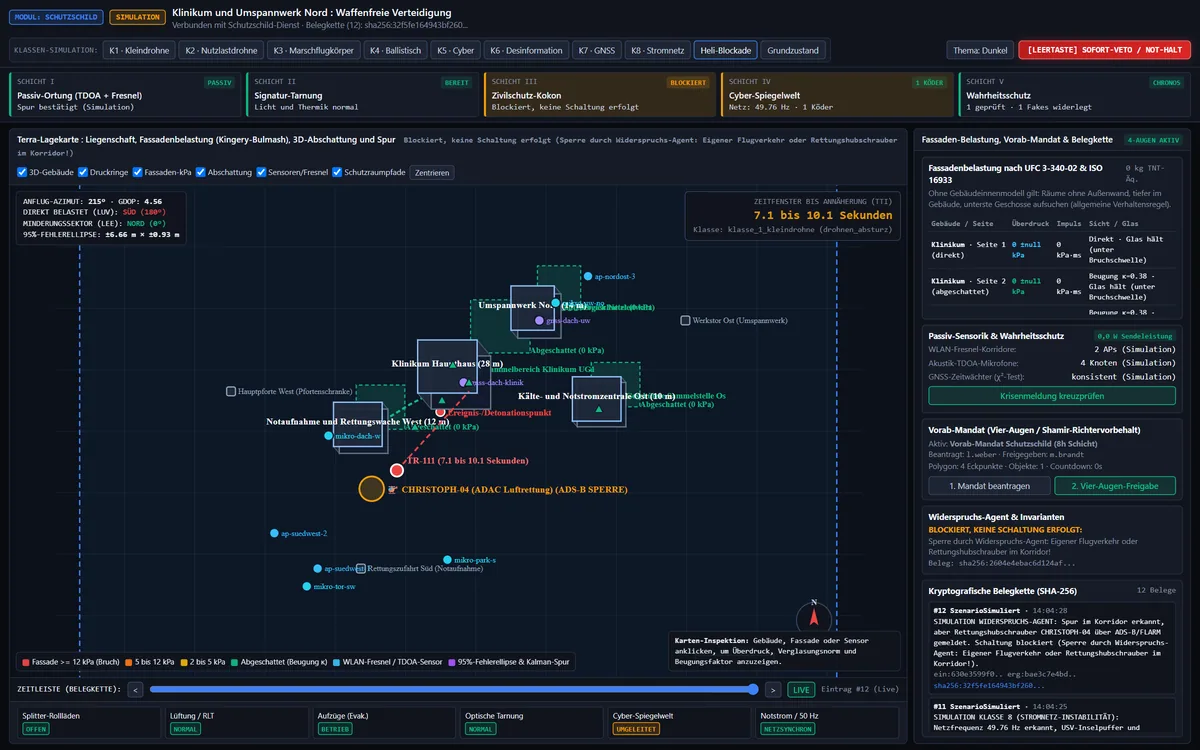
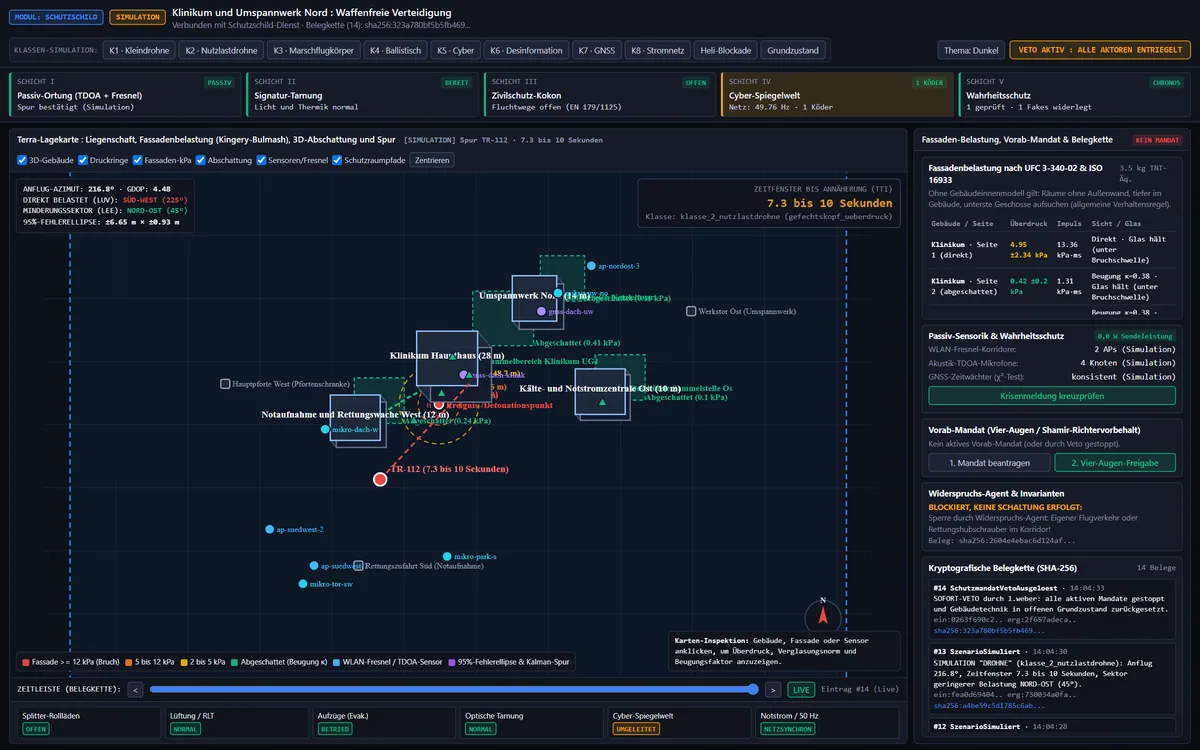
A drone approaches an invented hospital. Five layers protect in a weapon-free, reversible way: localisation without radiating anything, signature masking, civil-protection cocoon, cyber mirror world and truth protection. Two people approve in advance, a contradiction agent holds back, an instant veto resets everything. German narration and German on-screen text, English subtitles for the narration.
German narration with English subtitles. For another language, open the player settings, choose Subtitles, then Auto-translate.
The figures on screen come from the prototype's real computations, sensors and places are simulated and invented.
Principle cards name the public physics and literature behind it.
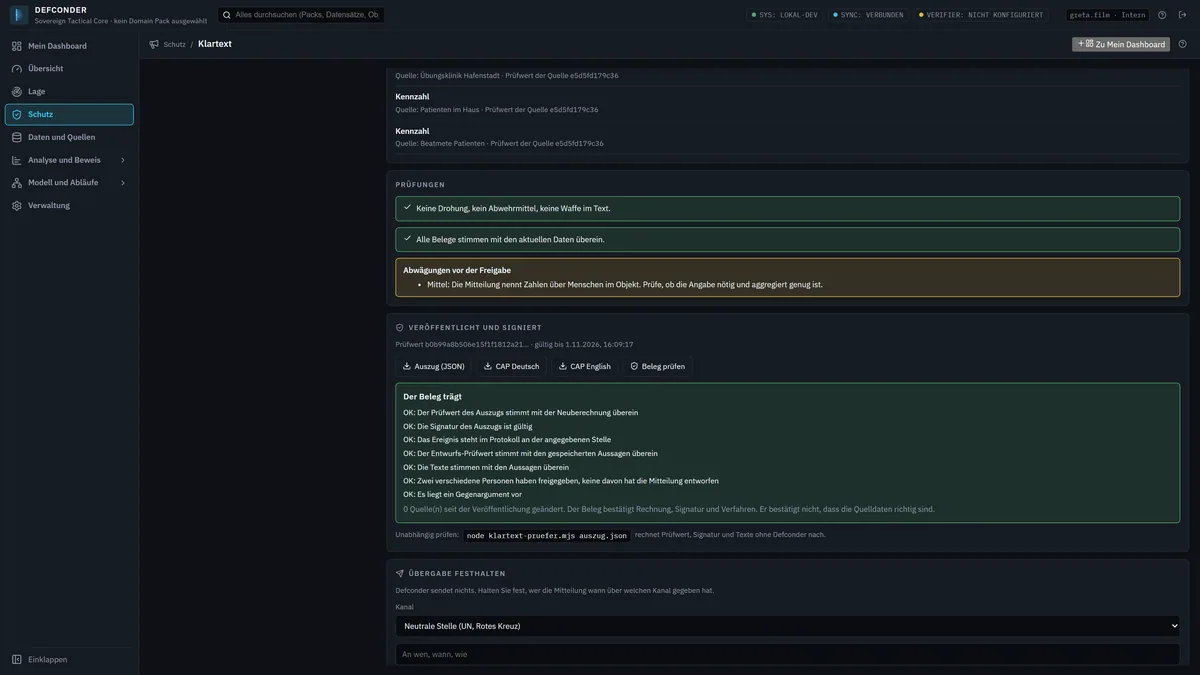
Klartext: There is a human being on the other side too
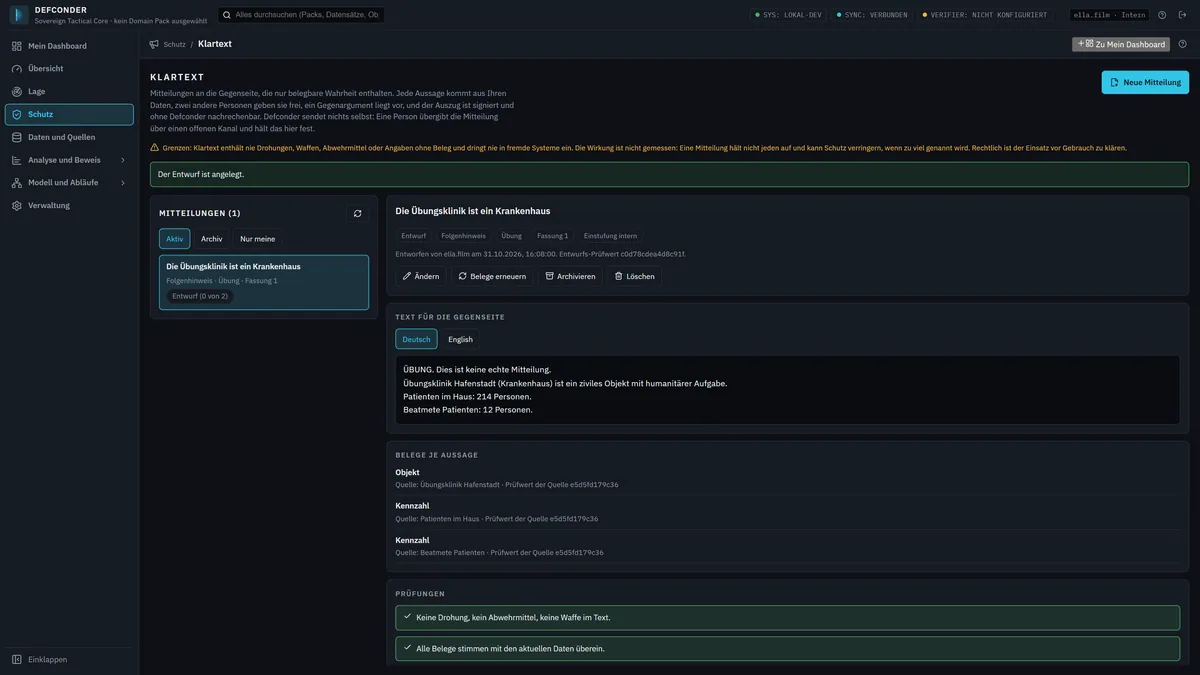
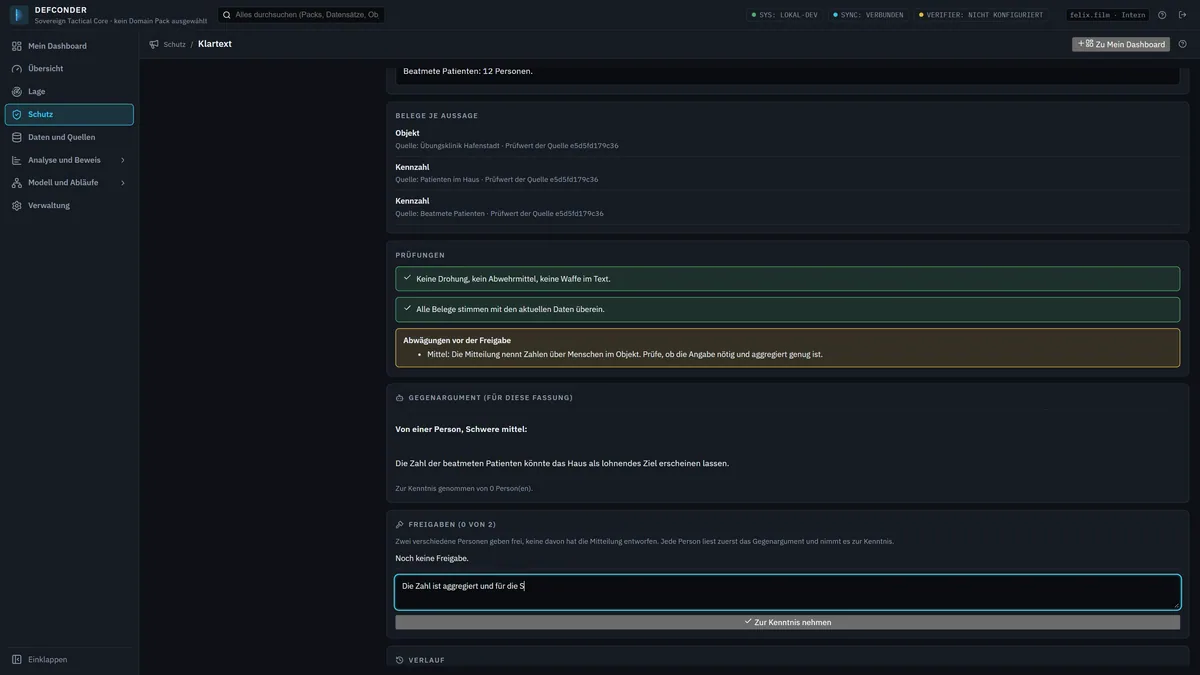
A track approaches an invented hospital. Instead of doing nothing or striking back, Defconder builds a message to the other side that contains only provable truth from your own data. The film shows both outcomes.
German narration with English subtitles. For another language, open the player settings, choose Subtitles, then Auto-translate.
A counter-argument is mandatory, two other people approve.
The extract is signed, an independent verifier recomputes it without Defconder.
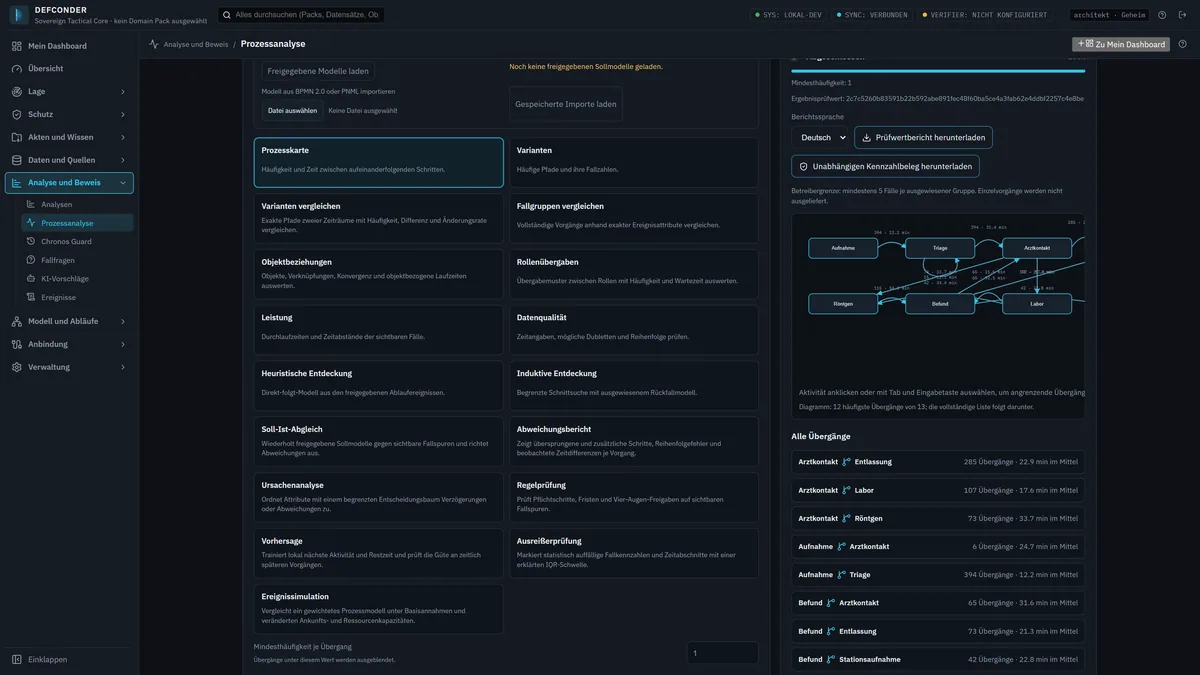
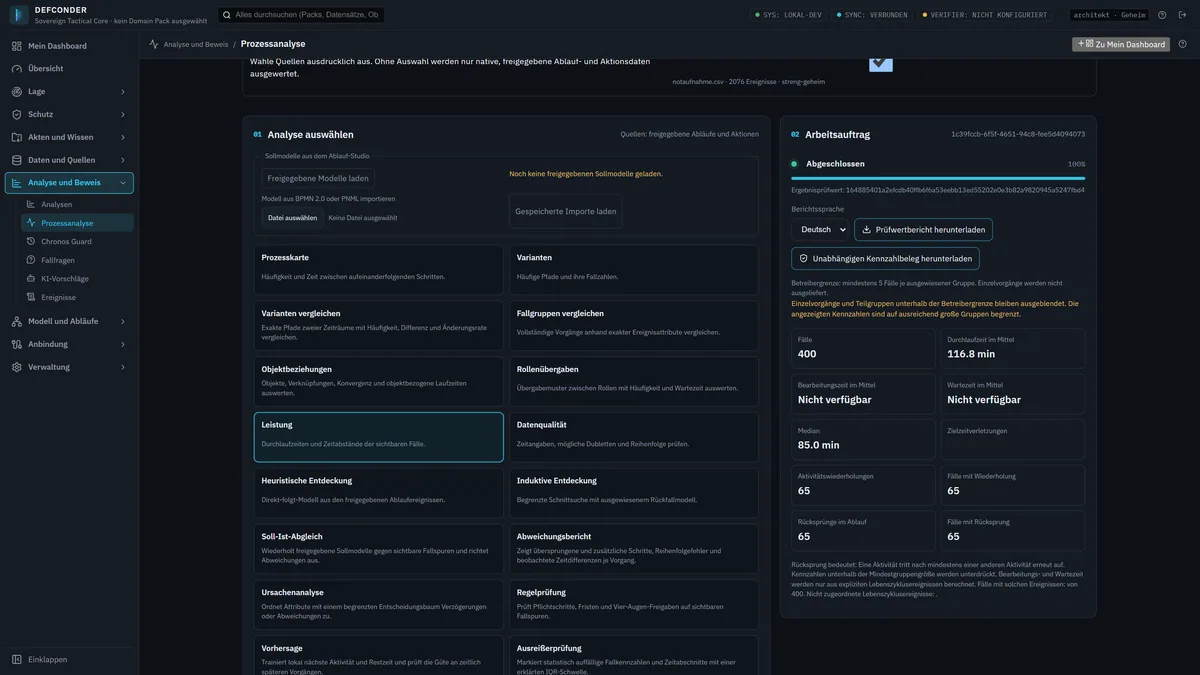
Process analysis: where does a process really stall?
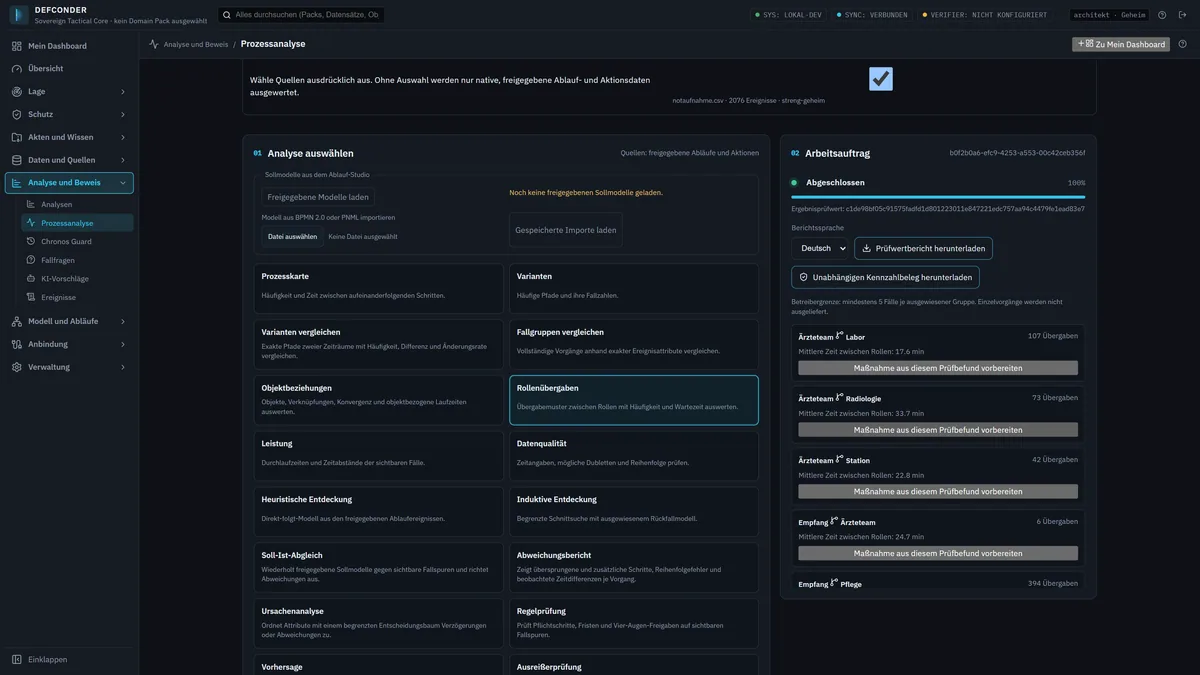
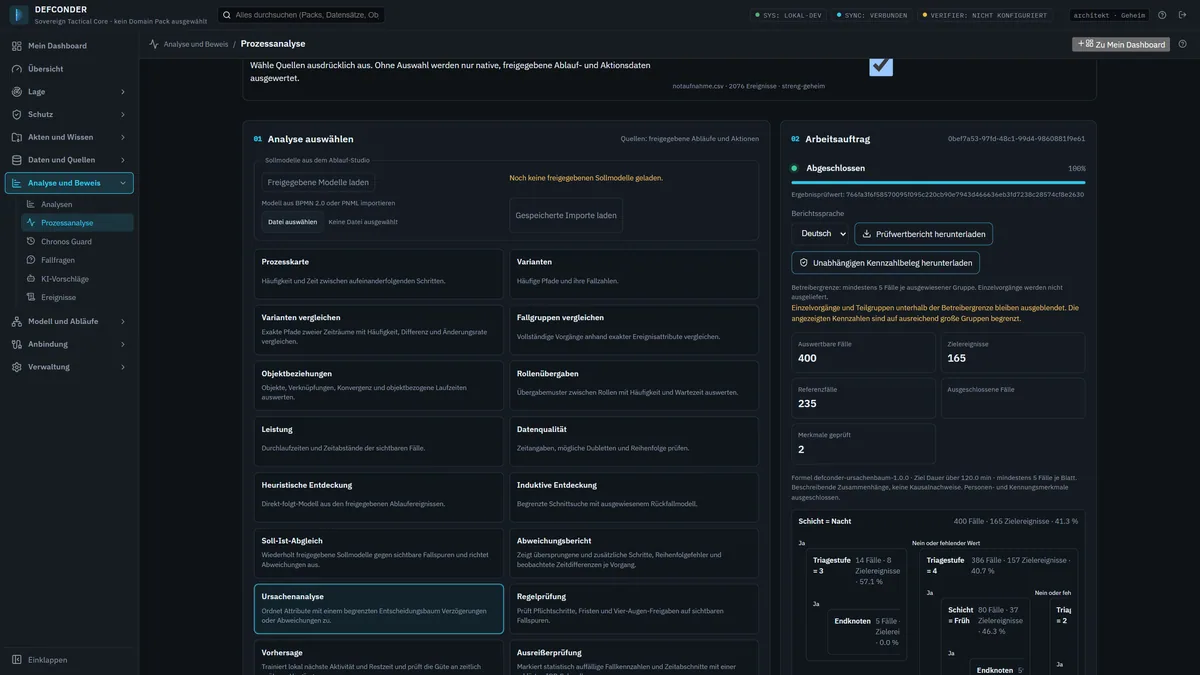
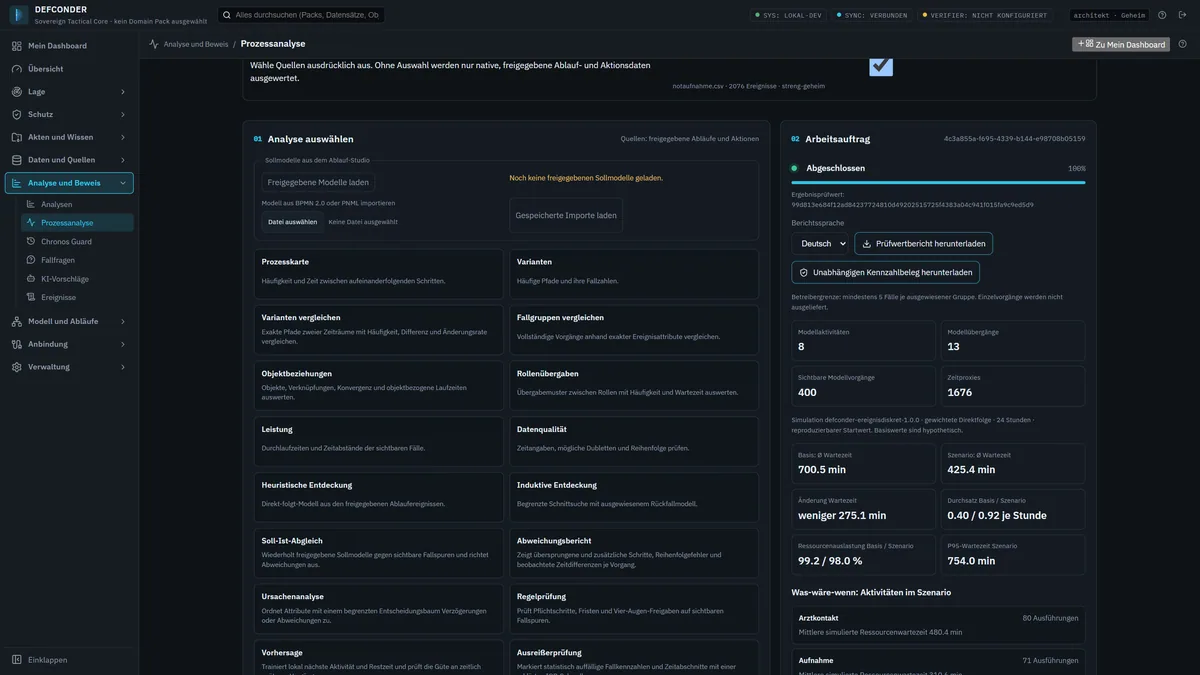
The events of an invented emergency department (400 cases) are imported and checked. Process map, variants, throughput times and waiting time at the handovers between roles come from your own log.
German narration with English subtitles. For another language, open the player settings, choose Subtitles, then Auto-translate.
Cases pseudonymised, groups under five cases hidden.
Every result with a check value, independently recomputable.
A complete domain pack for a disaster situation is built in the interface: 28 object types with inheritance, 28 relations, actions with rules, a dashboard and three applications. No program code. German voice-over.
German narration with English subtitles. For another language, open the player settings, choose Subtitles, then Auto-translate.
The prover rejects a link classified lower than the objects it touches, before it exists.
From a blank page to the document: profile, escalation, staff, roles, reporting points, backup power, measures on the map, plan coach, supply and outage, sample edition and final report. German voice-over.
German narration with English subtitles. For another language, open the player settings, choose Subtitles, then Auto-translate.
The plan coach checks 29 fixed rules, without AI.
Document, sample edition and final report come from the same data.
A world you can enter, built from open state data: fly in, set weather and time, trigger outages. Storm, power outage cascade, hazardous plume and fire spread in the wind. German voice-over.
German narration with English subtitles. For another language, open the player settings, choose Subtitles, then Auto-translate.
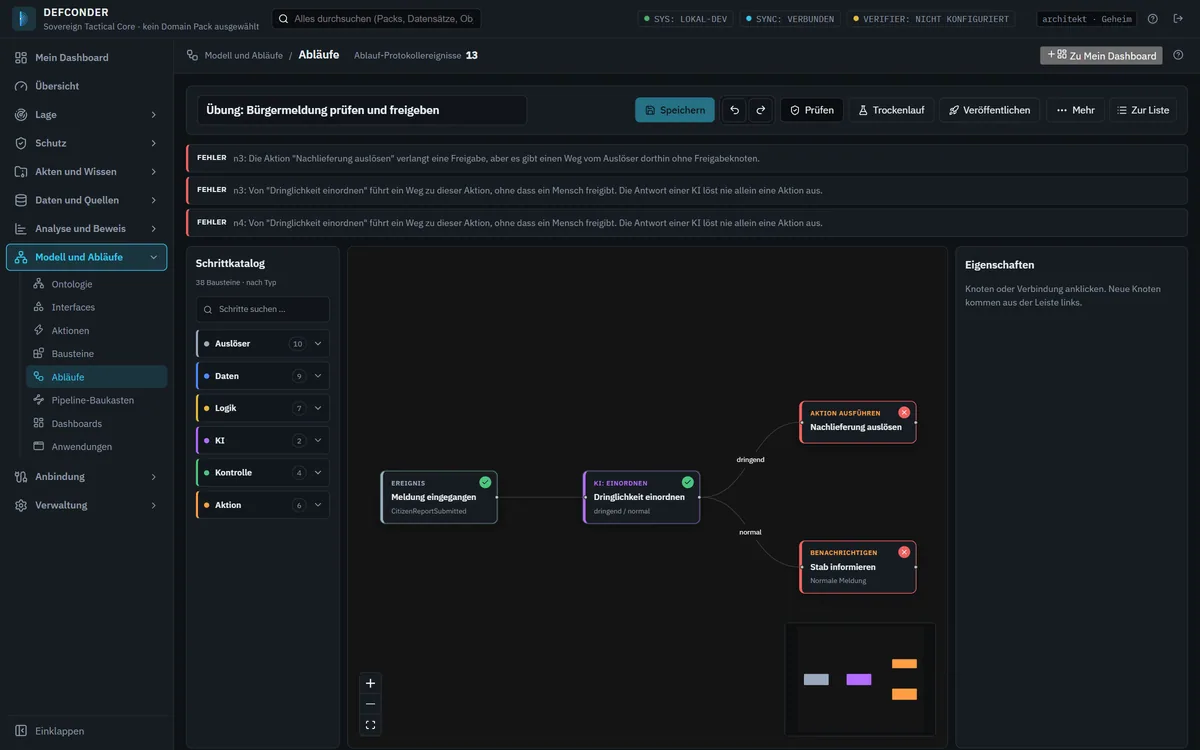
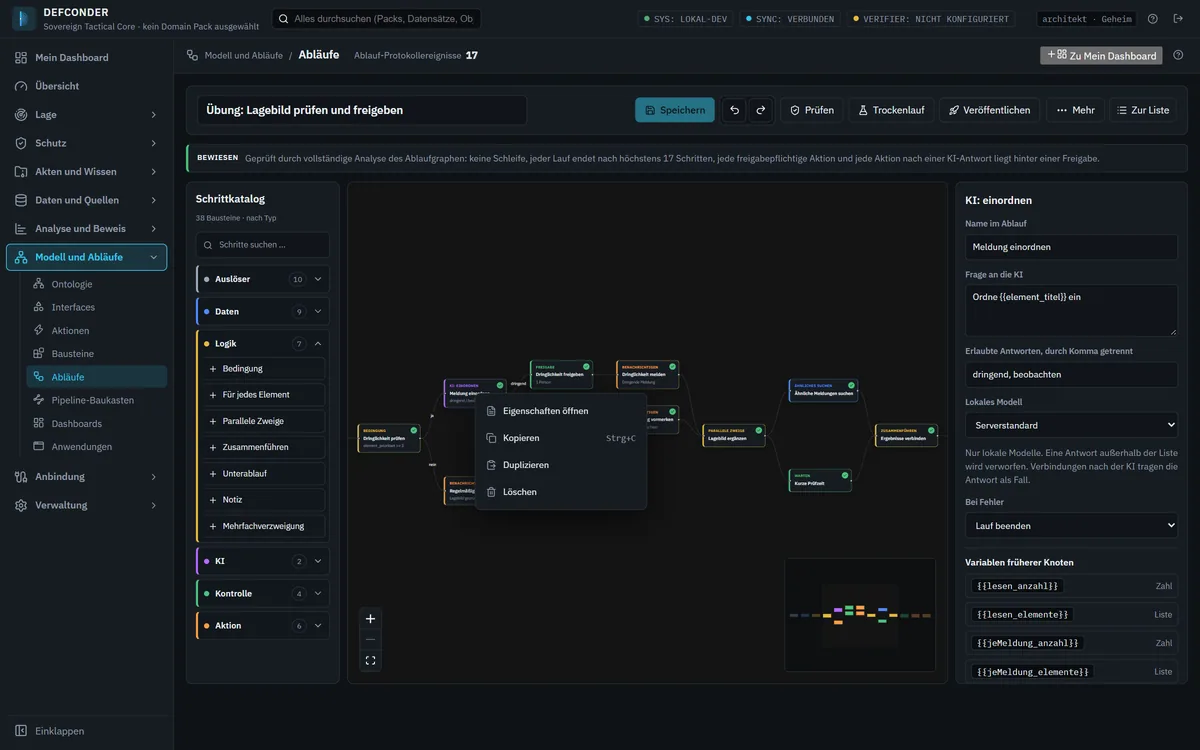
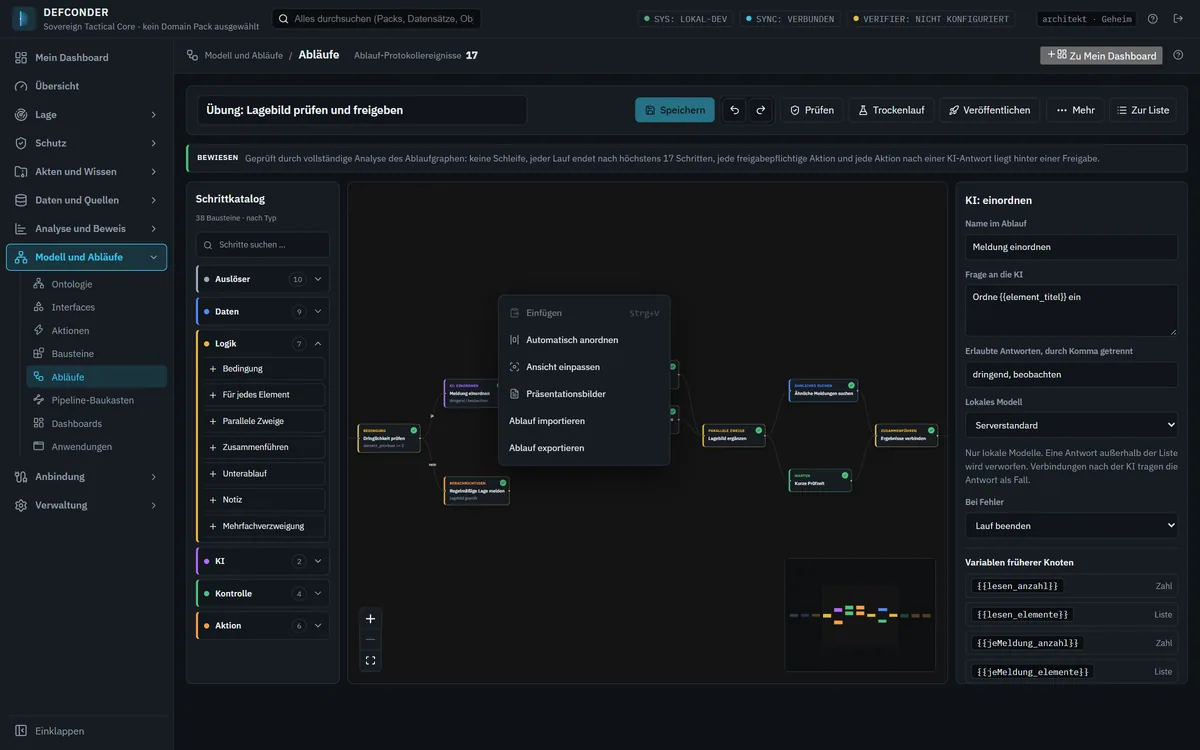
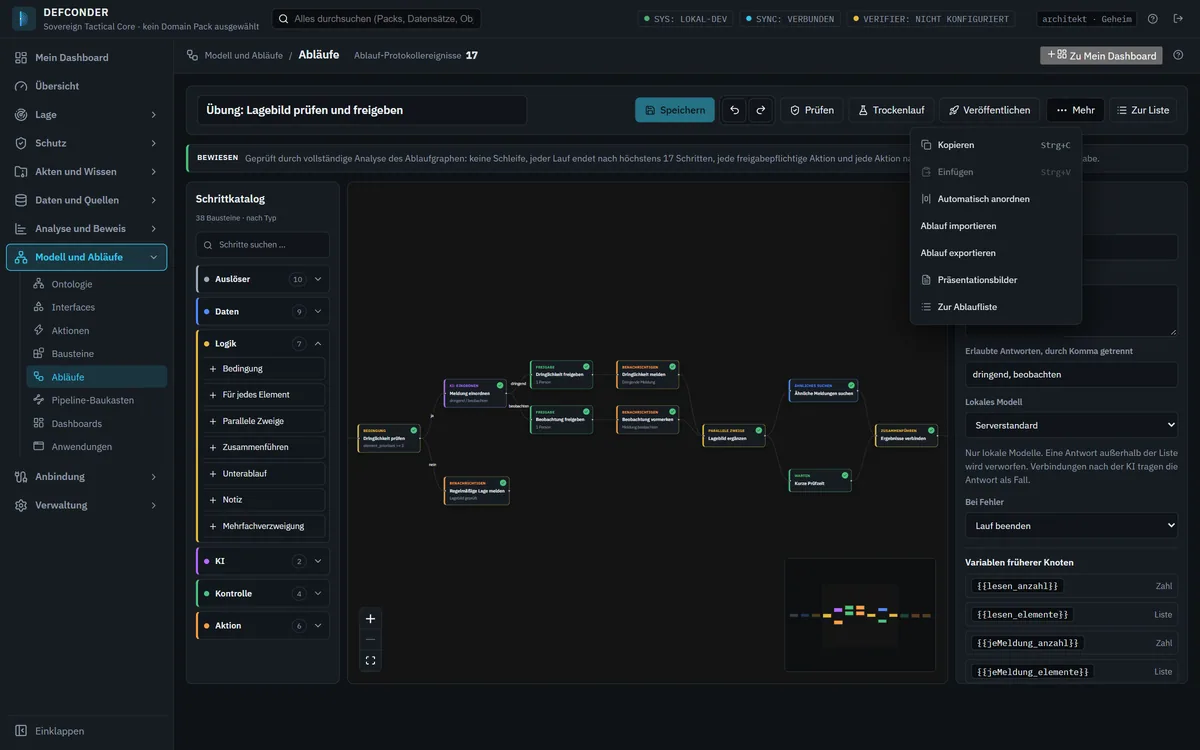
Workflow Studio live: An AI answer never triggers an action on its own
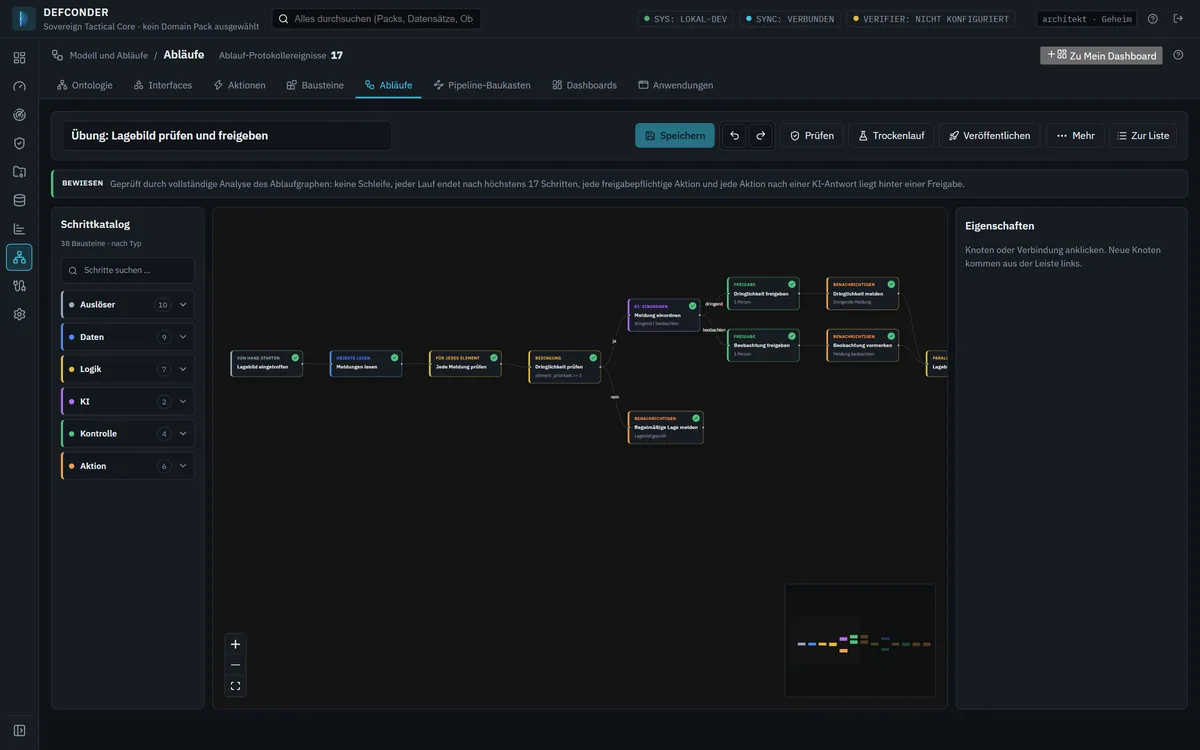
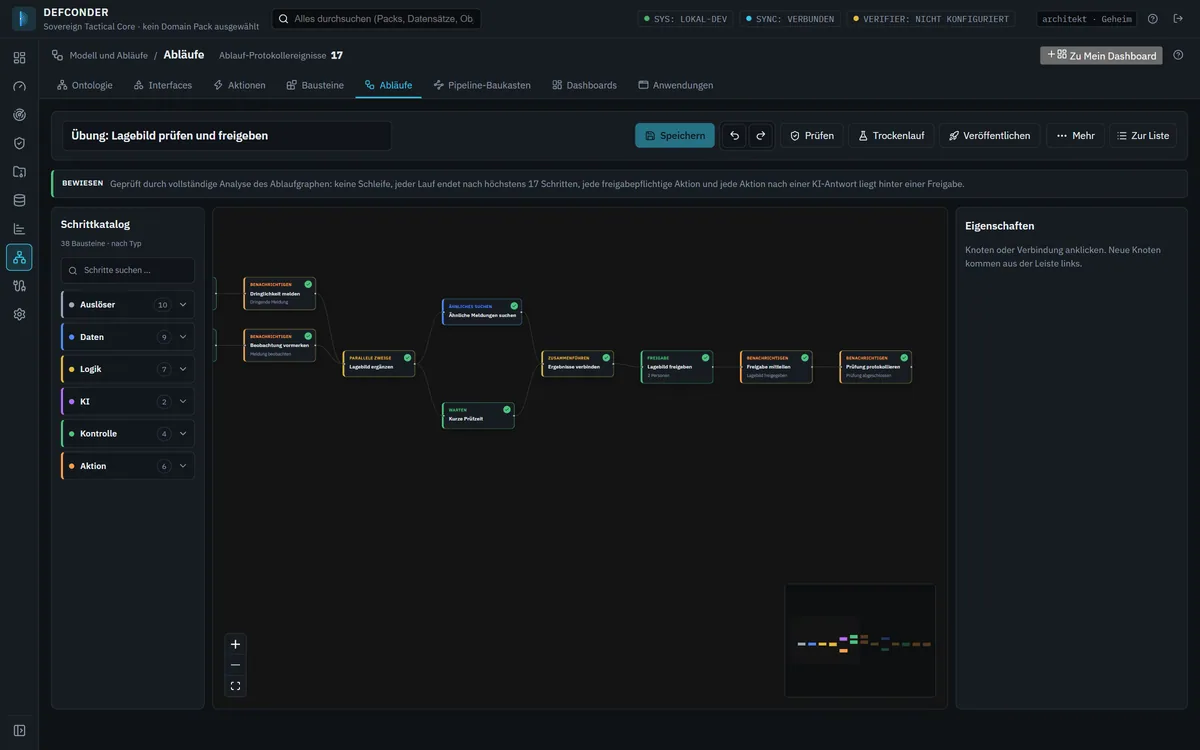
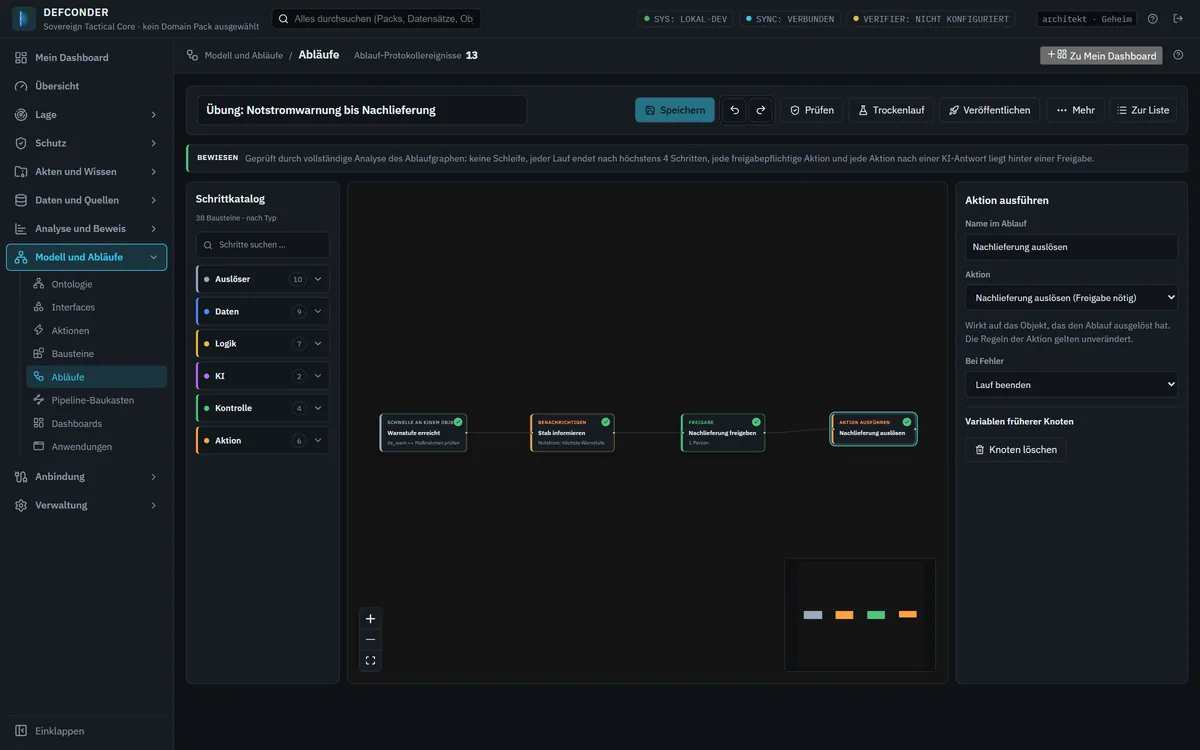
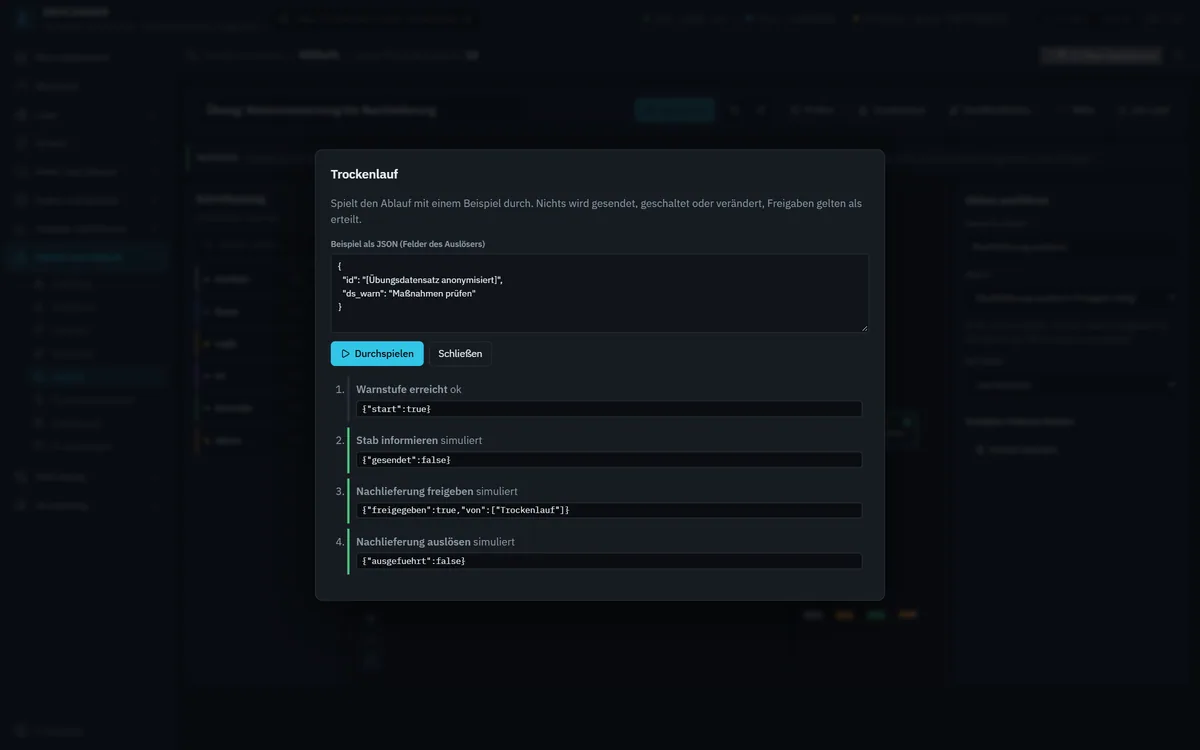
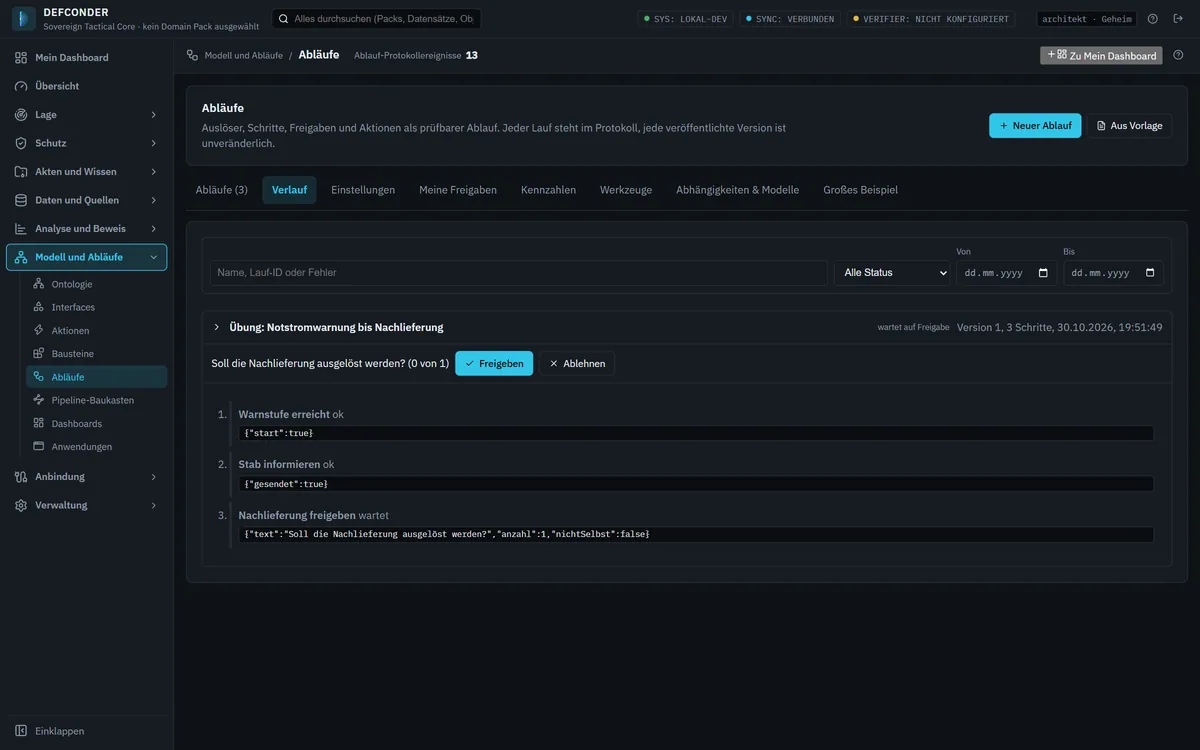
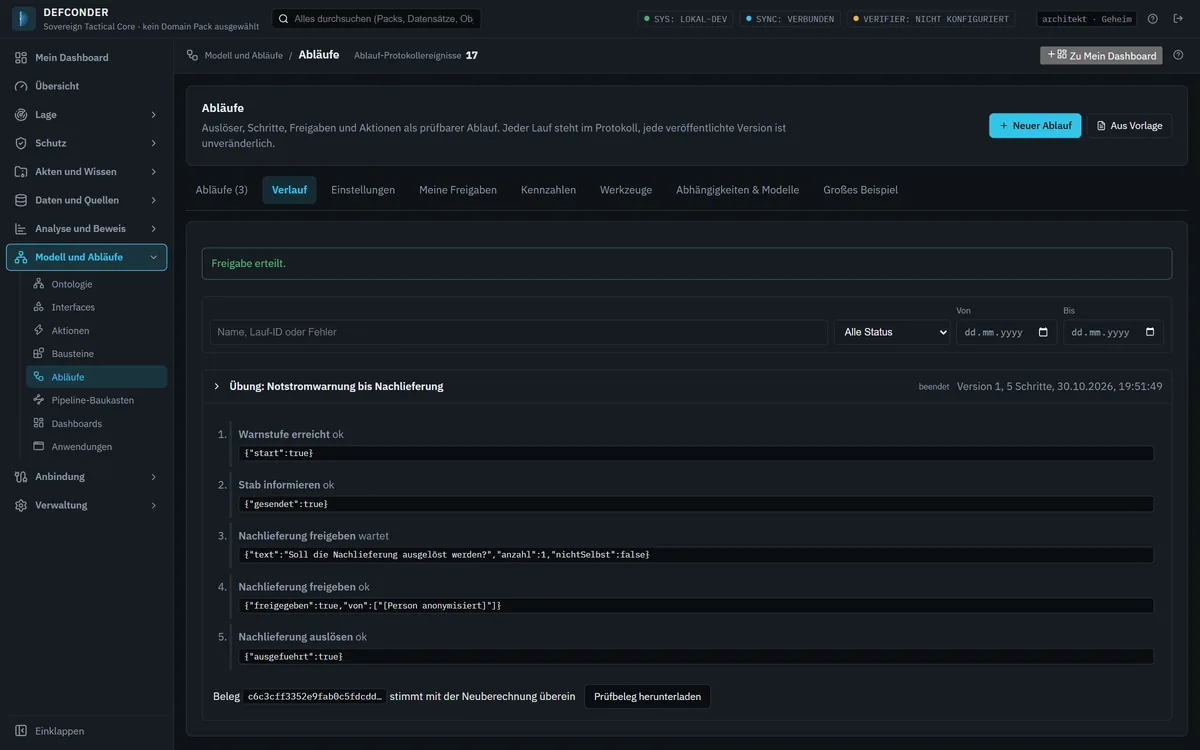
A workflow is built live on a blank canvas: an AI step and an action that requires approval. The check rejects the first draft, and once the approval is built in it is proven. Plus dry run, approval by a person and a receipt you can recompute. German voice-over.
German narration with English subtitles. For another language, open the player settings, choose Subtitles, then Auto-translate.
The check considers every path through the graph, not samples.
Version spaces: plan, compare and approve changes with two people
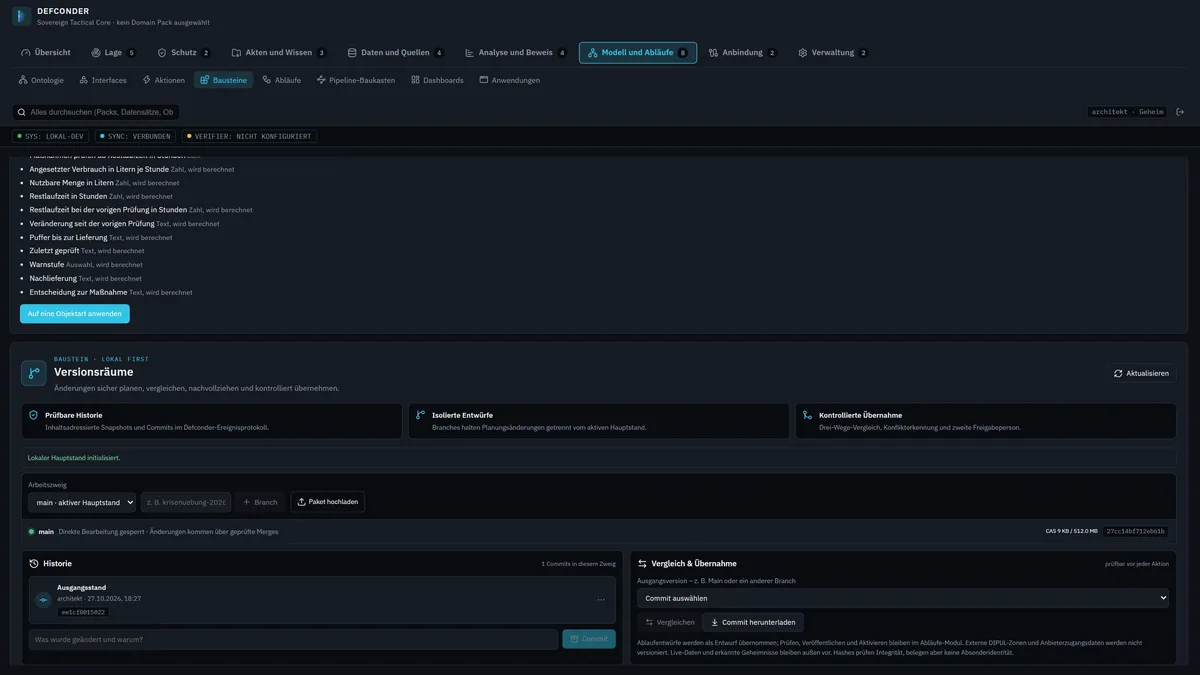
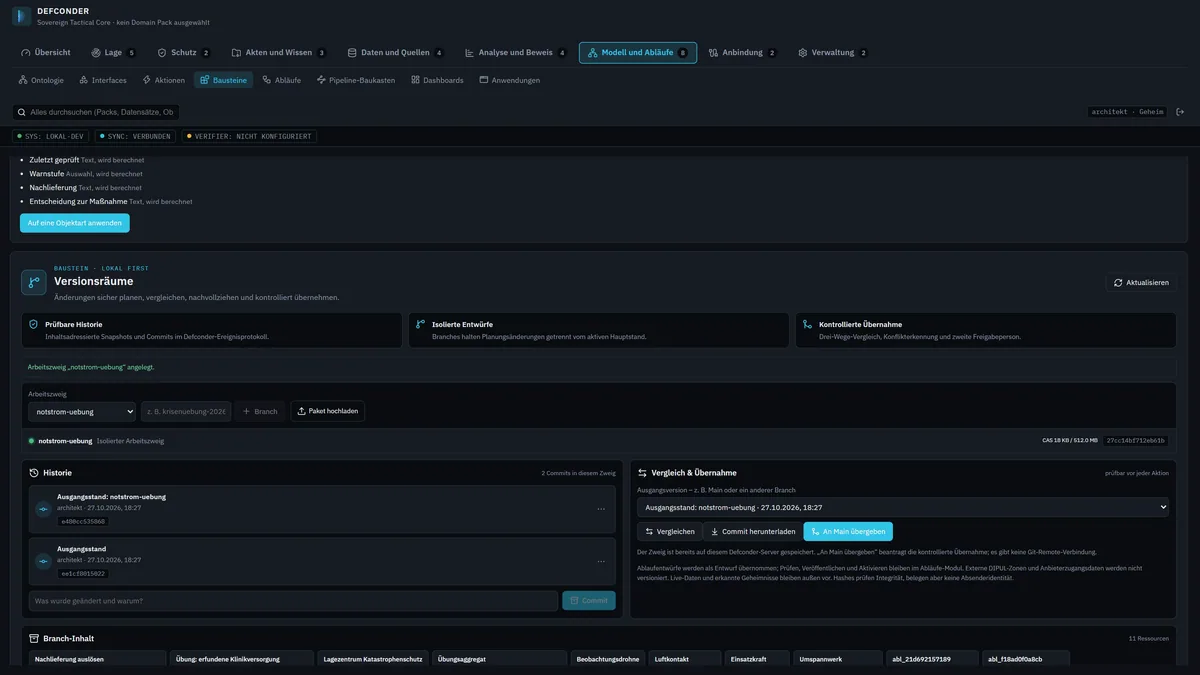
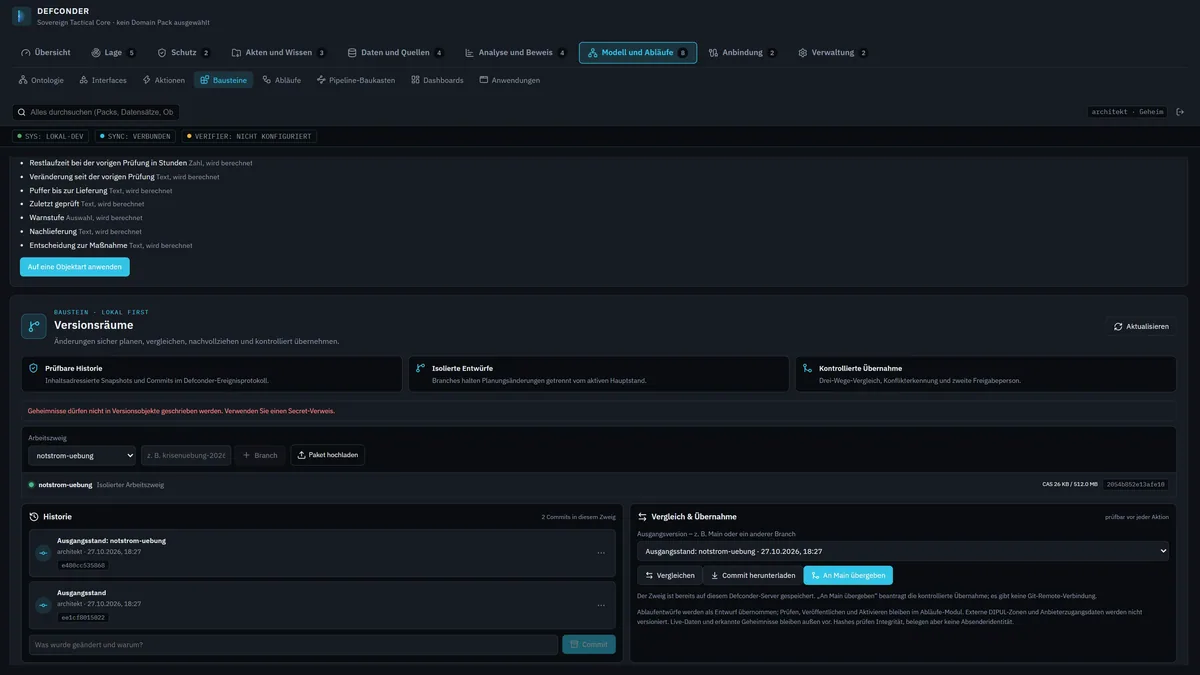
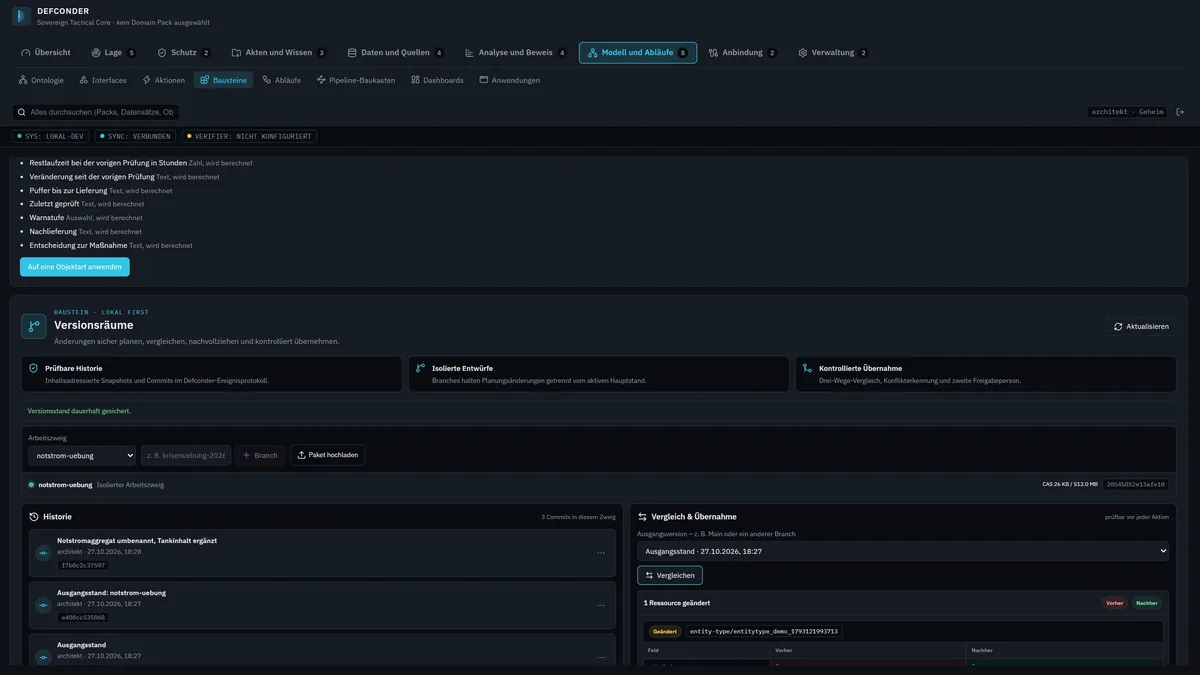
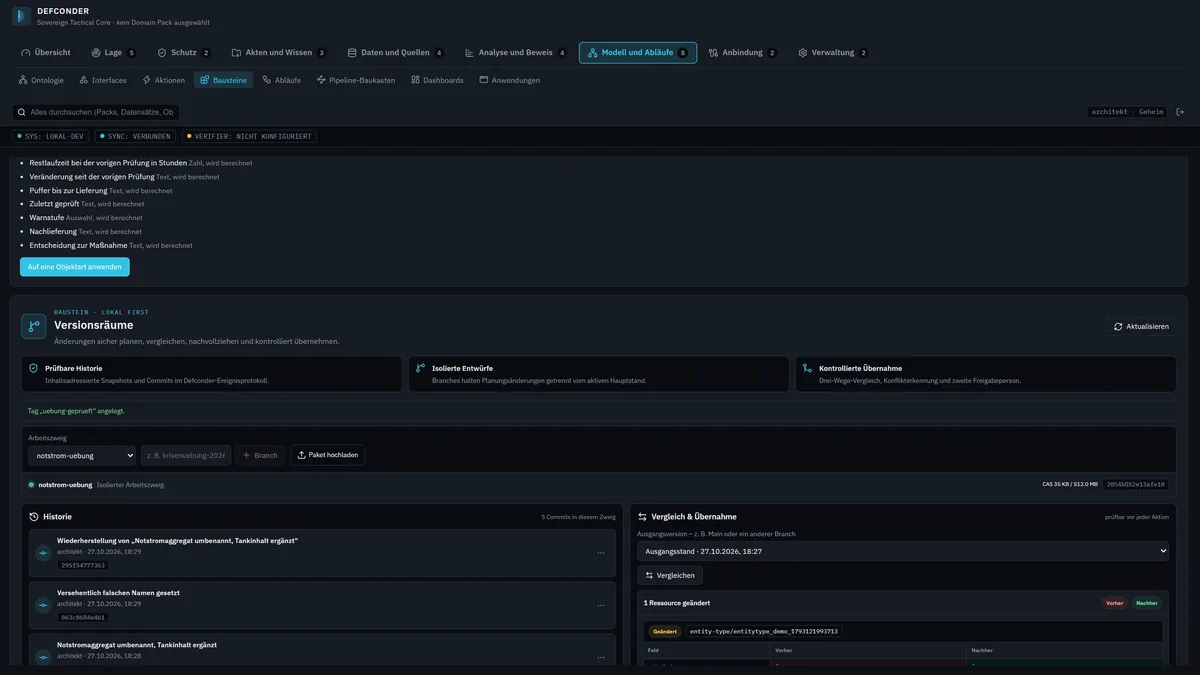
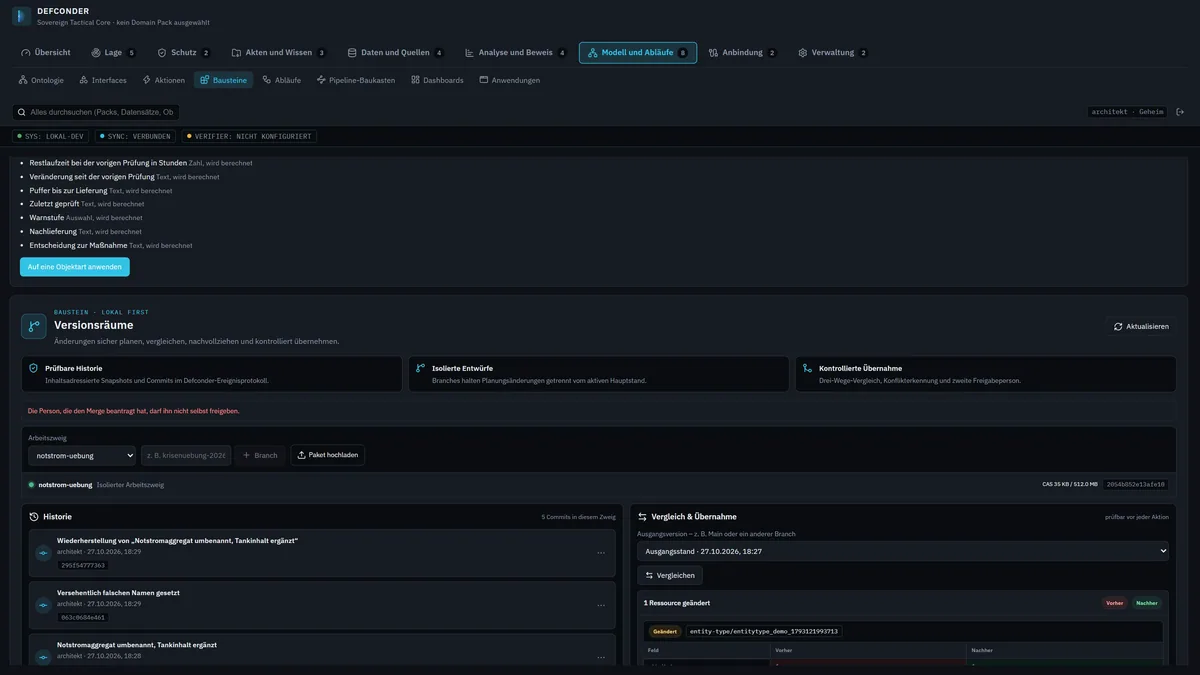
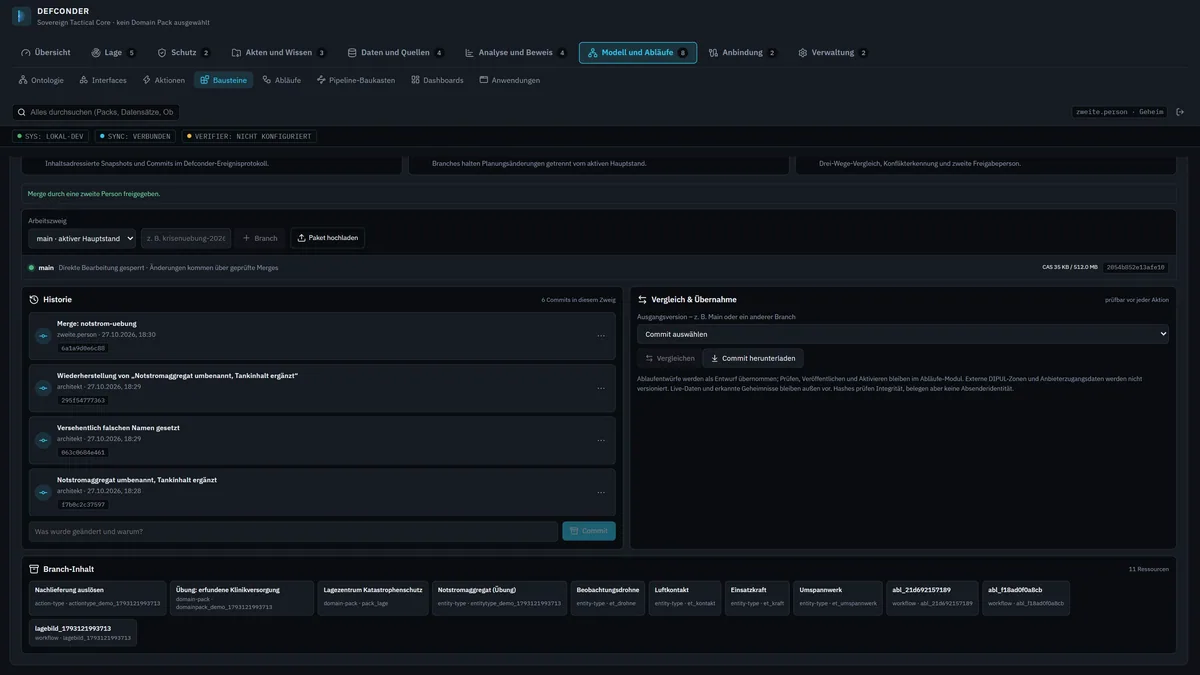
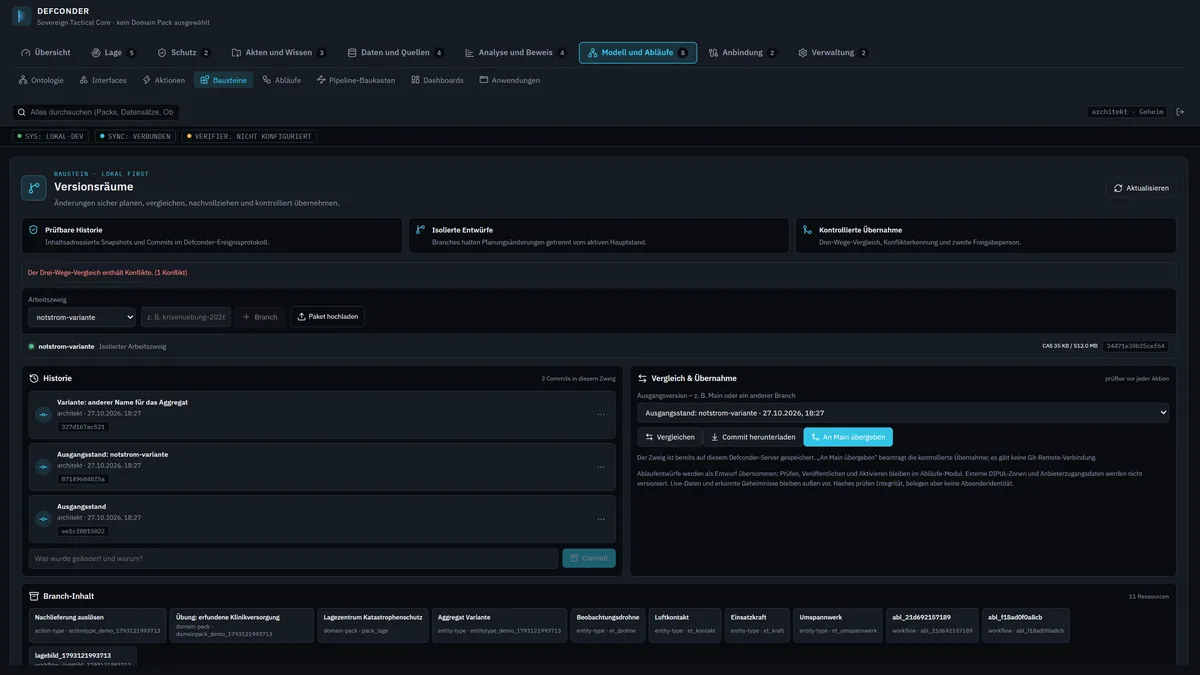
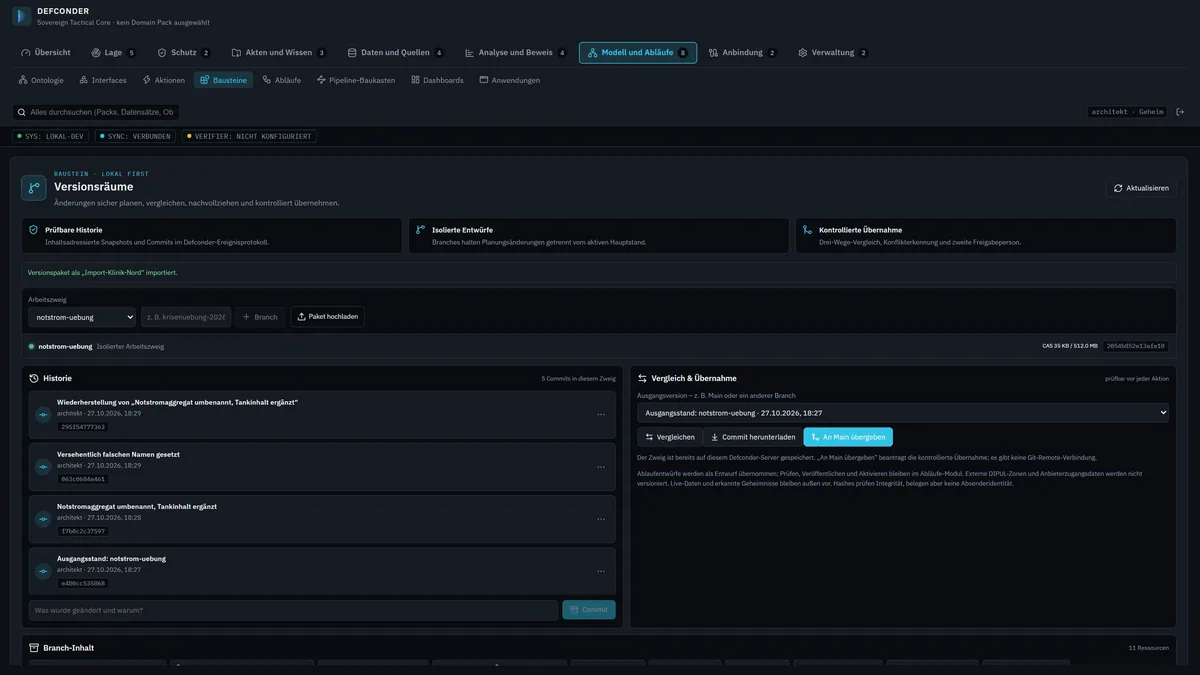
A hospital practises a power failure without disturbing operations: branch, field-by-field comparison, rollback, adoption by a second person, conflict detection and a package for another site. German voice-over.
German narration with English subtitles. For another language, open the player settings, choose Subtitles, then Auto-translate.
Self-approval is refused, and so is a password in the model.
All data is invented exercise data, version spaces store locally.
The films load only when you start a film and consent in the window that follows. Before that, no data is sent to YouTube (youtube-nocookie.com). Details are in the privacy policy.
Why it goes so fast
No army of consultants.
Domain models are built in the interface, without program code. Your specialist department creates objects, relations and rules itself and maintains them later.
Check before anything happens.
The prover rejects classification errors, the plan coach reports what is missing in the crisis plan. Both by fixed, traceable rules.
One change applies everywhere.
Views, documents and reports are generated from the data. Change the model and everything that follows changes with it.
Provable.
Every change is a chained event. Who changed what and when can be proven.
Local, no cloud.
Defconder runs on your infrastructure. Data and models never leave your house.
A world instead of a map.
Terra is a world you can enter, where you set weather, time and outages and play through the effects.
All films show invented exercise data, in the vector space film on technical texts our own texts. The voices are synthetic (Piper). Defconder is under development, not approved and not legally reviewed. As of 24 October 2026.
The difference
An operational picture you do not have to believe.You can recompute it.
Every change in Defconder becomes part of a chain of checksums. Whoever alters one entry alters every entry after it. This is computed for real, right in your browser. Tamper with an entry and have it recomputed.
Chain intact
Click an entry to tamper with it, then start the recomputation. Without input an example plays on its own.
Common with cloud platforms
Your data sits on the vendor's infrastructure.
Defconder
Your data stays on your own infrastructure.
Common with cloud platforms
The vendor supplies the log. You trust it.
Defconder
The log is hash-chained. Anyone recomputes it themselves.
Common with cloud platforms
The AI decides, you see the result.
Defconder
The rule decides, the AI proposes, a human releases.
At a glance
Command communication that keeps running when network and server fail. Status: in development.
Orders, alarms, receipts and escalation in one system
Continues by detour when the network fails
No eavesdropper, and delivery is provable
Defconder Comms
Networks fail. Command doesn't.
Comms is the command communication of the platform: end-to-end encrypted, on your own infrastructure, with orders, alerts and an archive whose integrity anyone can verify. The film shows the real software in two exercise scenarios.
Two exercise scenarios: a flood on the Rhine and a command exercise of armed forces. Real software, fictional names and data.
The film loads from YouTube (youtube-nocookie.com) only after your click. Before that, no data is sent to YouTube. By clicking you consent to your IP address and browser data being transmitted to YouTube (Google) when playing, including to the USA. Details are in the privacy policy.
The film has sound. All text is on screen, so it also works muted.
0automated checks, all passed
0fuzz inputs, 0 crashes
0devices in the load test with 20,000 messages, 95% of acceptances under 5 milliseconds
0participants per group call with video, no media server
If someone else can switch it off, it is not yours.
Account suspended.
Licence revoked.
Cloud gone.
Armed forces, control rooms and authorities lead today over platforms that a third party can switch off. Comms has no such switch: the server sits with you, there is no cloud requirement, no account with a vendor and no push through third-party services. If the internet drops, Comms keeps running in your own network.
This is true not only for Comms but for the whole Defconder platform: situational picture, map, command and tasking, AI and log run on your infrastructure, without a cloud account and without a vendor who could switch them off. Situation and command in one hand: yours.
01
Command
Command starts with one sentence
An instruction becomes an order with five columns: unit, task, means, target, route. Recipients acknowledge with "Understood"; the acknowledgement is signed and entered in the log.
Structured orders
Unit, task, means, target and route as fields instead of free text. Fewer questions back, and orders become analysable.
Signed acknowledgement
Whoever says "Understood" has signed it. Every acknowledgement is a link in the chain of the incident log.
Roles, not chance
Who may give orders is decided by role. Approvals follow the four-eyes principle.
Replies and reactions
Replies quote the original message, reactions take one tap. Both are signed and end-to-end encrypted like any message.
02
Alert
Nobody gets missed
An alert runs through an escalation chain. If stage 1 does not respond within its deadline, stage 2 takes over. On the phone the alert appears full screen, and every delivery is proven.
Escalation chain
Deadlines per stage, handover to the deputy, every stage time-stamped in the incident log.
Proof of delivery
Per recipient you see whether the alert arrived, was opened and was acknowledged.
Real Android
In the film the app runs in a real Android 16 (emulator, Pixel 8 Pro). Testing on a physical device is still pending and is named as such.
03
Network gone
Internet gone. Server gone. Command holds.
The server sits in your own network, not in someone else's cloud. If the connection drops, messages are queued and delivered once it is back. Without any server, the mesh relays alerts from device to device.
NoteThe mesh scene in the film is staged. We have tested device-to-device operation on real phones.
Queue
Whatever is written offline goes out once the network is back. This is real footage in the film.
Server in your own house
The server announces itself on the local network and devices find it on their own. Two servers synchronise.
Mesh without a server
Relaying with flood protection from device to device over Bluetooth, tested on real phones. Alerts take priority over everything else.
04
No eavesdropper
No eavesdropper. Provable.
Comms encrypts end to end with Messaging Layer Security (MLS, RFC 9420). The server only relays encrypted data. Two key holders open the archive together, and an open verifier in the browser shows whether the log is unchanged.
MLS in Rust
OpenMLS in the shared core: the same code runs in the browser (WebAssembly) and on Android.
Archive with four eyes
Three custodians hold key shares, two open the archive. Afterwards the key can be destroyed irrecoverably.
Open verifier
Every entry contains the hash of the previous one. Change an entry and the chain breaks, and the verifier flags it. The check runs in the browser against an open format.
05
Duress
Even under duress
If someone is forced to unlock their device, the decoy PIN shows an empty app. Meanwhile the crisis staff gets a silent alert, with nothing visible on the outside.
Decoy PIN
A second PIN opens an empty vault. From the outside there is no visible difference.
Silent alert
The crisis staff receives the message without the device showing anything.
Remote wipe
Lost or seized devices can be locked. Suspend an account in the directory and all of its devices are locked.
06
Load and future
Built for load and for tomorrow
A command tool has to hold under load and prepare for the next generation of encryption. We measured and built both, not just promised them.
Load test with 1,000 devices
100 rooms of 10 devices each with real MLS keys, 20,000 encrypted messages. The server accepted them with 95% under 4.6 milliseconds. Measured in the same process on a development machine, not over a network.
Hybrid post-quantum encryption
A build variant uses the key agreement of ML-KEM-768 and X25519. It runs in the core and in the browser, tested with two devices. It is an IETF draft, signatures stay classical, and an installation uses one suite.
Signed app, settings via MDM
The Android app is signed with its own distribution key. Server, CA key and invitation code can be preset through device management. This has not been tested against a real MDM yet.
Case study
Storm surge, 03:12: when everything fails one after another
A scenario in six steps. It shows which path takes over when the previous one breaks, and how far it reaches. Click through the steps or let it run.
link up
failed
Bluetooth device to device
radio via the gateway
Step 1 / 6tested
Normal operation
The control room alert runs through the server in your own house to all devices. Proof of delivery comes back.
Range: In the house network or Wi-Fi: typically 30 to 100 m per access point, with several points or cable a whole site.
The fallback paths at a glance
PathRequirementTypical rangeStatus
Own server in the house networkPower, Wi-Fi or cable30 to 100 m per Wi-Fi access point, with several a whole sitetested
Messages wait in the devicenoneno distancetested
Replacement server and server-to-server syncany IP linkindependent of distancetwo servers tested
Mesh over BluetoothPhones in radio range10 to 100 m per hop, up to 10 hopstested on real phones
Gateway via SMSMobile networkanywhere with mobile coverage, alerts only up to 160 charactersmodel, device test open
Gateway via radio (LoRa, TETRA, DMR)Radio at the gatewayLoRa typically 2 to 15 km, others by devicemodel, device test and approval open
The ranges are typical physical orders of magnitude for phones, Wi-Fi and radio. We have not measured them ourselves. The radio gateway has so far only run as a model. Without some link between the devices, Comms cannot transmit anything either.
Checklist
Ten questions for any communication system
Ask these questions of every vendor, including us. Our answers are next to them, with evidence. Where we do not pass a question today, that is stated as well.
QuestionDefconder Comms todayEvidence
01Can a third party switch the system off?
YesNo. The server sits with you. In the Comms code we found no licence check, no telemetry and no push through third-party services.
Review of the Comms code on 21 October 2026
02Can the server read messages?
YesNo. End-to-end encryption with MLS (RFC 9420). The server only relays encrypted data.
Core and browser tests
03Can the archive be checked for tampering independently?
YesYes. An open verifier in JavaScript, Python and Rust checks the chain of entries.
Verifier compatibility, 22 checks with tampering
04Can a single person open the archive?
YesNo. Three custodians hold key shares, two open the archive together.
Archive browser test, 20 checks
05Are there alerts with escalation and proof of delivery?
YesYes. Deadlines per stage, handover to the deputy, proof per recipient.
Alert test, 20 checks
06Does it protect when someone is forced to unlock?
YesYes. A decoy PIN opens an empty vault, and the crisis staff gets a silent alert.
Lock and remote wipe test, 7 checks
07Does it run without internet?
YesYes. In your own network Comms runs without internet, and without any server devices relay alerts by Bluetooth from phone to phone. A link between the devices remains a requirement.
Mesh test on real phones
08Is there a load test with numbers?
PartlyYes: 1,000 devices, 20,000 messages, 95% of acceptances under 4.6 milliseconds. Measured in the same process, not over a network.
server/tests/last.rs
09Is it prepared for post-quantum encryption?
PartlyA build variant with ML-KEM-768 plus X25519 runs. It is a draft, and signatures stay classical.
Core and browser test with the suite
10Has an independent body assessed or accredited it?
NoNo. We have an extensive in-house test bench, but no third-party report and no accreditation.
Roadmap in the documents
Statements about Comms come from our own tests, as of 21 October 2026. We do not compare with named products because we have not tested them ourselves. Check every vendor with the same questions.
And around it
Comms is more than chat. Everything runs on the same end-to-end protected core and can be operated as a module in the dashboard.
Calls with video
1:1 and group up to six participants, screen sharing, push-to-talk radio mode. Direct between devices (DTLS-SRTP), no media server.
Offline map
Vector map as a file on the device (PMTiles), survives restarts, asks no third-party servers. Situation maps and locations as structured messages.
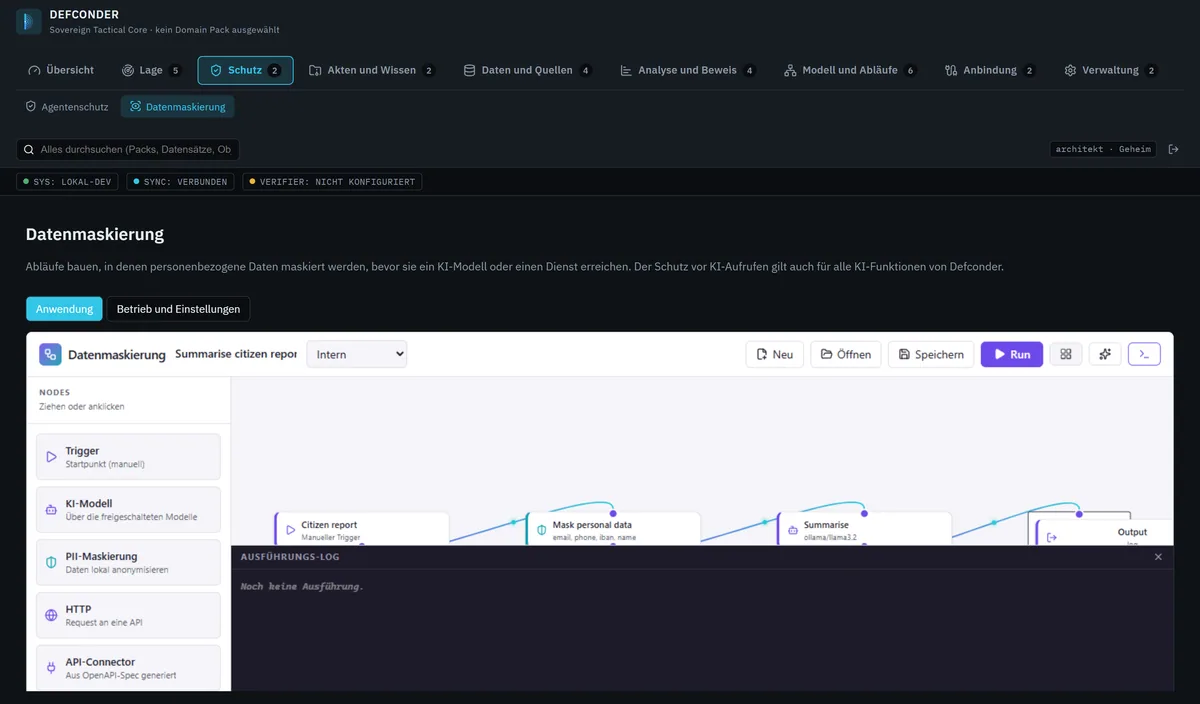
Data masking
A data filter detects personal data before it leaves the room. The situation proposal pre-fills fields, a human approves.
Connections outward
Gateways for webhook, Cursor on Target, MQTT, e-mail, SMS, Matrix and radio. A classification gate sits in front of every connector.
Sign-in and accounts
Sign-in with the organisation account (OIDC) and account management via SCIM. Tested against a replica, not against a real provider.
Hardware binding
The vault is bound to the Android keystore or a FIDO2 key. In the emulator the app honestly shows "software only".
Installable on iPhone and desktop
Comms can be added to the home screen as a web app and starts without a network. There is no native iOS app yet, and background alerts are limited on iOS.
All devices, one core
Browser, Android and the installed web app share the same Rust core and the same test suite. What holds on one device holds on the other.
What we call open
A command tool should be measured by what it does not claim.
198,727 corrupted inputs in the fuzz run, 0 crashes
Load test with 1,000 devices and 20,000 messages, server in the same process
Hybrid suite of ML-KEM-768 and X25519 tested in the core and in the browser
Device-to-device mesh over Bluetooth tested on real phones
Android app in the emulator (Android 16), dashboard module in the real module host
Verifier cross-checked in JavaScript, Python and Rust with tampering
Still open
Native iOS app (today an installable web app), load test over a real network with TLS, high availability
The hybrid suite is a draft with classical signatures and not a standard
Calls across network boundaries (needs the organisation's TURN) and beyond six participants
TPM and key attestation, organisation sign-in in the Android app
Independent security assessment and any accreditation, such as for classified information
Networks fail. Command doesn't.
Command communication that belongs to you
We are looking for pilot partners: control rooms, authorities, critical infrastructure operators and defence-related companies. Your use case sharpens Comms, and you get a test instance on your own infrastructure.
0Clearance levels from Open to Secret, enforced on the server
0AI automation levels: manual, with approval, autonomous
0Attribute types, including geo coordinates and NATO affiliation
0Obligation to use a foreign cloud
Sovereignty
Critical decisions do not belong on someone else's platform.
Agencies, armed forces and operators of critical infrastructure decide under time pressure. Their tools should belong to them: operable, verifiable and independent of legal jurisdictions, licences and data centres they do not control.
Your operation
The platform runs entirely on your infrastructure. There is no obligation to use a foreign cloud, not even for the AI.
Traceable down to the last entry
Every change is an event in a chained log. Nothing is overwritten and nothing disappears. Even deleting is an entry.
Rules that are proven
Security rules are not merely configured. A proof engine checks them before a change takes effect.
AI under your control
You decide which models run. From a classification level you set, the server blocks cloud models by itself.
Open for the exit
Data model, views and the complete log can be exported. Whoever leaves takes everything along.
Built in Germany
Designed for the requirements of European agencies and operators, not for those of another market.
The operating model makes the difference
The operating model makes the difference
Defconder
Common model of large cloud platforms
Operation
On your infrastructure, air-gapped if needed
As a vendor service in the vendor's data centres
Jurisdiction
Yours, because you hold the operation
The provider's
History
Chained log, tampering is visible
Change history inside the provider's system
AI access
Your own models, cloud only enabled and limited
Models of the provider or its partners
Access protection
Clearance levels on the server, denied when in doubt
Depends on configuration
Exit
Complete export of model and log
Depends on contract and format
The right column describes a common pattern, not a specific company.
Platform
One core. Everything an operational picture needs.
A model you draw yourself, and everything that follows from it: forms, maps, dashboards, actions, data preparation, analyses. No programming and no consulting days.
Zero-latency picture: no chain of command between reconnaissance and decision
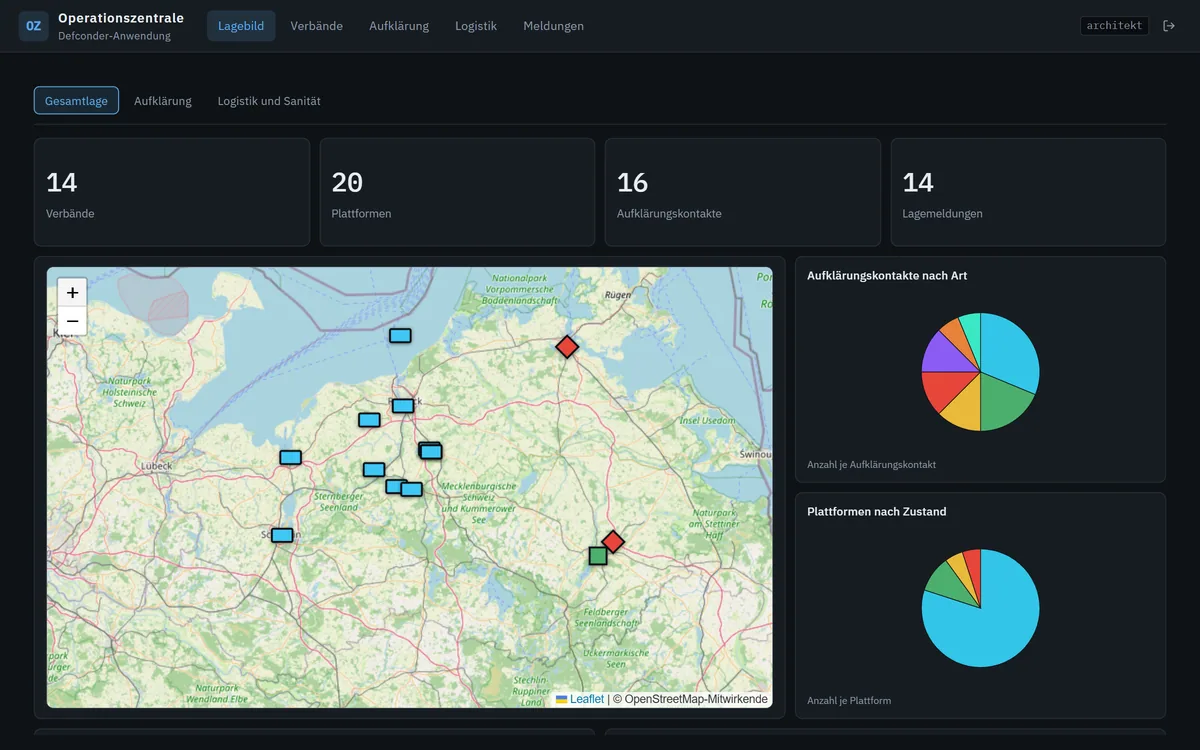
Every new record goes out over WebSocket to every authorised user instantly. No approval queue built into the system's core. Objects with a position appear on the map, shown per NATO APP-6 with frame and colour by affiliation, charts and tables show the same data with the same permissions.
Zero latency: new picture in real time for every authorised user, no detour through a central office
Friend, hostile, neutral, unknown
Map, chart and table as one view
Every widget respects the clearance level
Defconder
All images show fictitious exercise data. Map data: OpenStreetMap contributors.
Architecture
From sensor to decision
Every step has a clear task. Every stage runs on your infrastructure.
01
Sources
Sensors, specialist systems, reports, files
02
Sensor bridge
Key per object, clearance level, optional pipeline
03
Pipeline
Map, compute, filter, preview
04
Verification
Proof engine for classification and rules
05
Log
Chained, append-only, exportable
06
Ontology builder
Objects, relations and rules as a reusable domain pack
07
Layout & app builder
Forms, dashboards and named applications per user group
08
Views
Map, dashboards, applications, analyses, federated across multiple domain packs
AI gateway under your control
Local models by default. Cloud models only when enabled, and blocked from the level you set.
At a glance
Every data source in, the important part first, every entry provable.
Connect instead of programming: Defconder recognizes what a source contains
Millions of entries stay searchable
Every entry is bound to the tamper-evident log
Information from every source
Everything in. What matters up front. Every detail provable.
A situation never comes from a single data source. It comes from dozens: specialist systems, sensors, radio, files, network protocols, reports. Defconder takes them in any common format, works out for itself what is inside, and keeps millions of entries searchable. Every single entry is bound to the tamper-evident log. What matters becomes part of the picture, by rule or with one click.
Sources feed the stream, every format is recognised
0 millionentries searched and verified in a single stream
over 0reports per second taken in by the running server
under 0 msdatabase search time by key, time or map area, at five million entries
0log entries for one million reports
Measured on a single workstation, not on data-centre hardware. Authorities and armed forces run powerful servers with fast storage. With more cores and faster storage there is headroom.
1
Connect
Pick the source, enter an address, folder or topic. For well-known services a template is enough.
2
Recognise
Defconder reads a sample and proposes format, time, location and key fields as well as the paging.
3
Anchor
Every batch gets a checksum that is recorded in the main log. Changes show.
4
Promote
A rule or a click turns the entry into a record of the picture, with a reference to its origin.
Connect instead of program
Defconder works out format, time field, location field and paging from a sample. For well-known services a template is enough. A new source is configuration, not a project.
Nine ways in
Polling web interfaces, webhooks, drop folders, TCP, UDP, WebSocket, event streams, MQTT for devices and Kafka for data platforms. Credentials stay on the server as secrets.
Millions of entries, found instantly
Full text, time, place, key and any field. Answers arrive in milliseconds, even in the largest stream tested.
Every entry provable
Not just the hit, the mass behind it is bound to the log tamper-proof. Changed, deleted or injected: it shows. Every entry has a proof you can save.
What matters, up front
A rule or a click turns an entry into a record of the picture, with a reference to stream and origin. A cap per batch keeps the picture clear instead of flooding it.
Clearance applies here too
Every stream has its own classification. Promoted data is never classified lower. Anyone without the level does not even see the stream in the list.
Hits are not enough. Decisions need proof.
Plain data platforms deliver hits. In a situation you also need to know whether an entry is genuine, who may see it and what follows from it. Defconder answers all three, across millions of entries and on your own hardware.
Existing analysis systems stay in use. Defconder collects their hits, anchors them and connects them with everything else in the picture.
Source catalogue
What Defconder connects
From the specialist application to the sensor, from ship radio to the social network.
Case systems and authorities
Whatever existing systems offer as an interface, export or file is taken over without rebuilding.
Web interfaces (REST)
Drop folder
CSV, XML, JSON
GZIP files
Webhooks
HL7 v2 (MLLP) and FHIR R4 from the hospital
Sensors and devices
Gauges, cameras with metadata, gateways and devices that report their values.
MQTT
TCP and UDP
WebSocket
Syslog and CEF
key=value protocols
Sea, radio and navigation
Position reports from radio and navigation, decoded directly.
AIS ship reports
NMEA and GPS
Event streams (SSE)
Data platforms
Where a data hub already exists, Defconder attaches as a consumer.
Kafka with groups and read position
Polling with paging
Time windows and identifiers
Token sign-in
Social networks and messengers
Public posts as a source for the picture. Mastodon and Bluesky accounts without credentials, Reddit, Bluesky search, X and Telegram with your own access.
Mastodon
Bluesky
Reddit
X
Telegram
News and services
Reports, warnings and readings of public services in the same picture as everything else.
RSS and Atom
Authority bulletins
Weather and gauge services
Formats Defconder recognises by itself
JSON
JSON lines
GeoJSON
CSV and TSV
XML and RSS
Syslog and CEF
NMEA and AIS
key=value logs
Custom line patterns
HL7 v2 and FHIR
GZIP files
Examples
The same principle. Three situations.
Manhunt, disaster, defence: different sources, different rules, the same path from mass data to decision.
Manhunt: the hit among millions of readings
Vehicle data, tips, duty logs and answers from case systems arrive as streams. Millions of entries stay searchable, down to the second and the map area. Only the hit on a wanted vehicle becomes a record of the picture.
Sources
Plate readings, tips, case systems
Rule
Plate is on the wanted list
Picture
Sighting with place, time and a reference to the original entry
Which sources may be connected is decided by the authority's legal basis, not by the technology.
Disaster: water levels, warnings and reports together
Gauges, weather warnings, dispatch logs and reports from the public come together in one beat, by polling, through Kafka or as a file from a network drive. When a level passes the alarm stage, the incident site appears in the picture. Everything before it stays searchable.
Incident site with level history, ready to warn the public
Defence: thousands of contacts, few decisions
Ship radio, flight data, sensors, reconnaissance reports as files and network protocols flow into separate streams, each with its own classification. Even with millions of entries a day, only the unknown contact in the restricted zone becomes an object of the picture. The mass stays with the operator, on their own hardware, even air-gapped.
Sources
AIS, ADS-B, sensors, reports, logs
Rule
Identifier unknown and inside the restricted zone
Picture
Contact with source, reliability and classification
Exercise scenarios with fictional data. No real units or incidents.
Open data, ready to use
Official and open sources: built in, not bought in.
Warnings, weather, radiation, earthquakes, air picture, drone geozones, maps and population. Defconder ships verified templates for open government and community data. Connecting is one click, every source carries its licence and attribution, every retrieval is logged.
0templates for data streams, each tested against the real interface
0verified map services in the catalogue, with licence and attribution, including aerial imagery of all 16 federal states
0of them layers of the drone geozones, from flight restriction areas to power plants
0file formats for your own maps without internet: MBTiles, PMTiles, GeoPackage
Hazards and warnings
Official warnings flow into the picture as a stream, nationwide or for one district.
BBK and NINA: civil protection, Katwarn, BiWaPP, floods, police notices
German Weather Service: weather warnings
Official information of the respective authorities
Air picture and drone geozones
Positions of cooperative aircraft from two open sources with automatic switching on failure. Plus the official drone flight restriction areas as map layers.
adsb.lol (open receiver network)
dipul of the German air navigation service: flight restriction areas, control zones, airports, power plants, hospitals, authorities and more
adsb.lol: ODbL. dipul: CC BY-ND 4.0, the zones are never altered
Weather, radiation, earthquakes, fires
Readings and events with place and time, in the same map and search as everything else.
DWD readings and precipitation radar
Federal Office for Radiation Protection: ambient dose rate at almost 1,700 stations
GFZ: the latest earthquakes worldwide
NASA FIRMS: thermal anomalies from satellite data (with your own free key)
DWD: GeoNutzV. BfS: dl-de/by-2-0. GFZ and NASA: attribution
Maps and population
Official base maps, aerial imagery and the distribution of the population as layers. Without internet your own map runs from a file.
basemap.de and TopPlusOpen of the BKG
Aerial imagery (orthophotos) of all 16 federal states
Census 2022: population per grid cell
OpenStreetMap, also offline as a Protomaps map (PMTiles)
3D buildings (CityGML, CityJSON) and cadastre of the federal states as file import, buildings in 3D coloured by sector
BKG and census: dl-de/by-2-0. OpenStreetMap: ODbL
Freely available does not mean free of obligations.
Every source carries its licence and the required attribution. Data with a no-derivatives clause is shown unchanged. Whether permanent operation on an open source is permissible and reliable is for the operator to decide. For operations we recommend your own or contractually secured sources and use the open ones as a starting point and fallback.
Status of the checks: every template and map service was retrieved from the real interface. The NASA template needs your own key and is therefore only tested against the documented format. Open sources may limit requests or fail.
At a glance
Not just the site, but everything critical next to it, on a rotatable map.
Buildings with real height and sector: hospital, school, substation at a glance
Aerial imagery from all sixteen federal states
Served from your own server, your own maps and imported data also without internet
Surroundings in 3D
Not only the site. Everything critical next to it.
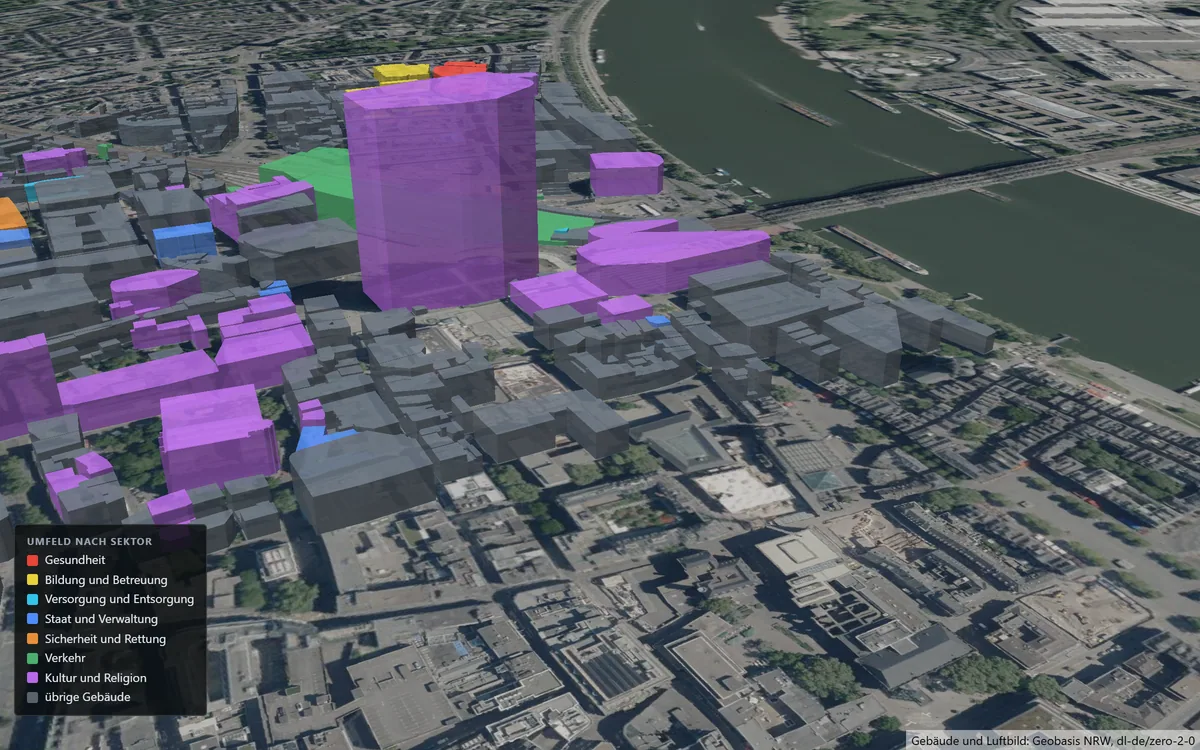
Official building models of the federal states, aerial imagery from all sixteen states and the picture in a tilted, rotatable map. Buildings carry their real height and, by use, a sector. Which hospital, school and substation lie next to the facility is visible at a glance. Everything is served from your own server. Your own maps and imported data also run without internet, the aerial imagery of the states and the geozones need the authorities' services.
Defconder
Example from a real file: Cologne city centre with the LoD2 3D building model and the aerial imagery of North Rhine-Westphalia (Geobasis NRW, Data Licence Germany Zero 2.0). For buildings without a footprint in the model, such as the cathedral, the outline is simplified from the hull.
Defconder
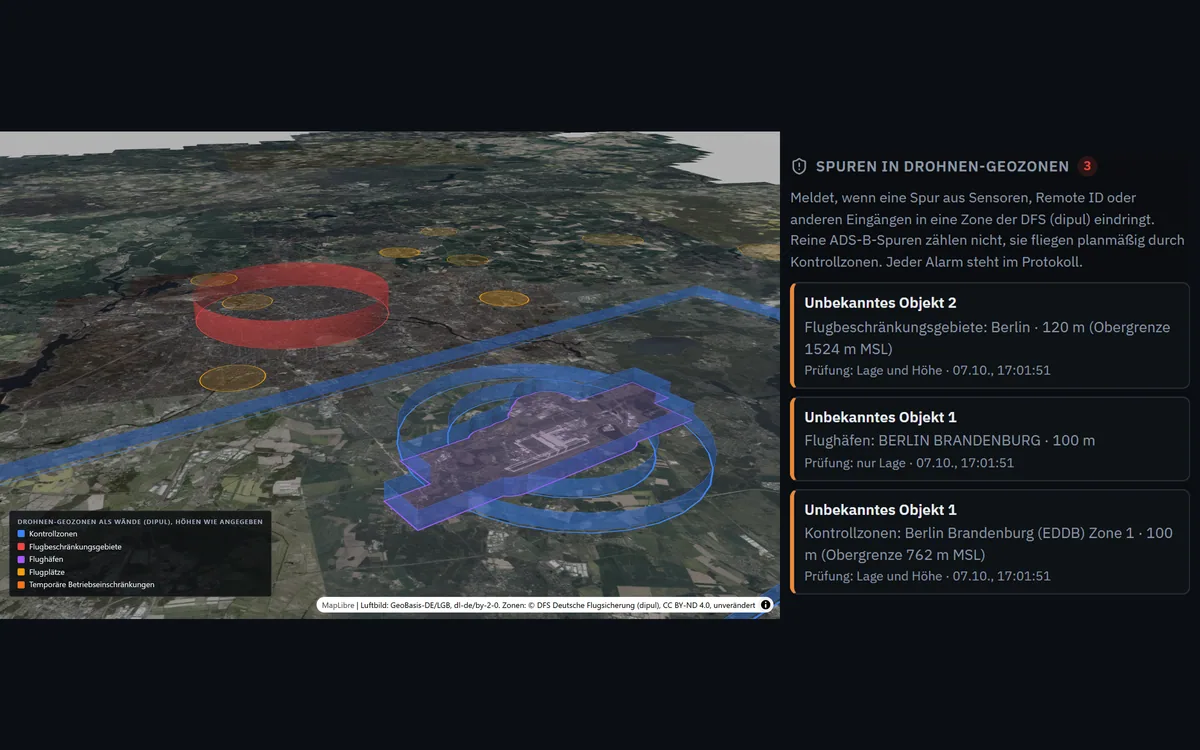
Left real data: Berlin on the aerial imagery of Brandenburg (GeoBasis-DE/LGB, dl-de/by-2-0) with the drone geozones of the DFS (dipul, CC BY-ND 4.0, unaltered) as walls. Heights are shown as given in the data, terrain is not included. Right the alert card of the interface with two test messages over the airport and the city centre, fed in through the Cursor-on-Target input.
0federal states with an aerial imagery service in the catalogue, each checked with a real tile
0sectors by which buildings are coloured from their official use
0buildings of a real LoD2 tile (56 MB CityGML), read in about four seconds
0building functions of the official code list from which the sectors are derived
Buildings with real height
CityGML and CityJSON from the land surveying offices are read in the server, converted to world coordinates and drawn as 3D bodies. The height comes from the measured values in the data. Tilted view with one click, rotate and tilt with the right mouse button.
Surroundings by sector
From the building function in the official data, Defconder assigns buildings to seven sectors: health, education and care, supply and disposal, state and administration, security and rescue, transport, and culture and religion. All other buildings recede in grey.
Aerial imagery from all 16 states
Baden-Württemberg, Bavaria, Berlin, Brandenburg, Bremen, Hamburg, Hesse, Mecklenburg-Vorpommern, Lower Saxony, North Rhine-Westphalia, Rhineland-Palatinate, Saarland, Saxony, Saxony-Anhalt, Schleswig-Holstein and Thuringia. Licence and attribution stay visible. For Hamburg the catalogue shows the latest vintage of the time series of the state survey office (Landesbetrieb Geoinformation und Vermessung).
Viewshed and water level
From an uploaded elevation model Defconder computes from where a point can be seen and which areas an assumed water level covers. These are scenarios without a forecast and without water depth.
Relief and labels
An uploaded elevation model appears as a real 3D relief. Maps from Protomaps data carry place, street and water names, set with built-in open fonts (Noto Sans, SIL OFL). The relief replaces the chosen map, the interface does not yet show both at once.
Maps under your own control
Your own server delivers tiles, files and fonts, every request is checked against the user's clearance. Your own maps run from MBTiles, PMTiles, GeoPackage, GeoTIFF, CityGML and CityJSON without internet. Only the DFS geozones and the online aerial imagery need a connection, and that can be switched off on the server.
Positioning interference from the air picture
Aircraft report in ADS-B how accurately they know their position. Per area of about 1,900 square kilometres Defconder counts how many report at least 185 metres of uncertainty, as a 15-minute sliding window, with and without a filter for older equipment. This is an indication of disturbed satellite reception and not proof. The data comes from adsb.lol.
Drone geozones as walls
The zones of the German air navigation service (dipul) stand in the map with their height values as translucent walls, on click also as filled bodies: control zones, flight restriction areas, airports, airfields and temporary restrictions. Where the data names no upper limit, as with airfields, the area stays flat. Zones are shown unaltered and retrieved live, so the server needs internet.
Alert when a track enters a zone
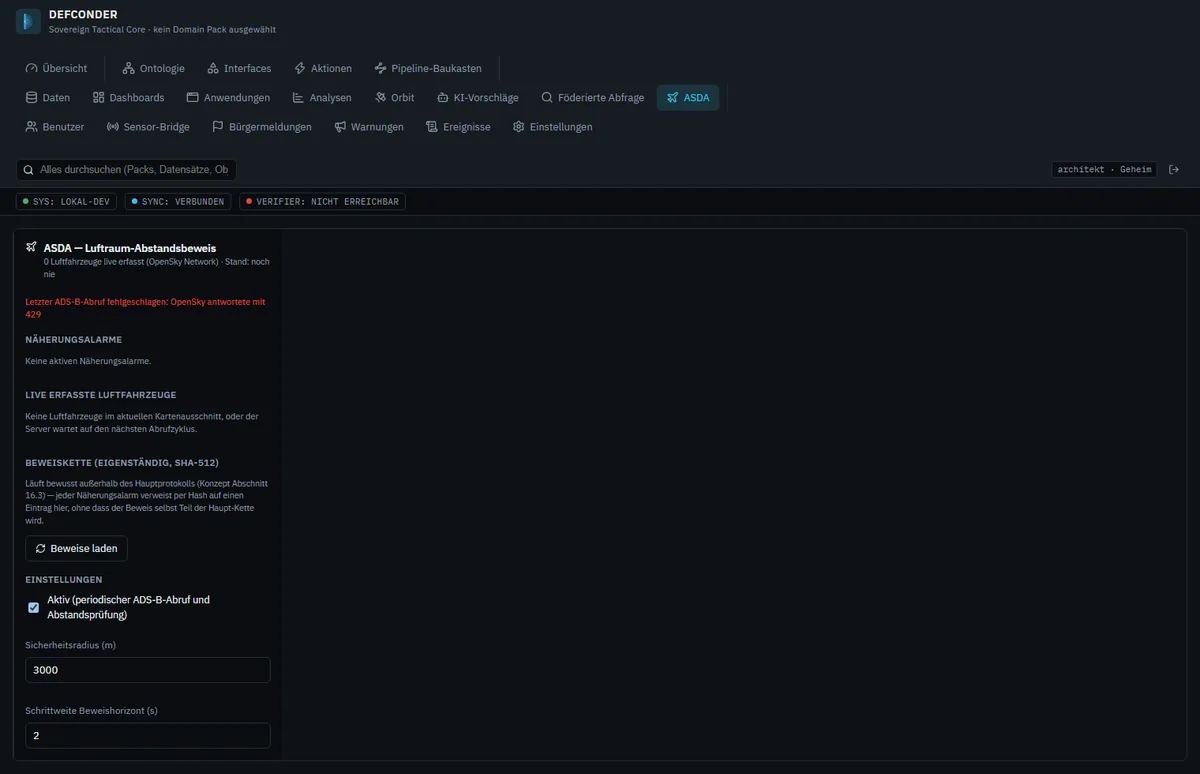
Every 15 seconds the server checks whether a track from sensors, Remote ID or other inputs lies in a zone, by position and, where the data allows, by height. The alert is an event in the log and, if set up, goes to e-mail and webhook. Pure ADS-B tracks do not count, they fly through control zones as planned. Height is compared with a 50 metre tolerance because sources report sea level and ellipsoid height differently.
Occasion: the German KRITIS Umbrella Act
The KRITIS Umbrella Act has been in force since 17 March 2026 (BGBl. 2026 I No. 66). Operators of critical facilities must plan resilience measures on an all-hazards basis and report security incidents. Defconder is no proof of compliance and replaces no legal advice. It supplies the situational basis: the surroundings, the air picture, warnings and the evidence of who saw what and when.
As of 7 October 2026. Limits: the relief works only with an uploaded elevation model and then replaces the aerial imagery layer, the map does not yet show both at once. In maps from OpenStreetMap data only buildings with a height value appear as bodies, in the checked example Florence about one in ten. The sector assignment is Defconder's classification by building function and not an official designation as critical infrastructure. The read time was measured on the development machine.
At a glance
A 3D world built from official data, where you play through crises beforehand.
Flood, fire, storm and the failure of power, gas and fuel as exercise scenarios
The exercise yields the crisis plan with map, roles and check
Runs on your infrastructure, also without internet
Defconder Terra: the 3D world
Defconder Terra: terrain, buildings, aerial imagery, weather and water. Computed, not just drawn.
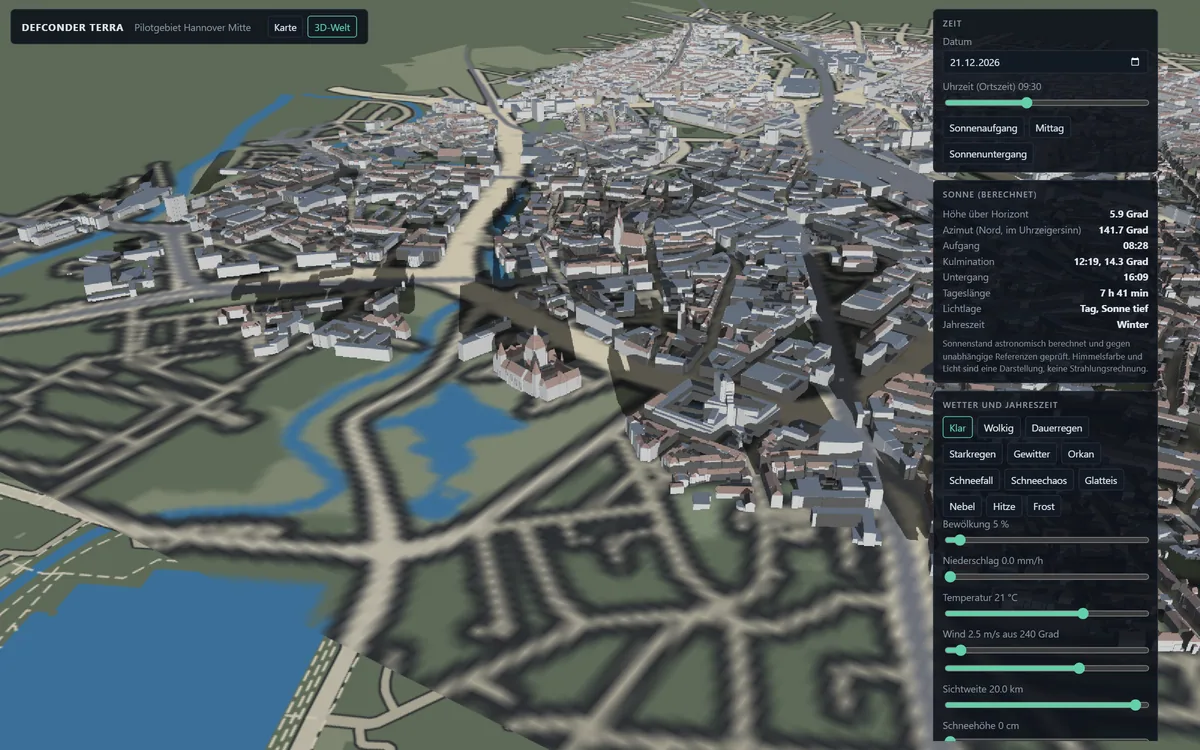
Terra is the 3D world of Defconder: real buildings, real terrain and real aerial imagery from official data, plus sun position, season and weather that you set continuously or take from the real situation of the German Weather Service. On top run exercise scenarios: flash flood and river flood, fire, pollutant plume, roof potential, storm, snow, ice, heat, mud and the outage of power, gas and fuel. From this comes the crisis plan with map, roles, resources and checks, and on request a sensor dataset with a computed thermal image for game and simulation engines. Everything runs on your own infrastructure, also without internet.
0building parts from official state data in the pilot area Hanover centre, with roof shapes
0automatic checks or more for the computation cores, the plan and the documents, including comparisons with the sun table of the US Naval Observatory, the EU database PVGIS and the exact solution for the dam break
0weather situations as templates, every value continuously adjustable or taken from the real situation
0data layers from official sources: radiation monitoring network, residents by census, protected areas, weather warnings
0check rules with which the plan coach examines a crisis plan in a traceable way and without AI
0requests to third parties in the test with blocked internet, in both views
World and weather
The scene follows date, time and weather. Whoever plans an exercise sets the situation. Whoever wants to know exactly takes over the measurement or the forecast of the Hanover station.
Defconder
Hanover centre, 21 December, 9:30. The shadows come from the computed sun position. Buildings: 3D building model LoD2 and terrain model DGM1 of the LGLN (CC BY 4.0), roads, water and green from OpenStreetMap (ODbL). Everything is served by your own server.
Defconder
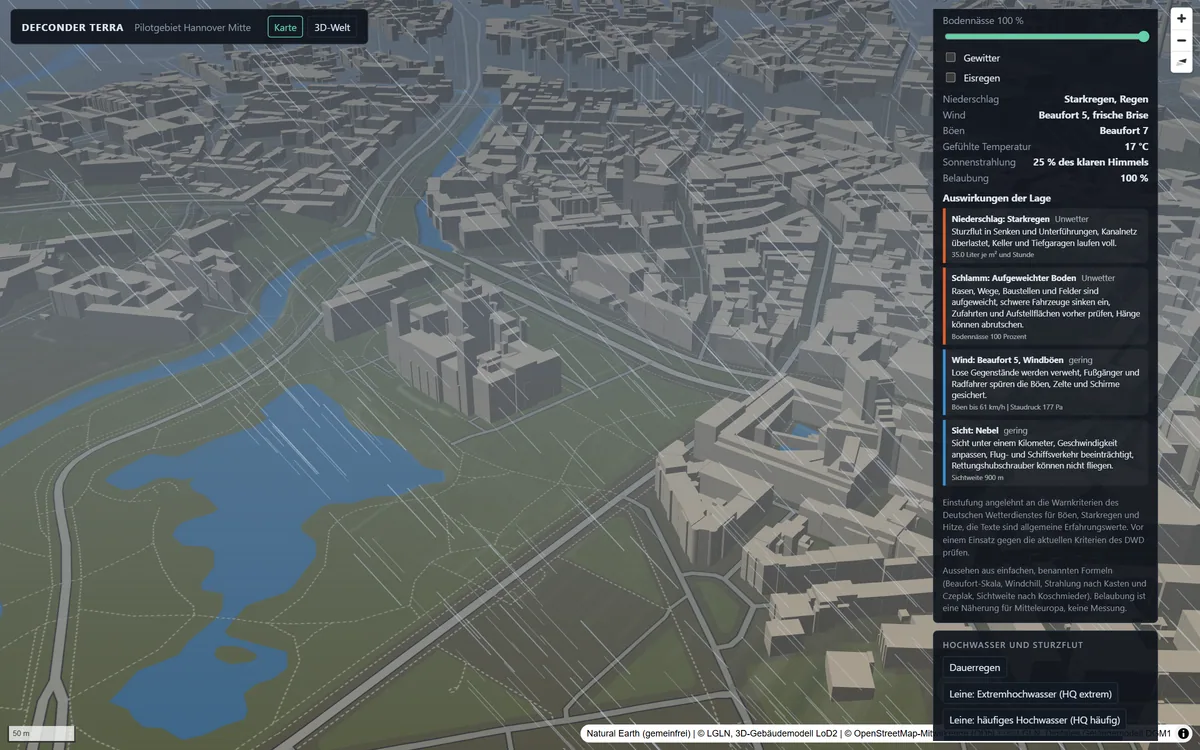
Heavy rain at 35 millimetres per hour. The colours are kept, the rain falls in the wind. On the right are the effects of the situation with level and figures. The classification follows the warning criteria of the German Weather Service.
Two views, one scene
A fast map for situation management and a 3D world with roof shapes and shadows. Date, time, weather, camera and layers are kept when switching. Both run with open libraries from your own server.
Sun and season
The sun position is computed astronomically and checked against an independent library and the tables of the US Naval Observatory: largest deviation 0.016 degrees. Sky colour, twilight, day length and foliage follow the date.
Weather you set
Cloud cover, precipitation, temperature, wind, visibility, snow and wetness can be set freely or chosen from templates: from heavy rain and thunderstorm to hurricane and snow chaos. Beaufort, perceived temperature, solar radiation and visibility follow named formulas and are checked.
Real situation from the weather service
One button takes the current measurement of the Hanover station or a point in the forecast of the German Weather Service: cloud cover, rain, temperature, wind, gusts, visibility, snow, thunderstorm and freezing rain. Missing readings are named. Only this retrieval needs internet.
What the situation causes
Storm, heavy rain, snow, ice, heat, cold, fog, thunderstorm and softened ground become effects with level, figures and text: gusts in kilometres per hour and dynamic pressure, snow load on the roof, risk of slippery roads, heat stress. In heavy rain the ground visibly turns to mud.
Passability during floods
For every water depth Terra says whether roads are free, restricted or no longer passable for cars and emergency vehicles. The thresholds are rules of thumb and marked as such.
Water, fire, plume, sun
The computation cores run in the browser or on your own server. Every computation names its assumptions and its check.
Defconder
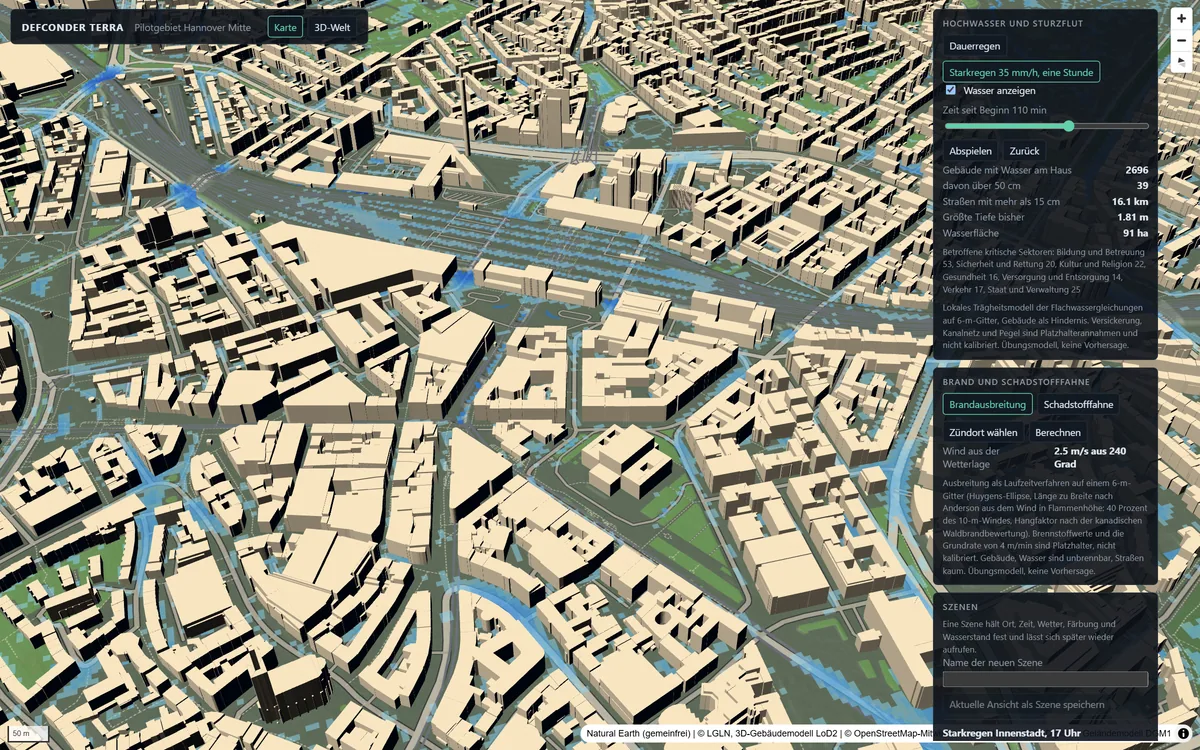
Exercise scenario heavy rain with 35 millimetres per hour, for one hour, computed on a 6 metre grid. Buildings are obstacles, infiltration and sewer network are placeholder assumptions and not calibrated. An exercise model, not a forecast.
Defconder
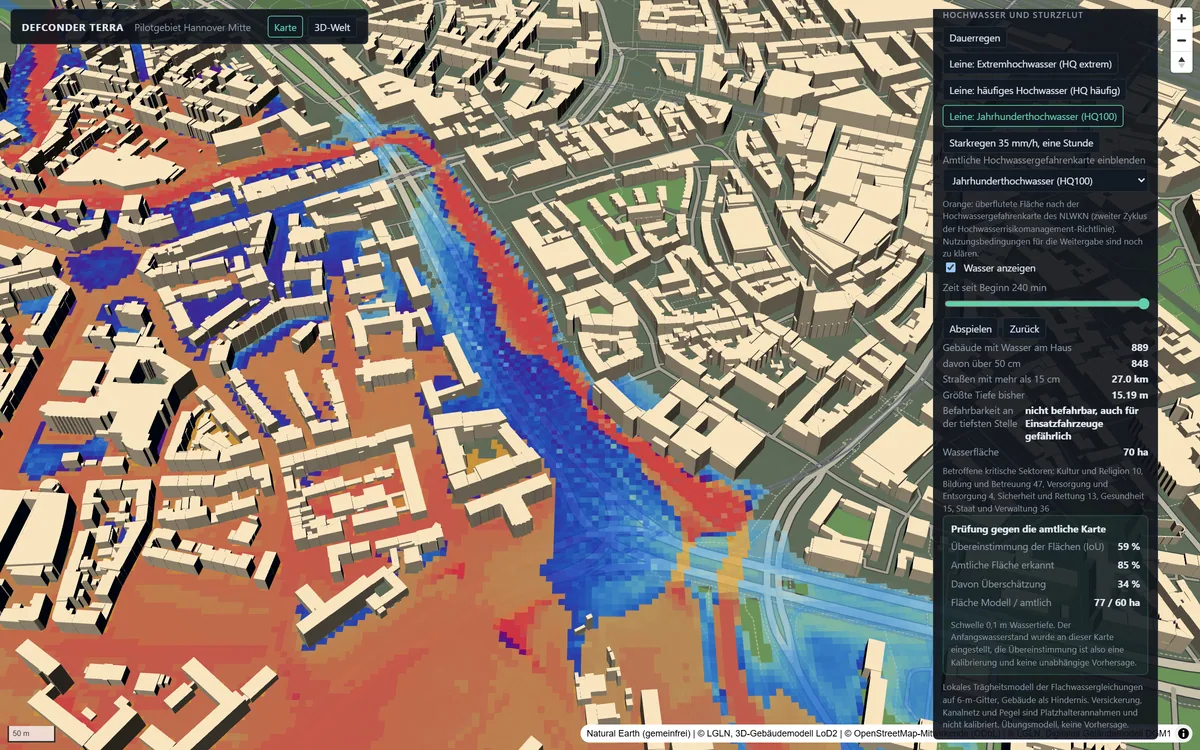
Leine, 100-year flood (HQ100). The official flood hazard map of the NLWKN lies on top in orange. The model covers 85 percent of the official area, the areas match by 59 percent, 34 percent of the computed area is overestimation. The initial water level was set against these maps: a calibration, not an independent forecast.
Flash flood with buildings as obstacles
A shallow water model computes where the water from a rain situation runs. It stays at rest where it must, conserves the water volume and meets the known exact solution for the dam break. Result: affected buildings, closed roads, sectors hit.
River flood of the Leine, checked against the official map
Three runs for frequent flood, 100-year flood and extreme flood. The official flood hazard maps can be laid over them, the agreement is shown in the panel. For the frequent flood the areas match by only 27 percent, which is shown as well.
Fire and pollutant plume
Click an ignition or source point: the fire spreads by wind, slope and fuel, the plume by wind and stability of the air. Both compute directly in the browser, in fractions of a second. The parameters are marked as placeholders.
Roof by roof: solar potential
From slope, orientation and shading by neighbouring buildings and terrain, Terra computes the irradiation of every roof surface. For twelve slopes and orientations the method is on average 1.2 percent off the EU database PVGIS, in the worst case 5.9 percent.
Supply and outage
What happens when a substation fails, the gas stays away or the petrol stations run empty? Terra computes it as an exercise scenario, from the first outage to the consequence in the plan. Real operator data can be attached as a file, further formats are in progress.
Defconder
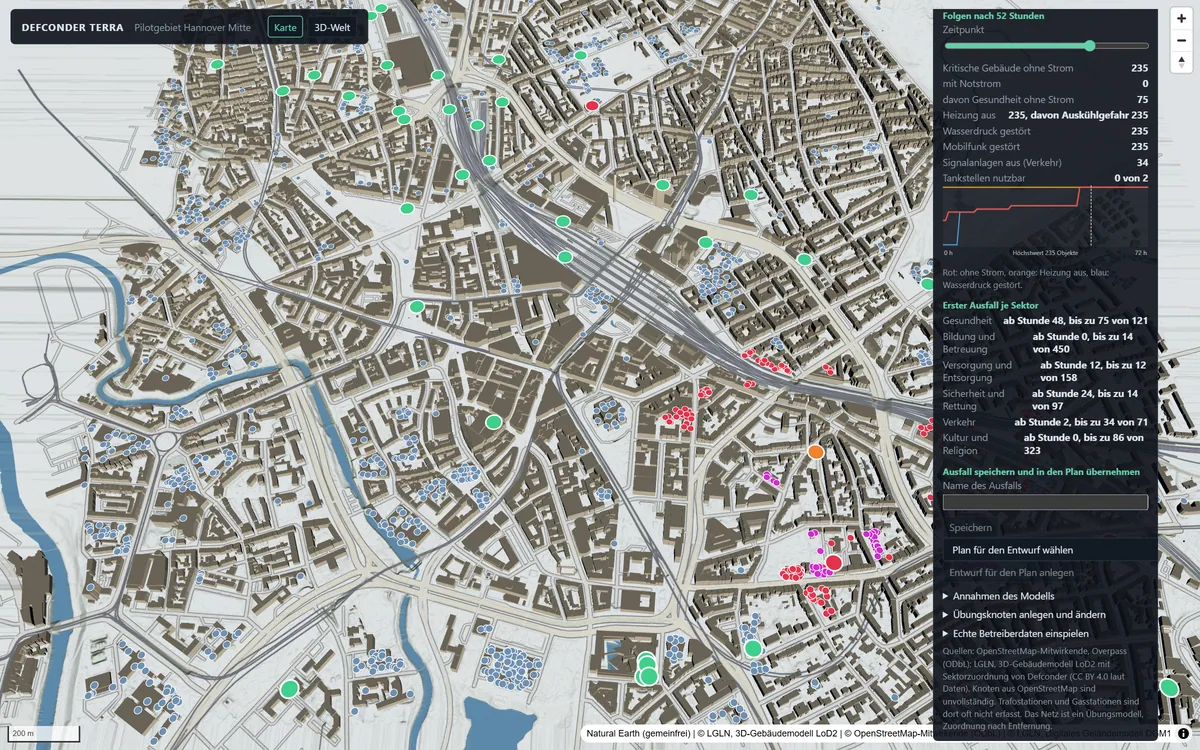
Exercise outage of a substation in frost, after 52 hours. The assignment of the 1,527 critical buildings follows distance, the emergency power times per sector are adjustable assumptions. Violet: health facilities whose emergency power is exhausted without fuel resupply. The network comes from OpenStreetMap and is incomplete.
Outage and cascade
Let a substation, transformer station, gas station, fuel depot or petrol station fail, with start and end. Terra computes hour by hour: emergency power per sector, heating, water pressure after a buffer time, mobile network, traffic signals, risk of cooling down in frost. All assumptions are adjustable.
Fuel and petrol stations
Petrol stations without power do not pump. Without delivery they run empty according to stock and crisis factor (panic buying). Emergency power lasts longer when fuel is resupplied and shorter when not: power, gas and fuel are linked in the model.
Exercise network from open data
55 nodes from OpenStreetMap (substations, transformer stations, petrol stations, gas storage) and 1,527 critical buildings as consumers. What is missing can be set as an exercise node, marked as exercise. It is a consequence model, not a load flow or hydraulic model.
Attach real operator data
File import for GeoJSON and CSV, every import with name, licence and origin, removable at any time, exercise and real data kept apart. In progress: CIM/CGMES (IEC 61970), INSPIRE utility networks (GML), OGC WFS and API Features, the Marktstammdatenregister as CSV and operator-specific adapters.
From the consequence into the plan
Saved outages run as a step in scenarios. From the outage Terra creates measures as drafts: emergency power for hospitals, fuel, warming rooms, water, traffic without signals, radio. The impact analysis holds the bridging time by emergency supply, and the plan coach reports when it is shorter than the recovery time.
Air picture and traffic
Moving objects in the world: real open flight data (ADS-B) at real altitude, the fused picture from Defconder with drones via Remote ID, plus exercise traffic on the real road network. Every object carries its origin, exercise and real data are marked separately.
Tracks from Defconder
Terra reads the fused picture from Defconder through the situation interface (lage-1, read-only, own access with the scope tracks). What Defconder ingests from Remote ID, SAPIENT, ASTERIX, Cursor on Target and ADS-B appears as drone, aircraft or ground vehicle in the 3D world, with the deviation Defconder reports.
Real flight data at real altitude
Positions from adsb.lol (Open Database License, credit adsb.lol contributors): each aircraft at its reported altitude above the terrain, with track, heading and a plumb line to the ground, coloured by altitude band. Snapshots are stored with timestamp and source and also work without internet. The open interface has a daily request limit.
Road traffic and drones as exercise
Up to 1,500 exercise vehicles (car, bus, truck, emergency vehicle) drive on the OpenStreetMap road network, one-way streets respected. Plus eight exercise drones flying circles, legs and raster patterns, and exercise air traffic on approach and departure at the airport. All invented and marked as exercise.
Public transport live only with a licence
Terra understands GTFS Realtime (vehicle positions). A source is only fetched if address, source and licence are entered. No particular source is built in, the licence of the chosen source must be checked before operation.
Limits
Positions from open sources can be incomplete, delayed or wrong, aircraft without a transponder are missing. Road traffic is an exercise model, not a measurement. For tracks from Defconder: Defconder only fuses reports from different sources if they are of the same kind and at similar altitude.
Aerial imagery and data layers
On request Terra shows the real aerial image with 20 centimetres per pixel instead of the map and lays official layers over it. Every layer names source, licence note and retrieval date in the program.
Defconder
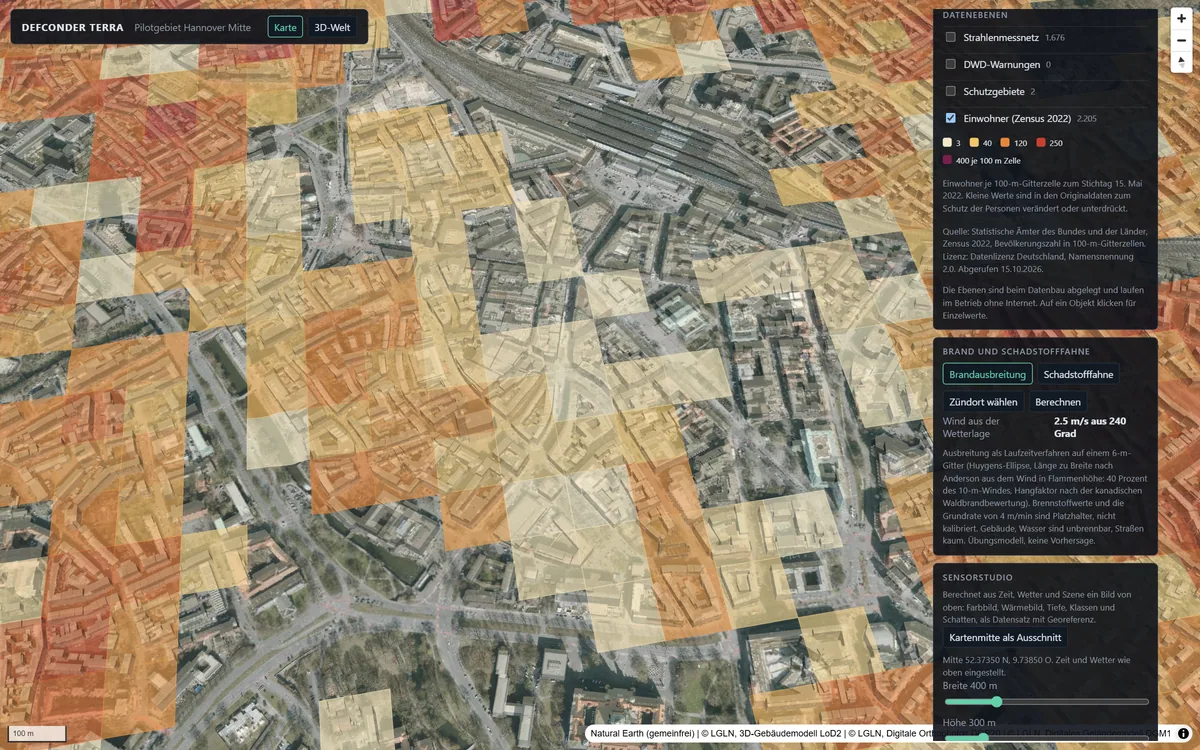
Digital orthophoto of the LGLN (taken March 2025) with the number of residents per 100 metre cell from the 2022 census. The layers are stored when the data is built and run without internet in operation.
Real aerial image under the 3D world
The aerial image lies on the terrain, the buildings stand translucent above it. Switchable in both views. The image shows the time of capture, not the season you set, and the panel says so.
Radiation monitoring network
Ambient dose rate of the stations of the Federal Office for Radiation Protection, 1,676 stations nationwide with hourly value, colour scale by value, single values on click.
Residents by census
Number of residents per 100 metre grid cell on the reference date 15 May 2022. Small values that are altered or suppressed in the original data are marked that way and not filled in.
Protected areas and weather warnings
Nature, habitat, bird protection and landscape protection areas of the Federal Agency for Nature Conservation, and the weather warnings of the German Weather Service for municipalities, as a snapshot at the time of retrieval.
Crisis plan on the map
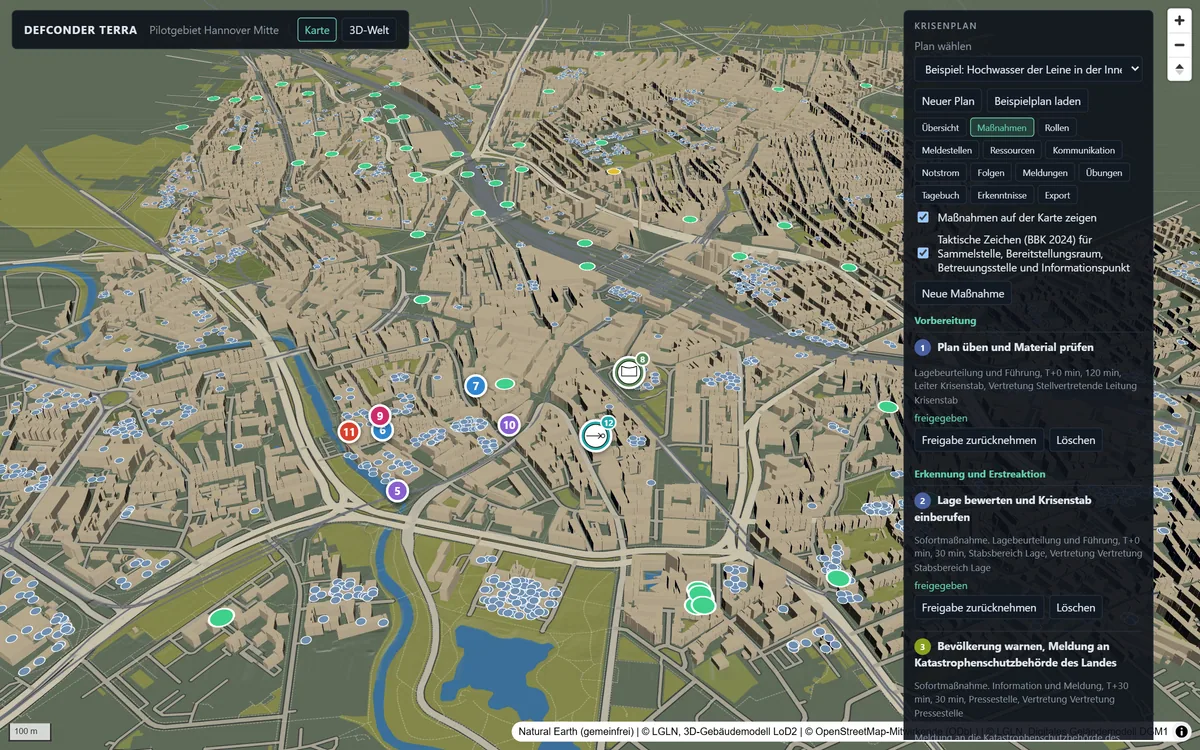
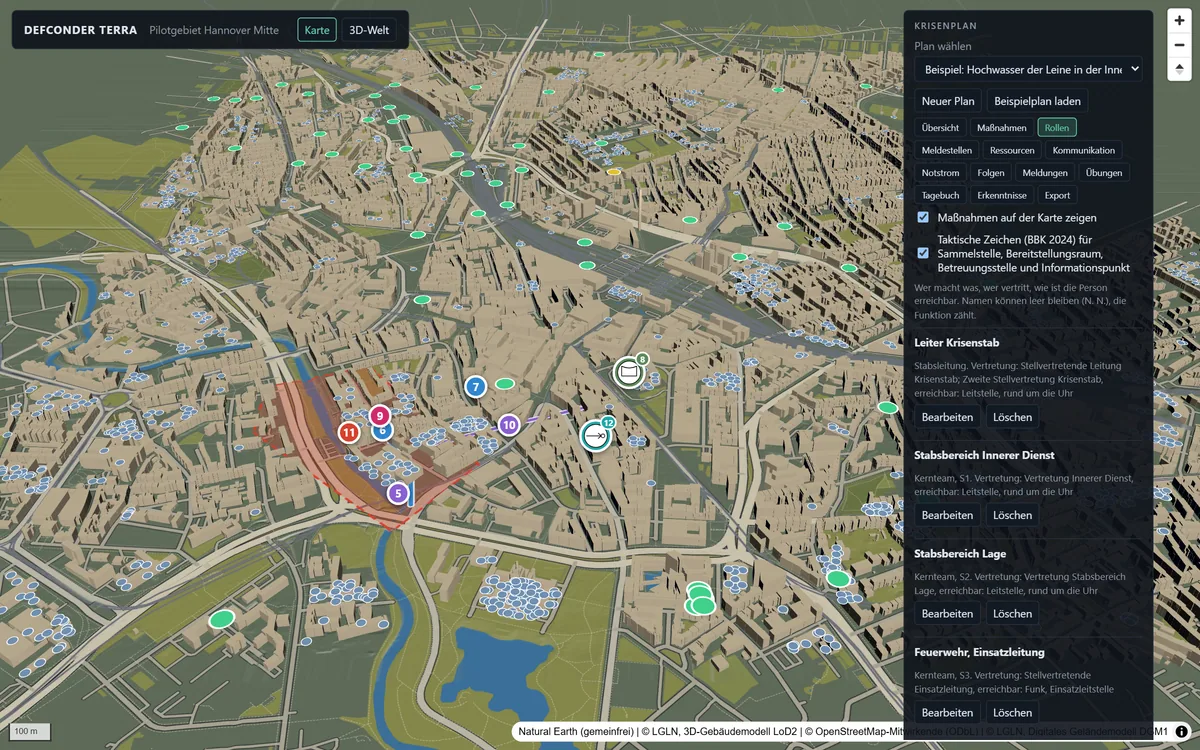
The situation becomes a plan: measures with number, type, responsible person and deputy stand as markers, zones, lines and arrows on the aerial image. The document follows at the push of a button.
Defconder
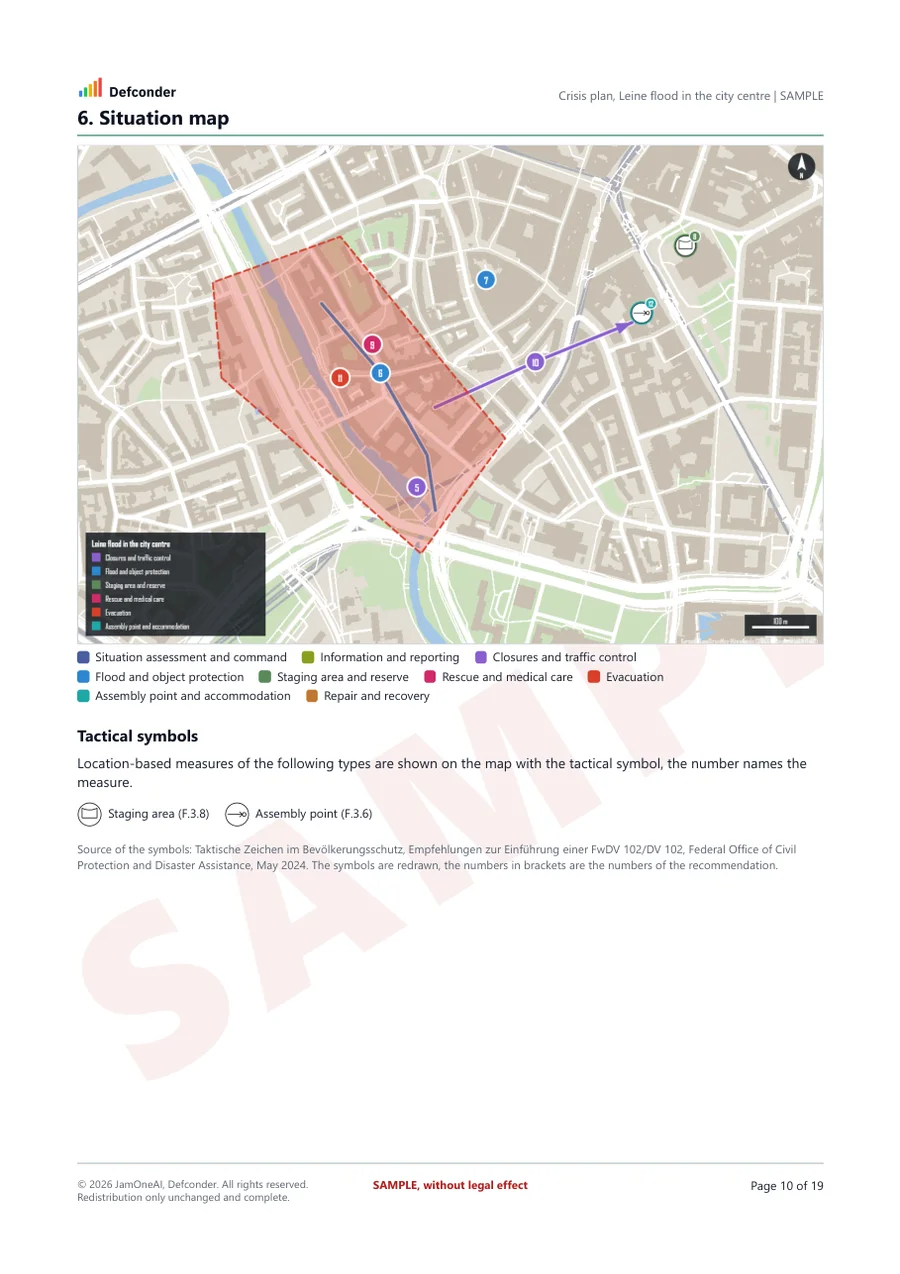
Example plan for an exercise: Leine flood in the city centre. The zone is the danger area, the arrow the escape route to the assembly point, assembly point and staging area appear as tactical symbols. In the panel the plan coach checks against 29 fixed rules. The plan names no real persons or phone numbers.
Defconder
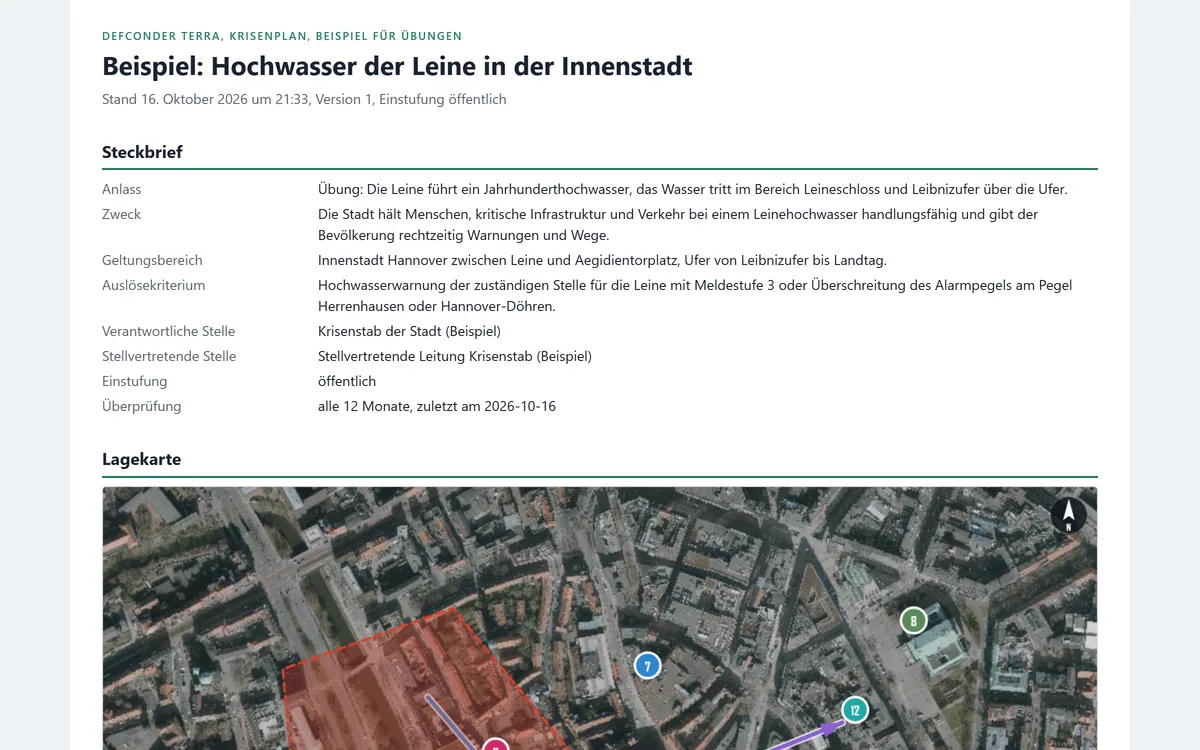
The document for reading is built from the plan state: profile, situation map, measures by phase, timeline, roles, resources, communication matrix, impact analysis, reporting duties, check by the plan coach and the proof from the chain. As a page for reading in your own network, as a Word file and as data.
Profile, trigger, escalation
Purpose, scope, trigger criterion, responsible and deputy office, up to six escalation levels and a review interval. The plan coach reports overdue reviews.
Measures with type, place and prerequisite
Thirteen measure types with colour, phase, start, duration, means, success criterion, prerequisites, lead time, escalation and map reference as point, zone, line or arrow. Assembly point, staging area, care point and information point appear as tactical symbols after the BBK recommendation 2024. Immediate measures are marked. Release only when all mandatory fields are filled in.
Who deputises for whom and how the person can be reached. Which resource exists in which quantity and where it is needed twice. Who informs whom by which route and by when. Which processes fail and how long that is tolerable. To whom, and by when, must be reported.
Plan coach without AI
Twenty-nine fixed rules check completeness, deputies, double booking of people, timing prerequisites and circular references, reporting deadlines, recovery against tolerable outage and emergency-power bridging, overbooking of resources, warning route for evacuation, place reference, release and review deadline, plus staff with groups and sections, head of staff with two deputies, immediate measures, reporting points with guiding questions, fallback channels without IT, emergency power against the guideline of 72 hours, de-escalation, lead time against warning lead time, exercises and findings. Every finding names the place and jumps there.
Draft from the situation
From a computed flood run Terra creates measures as drafts: assess the situation, warn, close roads, evacuate buildings and one measure per affected sector. Responsible persons, means and success criterion stay open for humans, and the draft cannot be released before they are filled in.
Document, Word, data, reading link
Page for reading and printing, Word file, data as JSON, situation map as image. The reading link shows the current plan state in your own network without editing.
Scenes and scenarios
Scenes hold view and situation. Scenarios play a timed sequence: rain starts, level rises, closure is triggered, measure starts. Plans, scenes and scenarios can be created, read, changed and deleted.
Every change in the chain
All plans and their parts are event based. Every event carries the hash of the previous one. A later change breaks the chain and is reported with the number of the first affected event. The state of the chain is shown in the plan document.
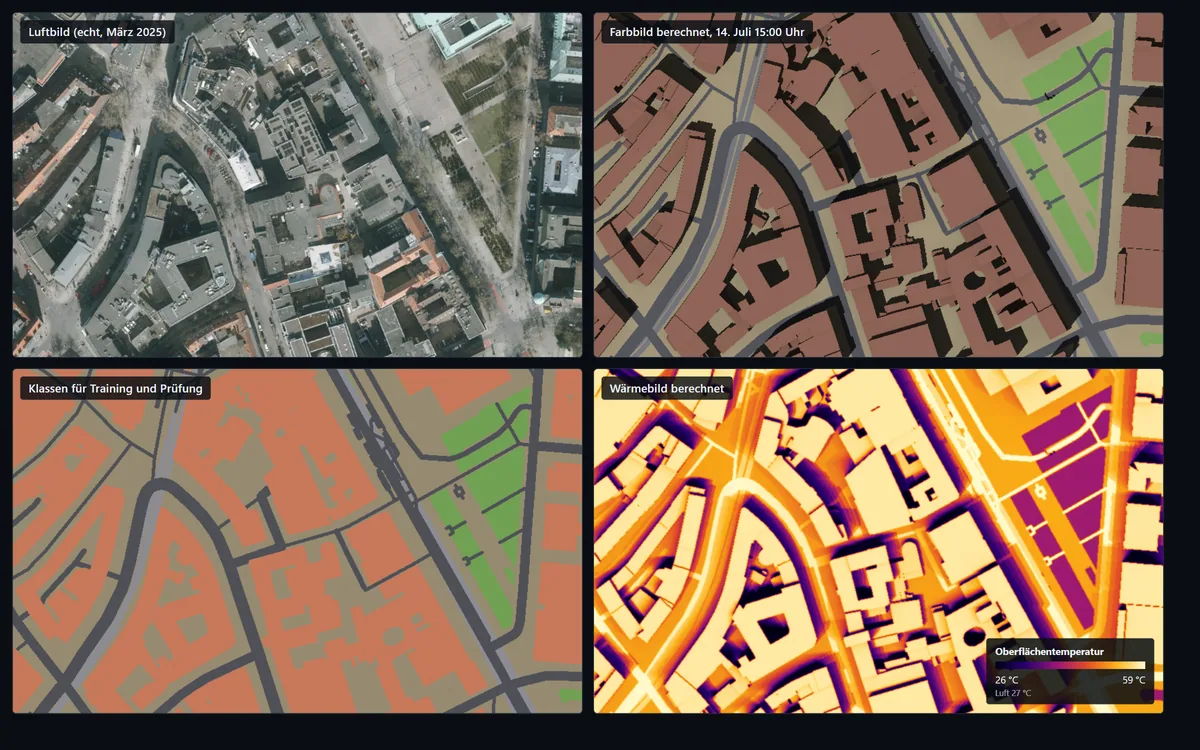
From time, weather and scene Terra computes a view from above and delivers it as a dataset: for training and testing software, for exercises with drone and satellite images, and for game and simulation engines.
Defconder
Section at the Opernplatz, summer afternoon. Aerial image, computed colour image, classes and thermal image from the same scene. In the thermal image roofs and sunlit asphalt are high, green areas and shade low. The temperature comes from an energy balance, not from a measurement.
Computed thermal image
An energy balance per pixel from absorbed sun, sky back radiation, wind and evaporation, with thermal inertia of the materials and shadows of neighbouring buildings. Sensor blur and noise are adjustable, the seed is fixed.
Dataset with georeference
A ZIP with colour image, aerial image, surface height, height above ground, classes, shadow and two thermal images in 16 bit (centikelvin), plus world files, class list, assumptions and sources. All channels have the same size and the same grid.
World export for engines
The pilot area as 3D Tiles and glTF with roof shapes, in three colourings, plus terrain, surface, classes and aerial image as rasters with georeference. For Cesium for Unreal, Cesium for Unity, Blender, Godot and QGIS, with instructions in the package.
What one expects from 3D situation maps and planning tools, and what Terra delivers beyond that
What one expects from 3D situation maps and planning tools, and what Terra delivers beyond that
Terra
Usual for 3D situation maps and planning tools
3D world
Buildings, terrain and aerial imagery from official data, on your own infrastructure, also without internet
3D buildings and terrain, often as a hosted service
Sun and shadow
Sun position computed astronomically and checked against the US Naval Observatory, roof potential checked against PVGIS
Sun position and shadow as a rendering
Weather and season
Continuously adjustable or from the real situation of the German Weather Service, with effects of storm, snow, ice, heat and mud
Weather situations and seasons as a rendering
Flooding
Shallow water computation with buildings as obstacles, time course, river checked against the official map, passability
Water level or heavy rain as an area
Supply outage
Exercise model for power, gas and fuel with cascade, emergency power, petrol stations and import of real operator data (further formats in progress)
Mostly not provided
Data layers
Radiation monitoring network, residents, protected areas, weather warnings, with source, licence note and retrieval date, no internet in operation
Layers with official data, mostly online
Crisis plan
Profile, escalation, measures with type and area, roles with deputies, resources with overbooking check, communication, impact analysis, reporting deadlines, plan coach with 29 rules, staff with sections, reporting points, emergency power, final report, draft from the situation
Plan modules with responsible persons and map, plan coach partly with AI
Document and export
Page for reading, Word, JSON, situation map, chain in the document
Document or Word export
Sensor data
Computed thermal image and dataset with classes, depth, shadow and georeference
Mostly not provided
Export to engines
3D Tiles, glTF and rasters with georeference
Mostly limited to the vendor's own platform
Proof
Reference checks of every computation core, limits per model, hash chain over every change
Change history
The right column describes what one can expect from common 3D situation maps and planning tools according to publicly described functions, without naming vendors and without claim to completeness. As of 15 October 2026.
What one expects from a good 3D situation map, and what goes beyond
What is expected: buildings in 3D, sun and shadow, weather and seasons, aerial imagery, flooding, sector colouring of critical buildings, data layers, roof potential, plans with a map. Terra offers that. Beyond it, Terra shows what the computation can and cannot do: every computation core has reference checks, every model names its limits, every plan its change history. Terra runs entirely on the operator's infrastructure, also without network, linked with tracks from several sensors, with alarms on geozone violation and with the tamper-proof log of Defconder.
As of 15 October 2026, pilot area Hanover centre. Limits: the models are simplified and not calibrated, especially for sewer network, soil type and fuel. The supply network is an exercise model from open data without line topology, OpenStreetMap records transformer and gas stations only incompletely, and real operator data need an agreement with the operator. The river flood of the Leine is set against the official flood hazard maps; for the frequent flood the areas match by only 27 percent. The thermal image looks straight down, uses material values from the literature and is not calibrated against measurements. The data of the German Weather Service is that of the Hanover station, not specific to the area, and needs internet for the retrieval. The aerial image shows the capture time March 2025. Terra is not a forecast. The terms of use of the state data, aerial images and flood maps for passing on to customers are still being clarified. There is no security test by third parties yet.
At a glance
A crisis plan as checkable data that a program checks for gaps before the emergency comes.
29 fixed rules, without AI
A designed document with red page, staff diagram and situation map
Sits on your infrastructure and stays reachable without internet
Crisis plan and alarm and operations plan
Crisis plan and alarm and operations plan with Defconder Terra
Defconder Terra keeps a crisis plan as checkable data: escalation, staff with sections, reporting points, immediate measures, emergency power, exercises and final report. From the data it produces a designed document with a red page, a chart of the staff and a situation map. The plan coach checks it against 29 fixed rules without AI. Everything runs on your own infrastructure, even without internet.
What is a crisis plan in Defconder Terra?
A crisis plan in Terra is a plan made of linked data instead of a text file: triggers and escalation levels, roles with deputies and sections, measures with start, duration, means and success criterion, reporting points with guiding questions, communication routes with a fallback channel and emergency power per site. Every change is recorded as an event in a tamper-proof chain. Terra produces the document from it, checks it for gaps and compares plan and reality after an operation.
0fixed check rules with which the plan coach checks the crisis plan traceably and without AI
0measure types with start, duration, resources, success criterion and map reference
0public sources the structure is oriented along, without any claim of conformity
0hours of emergency operation without refuelling as guideline value, calculated per site
0pages in the English sample, the German one has 17, all details fictitious
What a crisis plan in Terra contains
Every building block is its own data object that can be created, read, changed and deleted. Measures are released only when all mandatory details are filled in.
Defconder
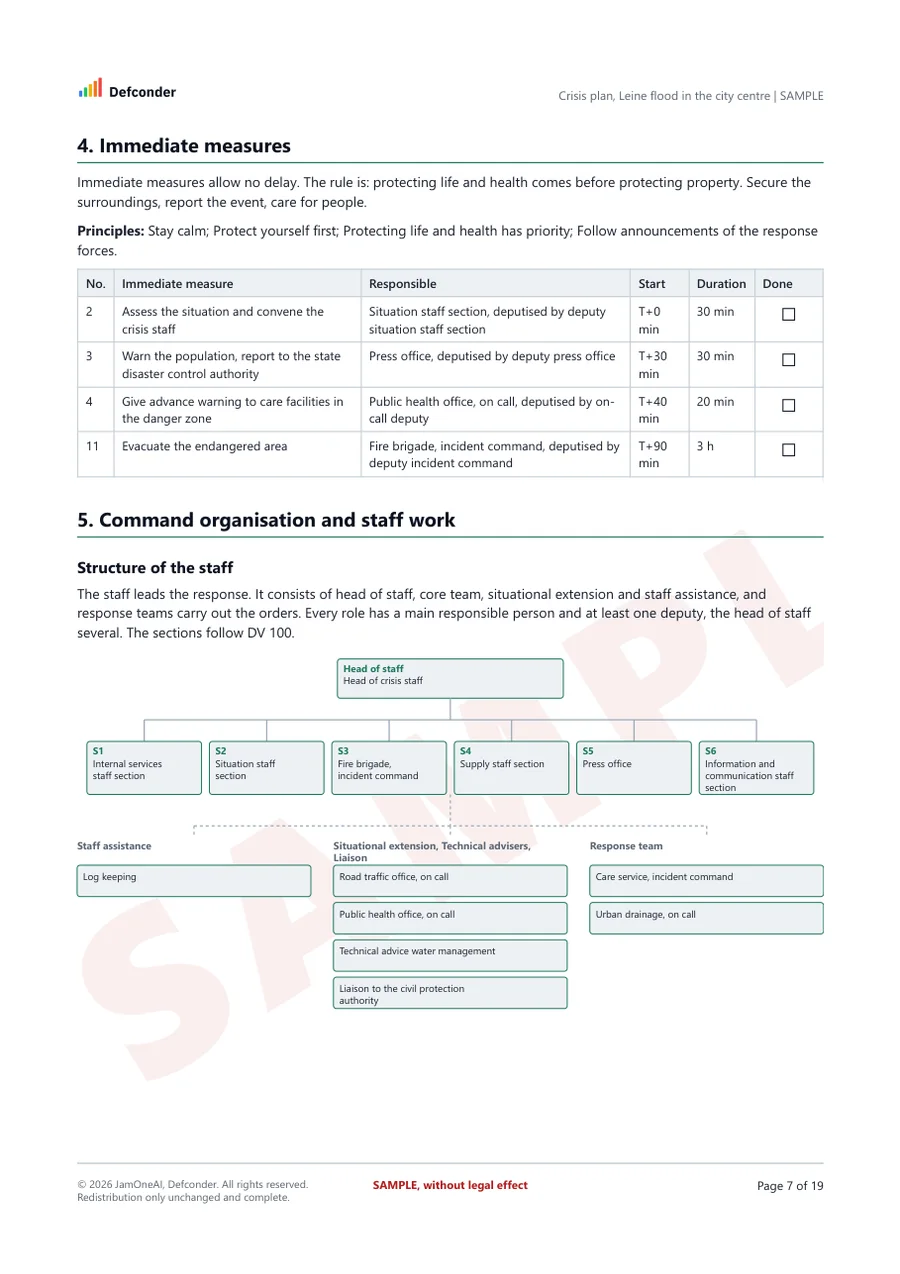
Roles with staff group, section and several deputies. On the map staging area and assembly point appear as tactical symbols with the number of the measure.
Profile, trigger, escalation
Purpose, scope, trigger, up to six escalation levels, warning lead time and review interval. Document properties such as classification, responsibility, storage location and approval are part of the document.
Staff and sections
Roles with staff group (head, core team, extension, assistance, response team, advisers, liaison), section S1 to S6 following the command organisation of DV 100 and several deputies for the head of staff.
Reporting points and guiding questions
Who receives event reports, how they can be reached outside working hours and which yes/no questions belong to the initial assessment. If one is answered with yes, the head of staff is alerted.
Immediate measures
Measures that allow no delay are marked and appear as a checklist with a done column in the document. The rule is: protecting life and health comes before protecting property.
Measures with map reference
Thirteen measure types with start, duration, means, success criterion, prerequisites and lead time. Location as point, area, line or arrow. For assembly point, staging area, care point and information point the map shows tactical symbols.
Communication with a fallback channel
Who informs whom, by which route and by when. The plan coach reports recipients that can only be reached through channels that depend on the network or on IT.
Emergency power per site
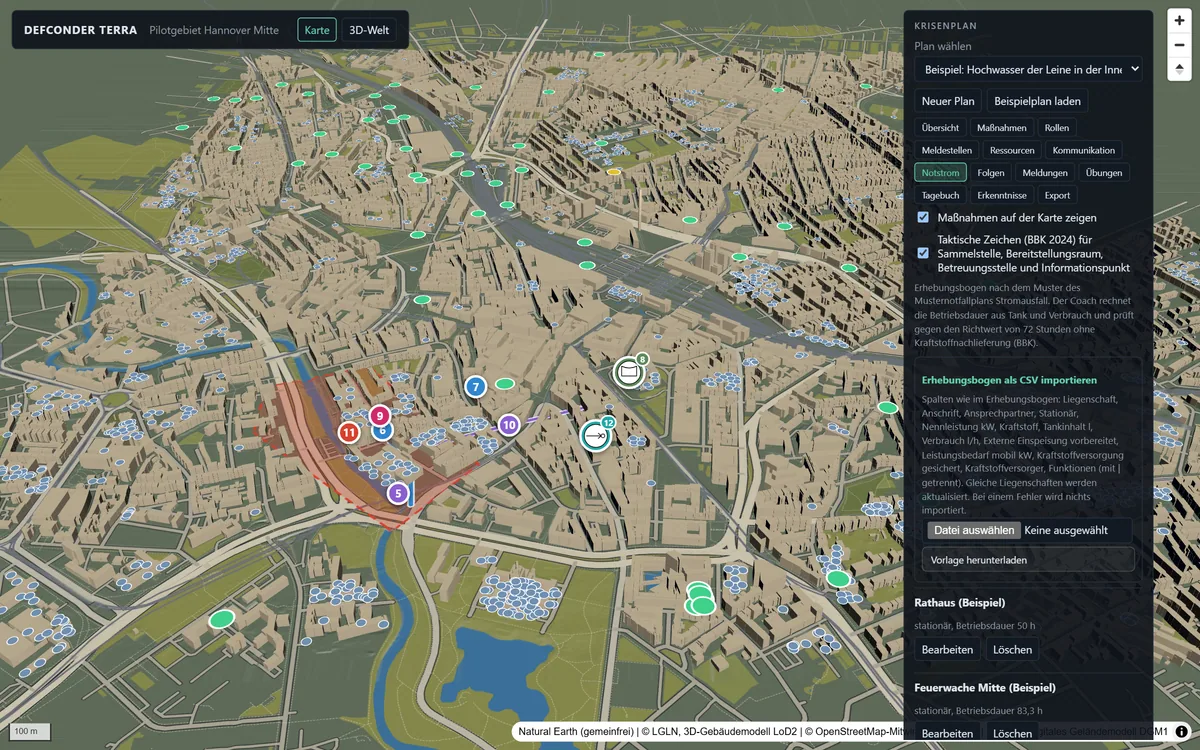
Survey form with output, fuel, tank content, consumption, mobile feed-in and secured delivery. Terra calculates the run time and checks it against the guideline of 72 hours. Import as CSV.
Impact analysis and reporting duties
Critical processes with tolerable downtime, recovery and bridging by emergency supply. Reporting duties with recipient, deadline and legal basis, legal bases as a free list.
De-escalation, exercises, findings
Criterion and procedure of de-escalation, documented exercises including those played from scenarios, and findings with priority, responsible person and target date.
Operations log and final report
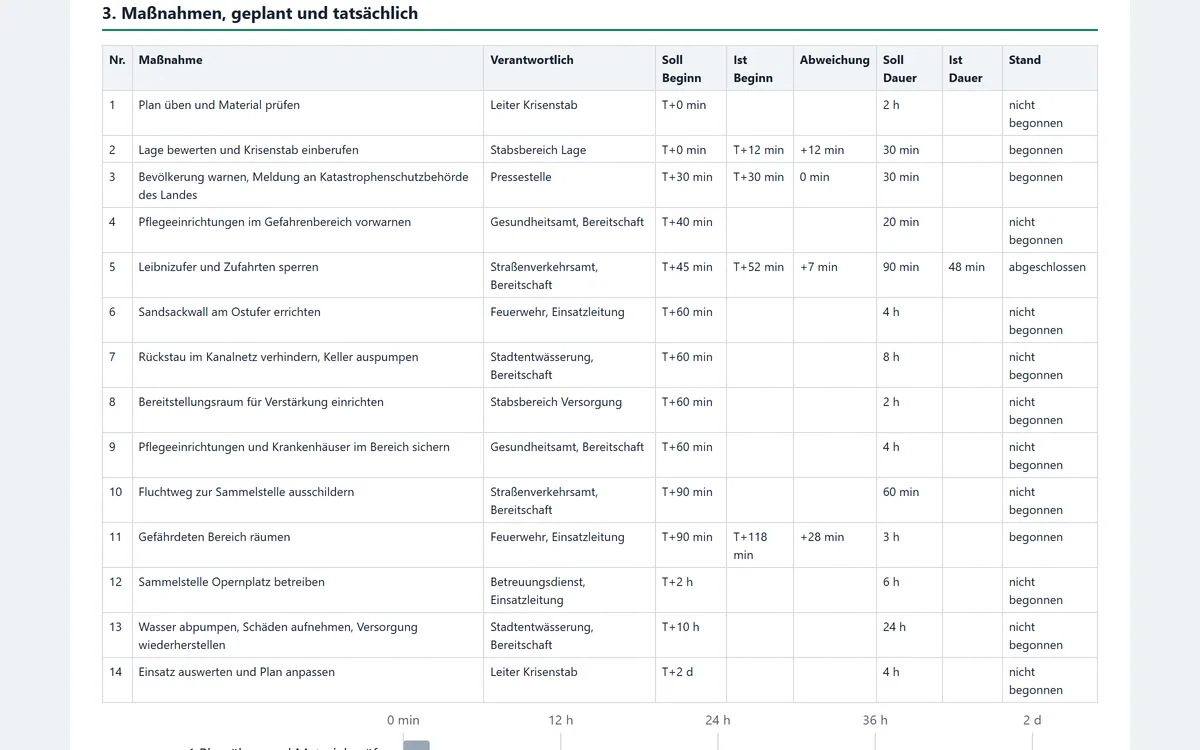
Reports, decisions and orders with time, assumptions marked as such. The final report compares planned and actual times per measure and lists the findings.
The document: red page, staff chart, situation map
From the plan state Terra produces a document to read and print, a Word file, the data as JSON and a designed sample version as PDF at the press of a button.
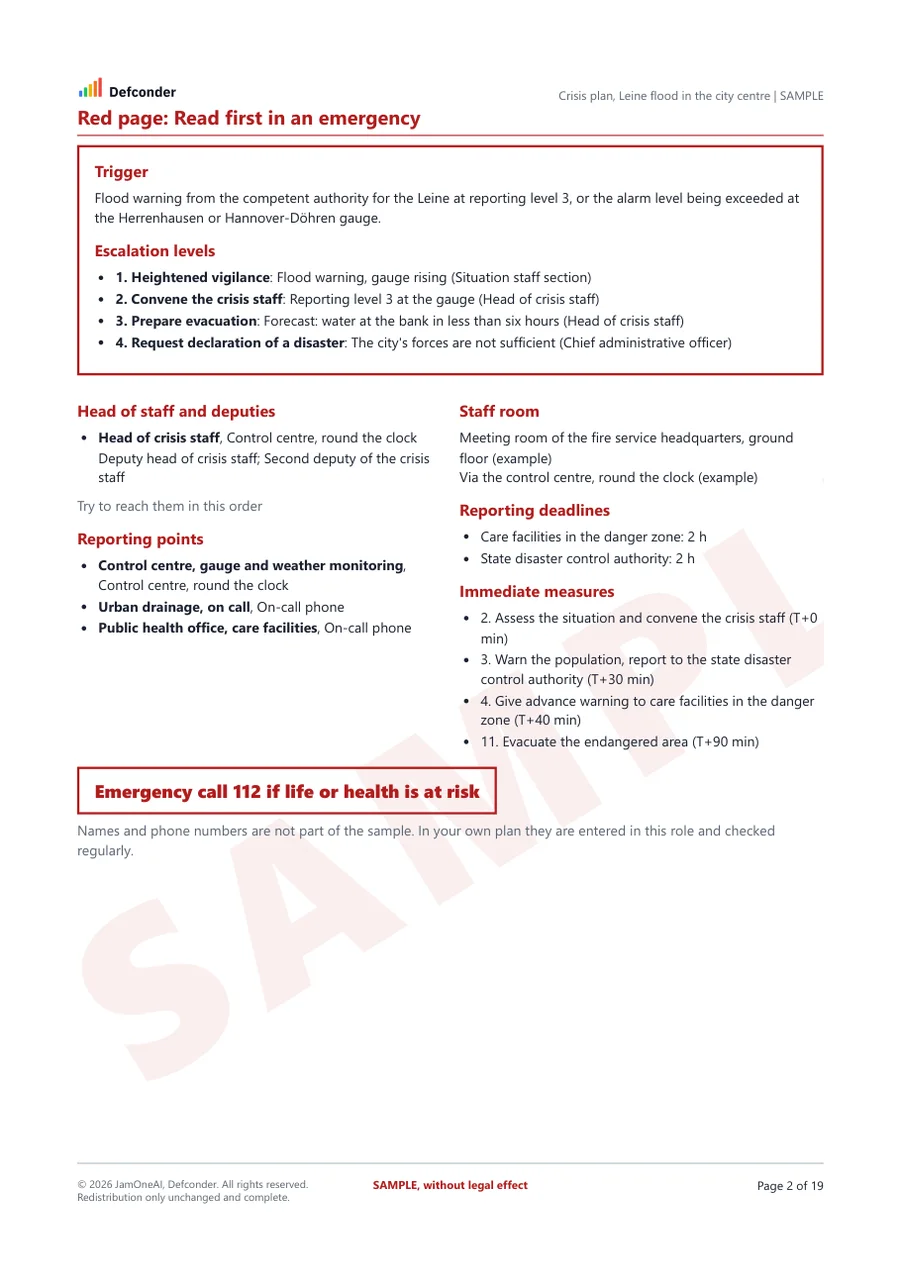
The document begins with a red page for an emergency: trigger, escalation levels, head of staff with deputies, reporting points, reporting deadlines, immediate measures and the emergency call. Then follow document control with change history and approval, terms, escalation and alerting, immediate measures, command organisation with a chart, situation map, measures by phase, timeline, emergency power supply, resources, communication matrix, impact analysis, reporting duties, de-escalation, check result and the proof from the verification chain.
Defconder
The reading document is generated from the plan state, the designed sample version with red page as PDF.
After an operation or an exercise the final report compares what was planned with what the operations log records: start and duration per measure, deviation in minutes, decisions and findings with responsible person and target date.
Defconder
Final report: planned and actual per measure from the operations log of an exercise (example data).
The plan coach: 29 fixed rules without AI
The coach checks against fixed, traceable rules. It does not guess and invents nothing, it shows gaps and points to the place in the plan.
Completeness
Profile, all phases covered, mandatory details, approval, document data.
Responsibility
Deputy for roles and measures, availability, double booking of persons, staff groups, sections, head of staff with at least two deputies, log keeping.
Time and dependency
Prerequisites and circular references, reporting deadlines, recovery against tolerable downtime and bridging, lead time against warning lead time.
Resources and routes
Overbooking, warning route for evacuations, fallback channel without IT, location reference.
Alerting and staff
Immediate measures, reporting points with guiding questions, staff room, powers, rhythm of briefings, de-escalation.
Emergency power, exercise, follow-up
Run time against guideline or secured delivery, documented exercise within the review interval, open findings with a responsible person and target date.
What the crisis plan is oriented along
The structure follows building blocks from public documents. Terra makes no claim of conformity with them and does not replace planning required by law. Whether a plan fits the requirements of the competent authority is for that authority to decide.
Source
What Terra takes from it
BSI Standard 200-4 Business Continuity Management and document template emergency manual, Federal Office for Information Security (Germany)
Document properties, terms disruption, emergency and crisis, immediate measures, reporting points with guiding questions, alerting and escalation, structure of the staff, de-escalation, review, tolerable downtime and recovery time
DV 100 Command and control in operations (Germany)
Sections S1 to S6, command process, order scheme unit, task, means, goal, route, operations log and final report
Orientation guide In 5 steps to the flood alarm and operations plan, State of Baden-Württemberg
Alarm plan and operations plan, activation by thresholds, warning lead time against lead time of measures, measures with responsible persons
Sample emergency plan power failure, Regierungspräsidium Karlsruhe, 2014
Survey form for emergency power per site, fuel management, alerting during power failure, emergency call points and care points
Emergency power supply in companies and authorities, volume 13, and Fuel supply during power failure, volume 18, Federal Office of Civil Protection and Disaster Assistance
Guideline of 72 hours of emergency operation without refuelling
Taktische Zeichen im Bevölkerungsschutz, recommendations for introducing FwDV 102/DV 102, Federal Office of Civil Protection and Disaster Assistance, May 2024
The symbols F.3.6 assembly point, F.3.8 staging area, F.3.13 care point and F.3.17 emergency information point, redrawn with source
Terra does not say compliant, according to standard, certified or checked. State law has not been checked, for example who declares a disaster. No check by a civil protection authority or a business continuity management consultancy has taken place.
Emergency power and fuel: survey, calculation, import
What happens when a substation fails, the gas stays away or the petrol stations run empty? Terra computes it as an exercise scenario, from the first outage to the consequence in the plan. Real operator data can be attached as a file, further formats are in progress.
The survey form records per site whether a stationary generator exists, how much fuel is in the tank and how much the generator uses per hour, whether an external feed-in is prepared and who delivers fuel during a power failure. Terra divides tank content by consumption and warns when the run time is below 72 hours and delivery is not secured. The Federal Office of Civil Protection and Disaster Assistance recommends emergency operation for at least 72 hours without refuelling.
Existing surveys can be imported as CSV. Equal sites are updated, and on an error nothing is imported. Interventions in the energy supply are a matter for the grid operators, Terra plans one's own ability to act and not grid operation.
Defconder
Emergency power per site with calculated run time and import of the survey form as CSV.
Why the plan should live where you can still reach it in an emergency
Four decisions that Terra makes differently from a plan in a web service: location, method, proof and calculation.
Reachable without network and without a provider
A plan for a power failure that only lives with a provider on the network can only be reached in an emergency if power, network and provider are running. Terra runs on your own infrastructure with emergency power and needs no internet. As a fallback it produces the red page and the document to print.
Check instead of guess
Terra deliberately uses no language model for the crisis plan. A pre-filled plan can be plausible and wrong, for example with a wrong deadline or a resource that does not exist, and under time pressure pre-filled content is easily waved through. Terra drafts only from a calculated situation and checks the plan against 29 fixed rules. Every finding names the place.
Changes are visible
Every change is recorded as an event in a hash chain. If an earlier event is changed, the chain breaks. Someone with access to all data could recalculate the chain. That is why the document names the head of the chain, and it should be recorded in a second place.
Calculated instead of drawn
Flood, fire spread, pollutant plume, weather effects and supply outage are calculated, with named assumptions and checks against independent sources. The calculation cores run in the browser or on your server. The draft for the plan follows from the calculated situation.
View and download the sample
A complete example plan as PDF, produced by Terra. All details are fictitious, no real persons, phone numbers or responsibilities appear.
Sample to view
What a crisis plan from Terra looks like
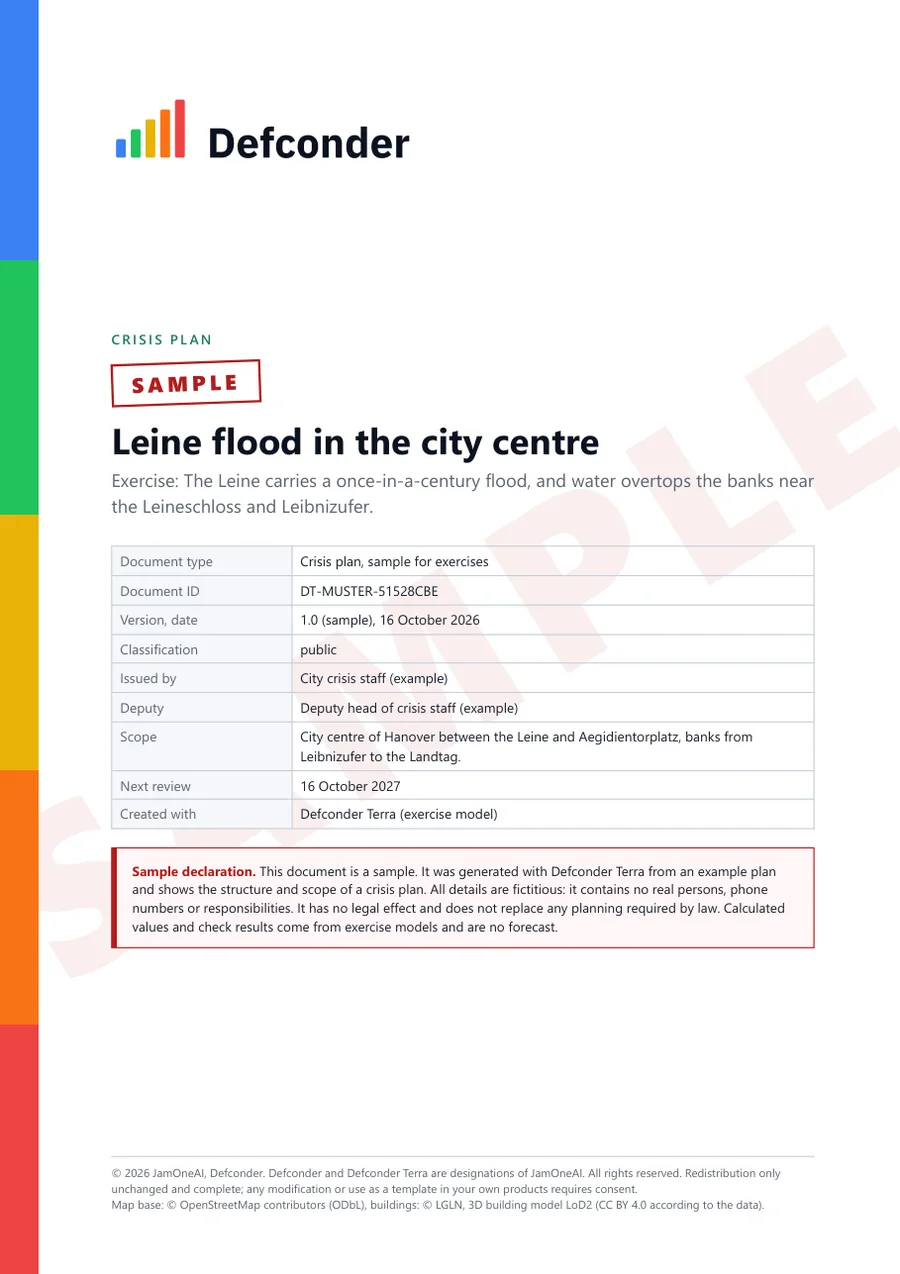
A complete example plan as a 19-page PDF: red page for an emergency, document control, terms, escalation and alerting with reporting points, immediate measures, command organisation with a staff chart, situation map with tactical symbols, measures, timeline, emergency power supply, impact analysis, de-escalation, plan coach check and proof from the verification chain. Structured along the building blocks common in alarm and crisis plans, without any claim of conformity with a specific standard. Generated by Terra, not typeset by hand.
Alarm and operations plans for floods, power failure and other situations, with staff, reporting routes and situation map.
Operators of critical facilities
Emergency planning with impact analysis, emergency power per site, reporting duties and proof for audits.
Authorities and companies with a crisis staff
Staff with sections, rules of procedure, operations log and final report.
Those who exercise
Scenarios can be played, exercises and findings are documented and feed into the check.
Limits: what Terra cannot do today
An honest list so that you know before a pilot what is missing.
Reporting duties: tailored to your organisation
Defconder is not off-the-shelf software. Terra keeps reporting duties with recipient, deadline and legal basis, and we work out the variants for your sector and your organisation together with you and deliver them with Defconder. The building blocks for this are close to completion.
In progress: tolerable data loss
The impact analysis knows tolerable downtime, recovery and bridging. Tolerable data loss (RPO) is in progress and close to completion.
No draft by a language model
The draft is made from the calculated situation and fixed templates, not from a text model. Responsible persons, means and success criterion stay open for people.
No certification, no security test
There is no information security certificate and no test by third parties, nor a check by an authority.
No hosting
Terra is operated on your infrastructure. Operation as a service is not part of the offer.
One pilot area
The data exists for Hanover city centre. Further areas need official data and clarification of their terms of use.
Models are simplified
Flood, fire, pollutant dispersion and supply outage are exercise models with named assumptions and no forecast.
No legal advice
The plan is a working basis. Legal bases depend on the law of the state. Real grid data is only integrated with the consent of the operators.
Planning a pilot with a real use case? We are happy to show Terra on your area.
A hospital package that consists only of configuration. Scenario with exercise data.
Wards, beds, emergency power, devices and supplies in one picture
The hospital information system reports via HL7 and FHIR, every message stays provable as a raw message
Patient data carries a classification level
Hospital
The crisis team sees what the ward knows.
A domain pack for hospitals that consists of configuration only: wards and beds, emergency power and fuel, life-support equipment, supplies, ambulances, triage and IT systems as objects with relations and rules. The hospital information system reports over HL7 v2 and FHIR, every message stays provable as a raw message, and the record in the situation picture is updated instead of duplicated.
The video loads only when you start it and consent in the window that follows. Before that, no data is sent to YouTube (youtube-nocookie.com). Details are in the privacy policy.
Defconder
The Crisis team hospital application in the exercise scenario of the fictitious Klinikum Beispielstadt: a district power outage and a mass casualty incident. All names and data are invented. The interface of the product is German.
Defconder
Generator in the exercise scenario: remaining runtime follows from fill level, reserve and load, the buffer until delivery stands next to it. Thresholds and delivery time are placeholders. All data is invented. The interface is in German.
Defconder
The stream of admission, transfer and discharge messages. Every HL7 message sits unchanged in the stream, its proof value is in the main log, and the marker shows which one became a record of the situation picture. The interface of the product is German.
0object types in the domain pack, plus 8 relation types and 7 actions with rules
0automated checks on the domain pack and the interfaces, all passed
0standards for connecting the hospital information system: HL7 v2 over MLLP and FHIR R4
HL7 v2 with acknowledgement
Admission, transfer and discharge messages (ADT) arrive over a persistent connection with MLLP framing. Defconder acknowledges every message (AA), explicitly rejects unreadable ones (AR) and only accepts from registered sender addresses.
FHIR R4
Bundles and single resources are accepted by webhook and split up. Every resource becomes an entry, fields such as id, status or subject.reference are available for mapping.
Update instead of duplicate
If the hospital system reports the same patient repeatedly, a key attribute selects the existing record and it is adjusted. An identical message changes nothing and creates no event. Fields that are not reported, such as the triage category, are kept.
Provenance you can verify
The raw message sits in the stream, its Merkle proof value in the chained main log. Every record points to the stream and entry it came from.
Patient data with a level
The patient type is held as restricted (VS-NfD) and as a special data category. An account with a lower clearance sees neither the records nor the messages behind them.
Remaining runtime and thresholds
From tank size, fill level, unusable reserve and the generator load, the action Check remaining runtime calculates the hours until empty, compares them with the delivery time and sets a warning level: normal, inform staff or check load shedding. If the tank will not last until delivery, the level rises even when the thresholds are not yet reached. Thresholds, reserve and delivery time can be set per house, the example values (6 and 3 hours) are placeholders. Trigger resupply and Decide load shedding record the decision but switch nothing off. Without consumption there is no remaining runtime and the action refuses. The calculation lives in a building block that any installation can apply to any object type, with no hospital pack needed, for example a tank, a water reserve or an oxygen store.
Emergency operation as a rule
If the hospital information system fails, the action IT emergency operation declares it and notes paper documentation on every ward it supports. On a system that is not disrupted the rule refuses.
Status and limits
Exercise scenario with invented data. No operation with real patient data, not approved, not legally reviewed.
HL7 v2 and FHIR are checked against example messages according to the standard, not against a real hospital information system. Before any use, a test against the vendor's test environment comes first.
Terms, triage categories and procedures are reasoned assumptions. They are aligned with disaster protection officers and crisis teams before anything runs productively.
Not built: outward bed reporting, connection to building automation (BACnet, OPC UA) and to dispatch systems with a proprietary format.
As of 22 October 2026. Demonstrated in a conversation, by video call or on site.
At a glance
Ready-made capabilities you place on your objects without programming.
See beforehand what will be created, then install
Across sectors, the stock keeps growing
Everything stays with you
Building blocks
One capability. Any object type.
Defconder does not grow through consulting projects but through building blocks: ready-made capabilities that you apply to your objects without programming. You pick the block, see up front what it creates, and apply it. The blocks work across industries, and the range keeps growing.
No programming
Pick a block, pick an object type, check the preview, apply. Existing attributes and records stay unchanged.
Any industry
The same capability fits an emergency generator, a fuel tank, a water reserve or an oxygen store, in a hospital, a utility or an authority. No change of domain pack is needed.
Provable
Every application is logged with block, release and target. What a block does can be read from the rules of its actions.
Stays with you
Which blocks you get depends on your delivery. There is no call home to the vendor. In your house you switch blocks on and off yourself.
Keeps growing
We extend the range continuously and across industries. New blocks arrive with the delivery, without you having to rebuild your domain model.
Check before acting
Actions of a block refuse when details are missing. Decisions with consequences require a release.
Defconder
The building blocks area in the interface. Every block states what it can do, what it creates and where its limits are. The interface is in German.
Stock and remaining runtime
How long will the stock last, and will it last until delivery? The block calculates the remaining runtime from fill level, capacity, unusable reserve and load, compares it with the delivery time and sets a warning level. One action triggers the resupply, a second records the decision on measures and requires a release.
Consumption follows the load between idle and full load
The warning level rises as soon as the stock will not last until delivery
Each check shows the change since the previous one, and a notification can be set for a raised warning level
Each house sets its own thresholds, reserve and delivery time, the block switches nothing off
Example with invented exercise data: a 600-litre tank filled to 56.6 percent, 10 percent reserve unusable, load 85 percent at 30 to 160 litres per hour, delivery time 4 hours. Result: 2.0 hours of remaining runtime, 2 hours short of delivery, warning level check load shedding.
Connections: plant technology and warnings
The block unlocks templates with which you read plant technology devices and take in warning messages. Every connection carries its origin: the device a value comes from, or the licence of the source.
Modbus TCP for generators, meters and gauges, read access only
CAP warning messages from a feed, with severity, urgency and area
Without origin or licence Defconder does not create a connection
Tested so far against a simulator and sample data, not yet on your device. Before operation we test together with you.
Defconder
The building block Stock and remaining runtime in version 2.0: inputs such as reserve, load and delivery time, calculated values such as usable amount, remaining runtime and buffer until delivery. The interface is in German.
Defconder
The Modbus TCP template in the form for new connections. The register map is in your device manual and is entered by you, Defconder does not guess it.
What building blocks do not do
They do not control plants. Modbus is only read, measures are only recorded.
Thresholds, reserve, delivery time and a device's register map are yours to bring, they are not predefined.
The calculation assumes the current load stays constant, with consumption linear between idle and full load. If the load rises, it has to be updated.
Several devices are looked at one by one, not added up into a combined group.
Connections have not yet been tried on a real device. Further plant technology protocols are not included yet.
From event to approved action, checked and with evidence.
Triggers, data, checks, approvals and actions on one canvas
Checked before the start, exportable as a run record afterwards
Replay from a saved checkpoint
Workflows
From event to approved action. Verifiable.
The Workflow Studio connects triggers, data, checks, approvals and actions on one canvas. This release adds exportable run receipts, retry from a saved checkpoint, a deterministic CLI runner, resource lineage and model lifecycle status.
What is the Workflow Studio in Defconder?
The Workflow Studio is a visual editor for versioned workflows. Before publication, Defconder analyses the graph for loops, missing details and paths to actions that require approval without an approval. Completed runs can be exported as run receipts and checked independently. Failed runs can be retried from a saved input checkpoint. A deterministic CLI runner, resource lineage and locally maintained model lifecycle statuses complete the tools.
Checked before starting
Graph analysis detects loops, missing details and reachable actions without required approval. The current checks also cover paths from AI nodes to actions.
Export and verify run receipts
A completed run contains a hash chain. Its JSON file can be exported and recomputed independently; changes to steps are detected.
Retry from a checkpoint
A failed run can be restarted from a saved, classified input checkpoint. The retry is recorded as a new run.
Deterministic CLI runner
The local runner executes workflow files with supplied host functions. The tested example produces the same receipt as the workflow core.
Resource lineage
Lineage shows stored object types, actions, event types, data streams, vector indexes, sub-workflows and selected models for each workflow.
Model status at a glance
Models can be maintained locally as experimental, active, deprecated or replaced. Status is not automatically synchronised with a model provider.
Building blocks for the whole workflow
Triggers from an event, a threshold, a schedule, a data stream or by hand. Plus data queries, conditions, loops over reports, parallel paths, waiting, merging, similarity search, AI classification and summaries, approval, action and notification.
A tidy editor
The step catalogue on the left collapses by category and is searchable. Context menus on canvas and nodes, a compact action bar, undo and redo, and import and export keep the way to a workflow short.
Publish with a second person
A published version stays immutable. On request, a second person must confirm the publication. Any change results in a new version.
Test cases and simulation
A dry run plays a workflow through with sample data without sending notifications or triggering actions. Stored test cases and a simulation with several events check the expected behaviour.
Compare and roll back versions
Two versions can be compared side by side. A rollback plan shows in advance what changes. Rolling back creates a new draft and leaves the old version untouched.
Approval inbox, history and metrics
Pending approvals are collected in one inbox. The history can be filtered, every step of a run can be inspected, and the approver's decision is recorded. Metrics show how often workflows were started, how they ended and which versions are in use. They are based on the recorded runs of the local instance.
Defconder
The large 15-node exercise workflow. The left section shows triggers, data, checks and the first branches. All example data is invented.
Defconder
The right section follows the paths through search and a join to approval and completion. The green bar shows the graph check result.
Exercise: warning level to resupply
An invented emergency generator reaches a warning level. The workflow notifies staff, waits for approval and then records the action.
An action requiring approval stays pending until approval
The approving person is recorded in the run
The dry run shows steps without effects
All data is invented exercise data.
Exercise: check and approve a report
An invented report is classified. The draft shown contains deliberate errors so the check can reveal missing approval paths.
Errors are shown at the affected node
The graph can be viewed as a branching workflow
A locally maintained model status appears in lineage
All reports and names are invented for the demo.
Defconder
The faulty exercise draft is not approved. All three findings identify a path to the action without an approval node.
Defconder
The step catalogue arranges 32 building blocks in six categories. Search and collapsible groups keep large workflows manageable.
Defconder
An expanded category shows its building blocks, here the seven blocks for data. The other groups stay collapsed.
Defconder
The action bar is compact: save, undo, check, dry run and publish sit in one row, less frequent tools in the More menu.
Defconder
Right-click a node: open properties, copy, duplicate or delete. The properties appear in the side panel on the right.
Defconder
Right-click the canvas: paste, auto-arrange, fit view, create presentation images, and import or export workflows.
Defconder
The same tools are available in the More menu of the header. Undo and redo sit next to it.
Defconder
The properties show the selected node name, assigned action and error strategy.
Defconder
The dry run marks notification and action as simulated. Internal example identifiers are anonymised in the capture.
Defconder
The run visibly waits for approval. Its recorded steps remain available for inspection.
Defconder
The receipt was exported and independently verified. Person identifiers are anonymised in the capture.
Defconder
Lineage links stored resources to workflows and nodes. The local model catalogue is empty in this example.
What this release demonstrates
The scenarios and data shown are invented exercises from a local test instance, not a field deployment.
Run and package checks were executed against the local test server in this session; this does not constitute independent security certification.
Model lifecycle is locally maintained metadata. Automatic provider synchronisation and bulk migration are not included.
Some registered nodes need host adapters that are not connected in this installation.
Workflows do not control installations. Approval and effects depend on the connected actions.
All names and data in the workflows shown are invented exercise data. Person identifiers are anonymised in the screenshots.
At a glance
Changes to the model first as a draft, then approved by two people.
The main state is locked against direct changes
Field-by-field comparison, conflicts are detected
Whoever requests the merge may not approve it
Version spaces
Plan changes, compare them and release them with a second person.
Version spaces secure the live state of Defconder as the main state. Changes are made in separate branches, compared field by field, and only go into operations after a second person approves them. Everything stays local on your own Defconder server.
What are version spaces in Defconder?
Version spaces are a local version control for the model: domain packs, object types, relations, actions, layouts, analyses and workflow drafts. The main state is locked against direct changes. Changes go through branches with commits, comparison, restore and tags. One person requests adoption into the main state and a second person approves it. Two changes to the same field are detected as a conflict. States can be handed on as a package with checksums.
Defconder
The Version spaces building block. The live state is secured as the main state. All names and data are invented exercise data. The product interface is German.
Defconder
A branch of its own is created for the exercise, separate from operations. Direct changes to the main state are locked.
Main state locked
The live state is locked against direct changes. Changes only arrive through checked merges.
Isolated branches
Drafts and exercises run in branches of their own. Operations stay untouched until a change is approved.
Commits with a reason
Every secured state carries a message, the author and the time. The history lives in the chained event log.
Comparison field by field
For every changed resource the comparison shows the fields with old and new value before anything is adopted.
Restore and mark
An earlier state can be restored in a branch. This creates a new commit, nothing is deleted. Tags mark verified states.
Adoption by two people
Whoever requests adoption may not approve it. A second authorised person decides, and the approval is in the log.
Conflicts are detected
The three-way comparison checks base, branch and main. If two branches change the same field, nothing is silently overwritten.
No secrets in the history
Passwords and credentials are rejected in version objects. Only a reference to the secret is stored.
Packages with checksums
A state can be exported as a package and imported at another site as its own, separate branch. The checksums protect integrity.
Eight rights of their own
View, secure, create branches, request adoption, approve adoption, restore, export and import are separate rights in role management.
Case: The hospital practises a power failure
An emergency generator is to be described anew, and ongoing operations must not be disturbed.
The main state is secured, the exercise runs in the branch notstrom-uebung
The generator is renamed and the tank content added, a password in the model is rejected
A wrong name is rolled back, the verified state gets a tag
One person requests adoption, self-approval is rejected, a second person approves
All names, data and persons are invented. The case is an exercise and not a domain rule for a hospital.
Case: Two changes to the same field, one state for a partner site
While the branch is running, someone changes the same field differently in a variant. And a partner site needs the same state.
Adopting the variant is detected as a conflict and not overwritten
The branch has to be adjusted and secured again
A commit is exported as a package with checksums
The partner site imports it as its own, separate branch, never directly into operations
The conflict is detected in the three-way comparison. The message in the interface names the number of conflicts.
Defconder
A password in the model is rejected: secrets must not be written into version objects. A reference is used instead.
Defconder
The comparison shows every changed field with old and new value: the new name and the added attribute.
Defconder
Restoring creates a new commit that carries the name of the restored state. Nothing is deleted.
Defconder
Self-approval is rejected: the person who requested the merge may not approve it themselves.
Defconder
A second person approves. The merge appears in the history of the main state, with their name.
Defconder
A variant changes the same field differently. The three-way comparison detects the conflict, adoption is not carried out.
Defconder
An exported package is imported as its own branch, here under the invented name Import-Klinik-Nord.
What this view shows and what it does not
The scenarios and data shown are invented exercises from a local test instance, not a field deployment.
Version spaces store locally on the Defconder server. There is no Git remote connection.
Checksums prove the integrity of a package, not the identity of the sender.
Workflow drafts are adopted as drafts. Checking, publishing and activating stay in the Workflows module.
Live data, detected secrets, provider credentials and external no-fly zones are not versioned.
Branches and tags cannot currently be deleted or archived, and the packages are not signed.
All names and data are invented exercise data. The user names in the captures are test accounts.
At a glance
Read in, link and match large datasets without anything being guessed.
Millions of entries, each with a check value
Person matching blocks instead of merging strangers
Purpose limitation and multi-person approval modelled on judicial authorisation
Large data volumes
Millions of records, every match traceable.
Defconder ingests large datasets, links them into a graph, matches persons without merging strangers, places addresses on the map and searches by meaning instead of keywords. Everything runs on your own server, every entry carries a proof value, and whatever a human has to decide is blocked instead of guessed.
The video loads only when you start it and consent in the window that follows. Before that, no data is sent to YouTube (youtube-nocookie.com). Details are in the privacy policy.
Defconder
The graph over millions of entries: nodes with icons, tooltips on hover, shortest path between two persons. Every edge names the stream and entry it came from. Exercise data. The interface of the product is German.
Defconder
Person matching: from fifteen points and three independent pieces of evidence a pair is merged automatically. Twin risk, a conflicting date of birth or a common name block the pair until two people have decided. The interface of the product is German.
Defconder
Geocoding without internet from open map data. The result states its precision (house number, street, postcode, town). Ambiguous addresses deliberately get no coordinate. The interface of the product is German.
Defconder
SQL over the data lake with a chart: dispatches per hour of the day from 43,743 exercise messages. Every query is read-only and recorded in the main log. The interface of the product is German.
Defconder
Semantic search over 5,000 situation reports; the meaning map shows which reports are close in content. The language model runs locally, nothing leaves the server. The interface of the product is German.
Defconder
Blind graph: investigators see connections under pseudonyms. Real names are unmasked for a limited time only with an uploaded order and the signatures of at least two custodians. The interface of the product is German.
0million rows (3.9 GB) ingested in 505 seconds on a single machine
0million edges between 11 million nodes built into a graph in 306 seconds
0false automatic merges across 3.6 million person records with known ground truth
0milliseconds for 10,000 address lookups, offline
Streaming instead of memory limits
Files of any size (CSV, NDJSON, Parquet, whole folders) are read in chunks. Each chunk gets a Merkle root in the chained main log, each row its own proof value.
Connect databases
PostgreSQL, SQL Server, Oracle, MySQL, MariaDB and SQLite are queried as sources. Credentials sit in the vault, queries are read-only, time offset and resume are part of the configuration.
Graph with provenance
Link rules define which fields become nodes and edges. Path search, neighbourhood and filters run over the data lake. Anyone who may not see a stream does not see the edges attached to it.
Matching that blocks
Phonetic pre-selection, a points system and independent evidence. When there is risk, the software does not decide: the pair stays blocked until two people have assessed it. Every decision is an event in the log.
Geocoding open and offline
An address index from OpenStreetMap data is built in seconds and works without a network. Optionally a chain queries Nominatim or Photon, bound to the stream classification, without writing addresses to the usage log.
Local semantic search
Embedding uses a local model. Exact search over a million vectors takes under a second, an approximate index makes it up to thirteen times faster. Plus a three-dimensional map of meanings.
DuckDB analysis in the browser
Group, count, time series: SQL directly on the stream, with bar, line and area charts, column profile and CSV export. After 60 seconds a query is aborted.
Judicial approval built in
In the blind graph real names stay encrypted. Unmasking needs the order as a file and approvals under the multi-person rule. The key is held in memory only for the duration of the approval.
Purpose limitation
Roles and clearance levels apply all the way into the graph. Queries and unmaskings are events with time, person and purpose, so it can be proven later who saw what and when.
Who has access to your data?
Defconder runs on your infrastructure: no cloud, no account at the vendor, no remote access.
With platforms from US vendors, the vendor can be compelled under the US CLOUD Act to hand over data it controls or has access to, even when the servers are in Europe.
Put this question to every vendor, us included: who besides you can access the data, who can switch the system off, and where is that in writing?
This is not legal advice. Whether and how it applies to your procurement is for your legal department.
Status and limits
All measurements come from a single machine with exercise and random data. No statement about clusters or many concurrent users.
At one million vectors the approximate index reaches 87 to 97 percent of the exact hits depending on the setting. Anyone who needs all hits uses the exact search.
The quality of semantic search depends on the language model. German needs a multilingual model; small English models give weak results.
Oracle is verified by unit tests only, MySQL only through MariaDB with the same interface. PostgreSQL, SQL Server, MariaDB and SQLite are tested against running instances or files.
Judicial approval protects real names in the blind graph. Anyone with administrator access to the server and raw streams sees the raw data. Threshold decryption and hardware help against that, software alone does not. Both are planned stages, not promises.
Not legally reviewed. Use with real personal data requires a legal basis and a data protection impact assessment.
Status 22 October 2026. Demonstration in conversation, by video call or on site.
At a glance
Questions to the case in full sentences, every answer with source and check value. Status: built and proven in test.
Defconder runs the query itself, the model only explains
Every statement with a verbatim quote, otherwise marked as not proven
Only your view, only local models, proof you can recompute
Case questions
Ask the case. Every answer with proof.
Ask a question in full sentences. A local model turns it into a query, Defconder runs that query itself and shows how. Every statement names its source with a verbatim quote. Whatever cannot be proven is marked as not proven.
What are case questions in Defconder?
Case questions are questions in plain language put to a case or to the data you are allowed to see. A local model turns the question into a query, and Defconder checks and runs it itself. The result comes from the data, not from the model. Statements by the model count as proven only if the quote appears verbatim in the named source. Every answer carries a check value and can be recomputed without Defconder. Status: built and proven in test, with invented data.
Defconder
A question in full sentences, below it the query Defconder ran and the result. All data is invented. The interface is in German.
The system computes, the model explains
The number, the list and the groups come from a query that Defconder runs itself. You see the query as text. If the model fails, the result stays.
Every statement with source and quote
The model may only say what it can prove verbatim. If a quote or a number does not match, the statement is shown as not proven and cannot be confirmed.
Only what you may see
Case questions use the same view by clearance level as the rest of the system. What your account may not see enters neither the query nor the answer.
Local models only
Only models you have approved on your own infrastructure run, never cloud models. The operator lock of the AI layer applies here too.
Links only after an objection
If the model proposes a connection, a second agent first writes the strongest argument against it. Only after you have read it does Defconder record the link.
Proof you can recompute
Every answer gets a check value in the log. The proof recomputes sources, quotes and query, and an independent tool checks the extract without Defconder.
Defconder
Two statements by the model, each with quote and source. If proof is missing it says not proven, and the statement cannot be confirmed. The interface is in German.
Defconder
The proof recomputes check value, sources, quotes and query and says whether the answer holds.
Measured
In a test on the invented Hafenmarkt case with 2400 offences, two local models and five questions each: eight answered correctly, two rejected by the system, no wrong answer shown. A small sample, no promise for your data.
What this release proves
The cases and data shown are invented and come from a local test instance, not from practical use.
Quality depends on the model. Defconder checks query, quotes and numbers, not every error of reasoning. A quote that does not support the statement must be read by a person.
On machines without a graphics card an answer with a model takes minutes. The query alone is much faster.
The proof confirms computation and consistency. It does not prove that the source data is correct or complete.
Not yet included: media findings and files as a source of an answer.
Status: built and proven in test. On machines without a graphics card an answer with a model takes minutes. All information without guarantee, all sample data invented.
At a glance
Where does a process really stall? Process map, variants and bottlenecks from your own log, local, with a check value. Status: built and proven in test.
Paths, times and handovers from the real cases
Cases pseudonymised, small groups suppressed, off by default
A metric proof that an independent tool recomputes
Process analysis
Where does a process really stall? Recompute it on your own log.
Process analysis reads events from your own log, from approved workflows or from imported files and shows how cases actually run: paths, times, bottlenecks at handovers. Everything runs locally and encrypted, cases appear pseudonymised, small groups stay hidden, and every result carries a check value.
What is process analysis in Defconder?
Process analysis is a process-mining building block for your own event log and for imported event data (CSV, XES, OCEL, Parquet). It shows the process map, variants, throughput times and handovers between roles. It is off by default, runs locally in limited worker processes, pseudonymises cases and suppresses groups below the minimum size. Every result has a check value, and an independent tool recomputes the metric proof without Defconder. Status: built and proven in test, with invented data.
The video loads only when you start it and consent in the window that follows. Before that, no data is sent to YouTube (youtube-nocookie.com). Details are in the privacy policy. German narration with English subtitles.
Defconder
The process map from 400 invented emergency cases: case count and mean time at every transition. The interface is in German.
Process map from the real cases
How often does it go from step to step, and how long does that take on average? The map is built from the events, not from a wish model.
Variants without singling anyone out
The most common paths with case counts. Groups below the minimum size (five by default) are never shown.
Figures with limits
Throughput time, median, rework loops. What cannot be computed is shown as not available instead of being estimated.
Bottlenecks at the handovers
Waiting time between roles with frequency. A finding can be turned into a measure with an owner, a deadline and a metric.
Local, encrypted, off until released
Imported sources are stored encrypted, cases pseudonymised. Process analysis only runs once an administrator switches it on.
Check value and independent proof
Every result carries a check value. The metric proof can be downloaded, and a separate verifier recomputes it without Defconder.
Seventeen kinds of analysis in one view
From the process map to the what-if simulation: the analyses run as limited jobs in their own processes, can be filtered, saved as a view and issued as a printable report with a check value, in German and English.
Understand
Process map with frequency and time
Variants and variant comparison of two periods
Compare case groups by exact attributes
Object relations according to OCEL 2.0
Measure
Performance: throughput time, median, target time
Role handovers with waiting time
Data quality: times, duplicates, order
Outlier check with an explained threshold
Discover
Heuristic discovery from the events
Inductive discovery with a declared fallback model
Export as BPMN 2.0, PNML or model JSON
Check against the target
Target-actual comparison with target models from the workflow studio or from BPMN and PNML import
Cause analysis with a limited decision tree, correlations instead of proof
Look ahead
Prediction of the next activity and remaining time, trained locally and checked on later cases
Event simulation for what-if on arrivals and resources
Act and prove
Turn a finding into a measure with an owner, a deadline and a metric
Saved views and filters
Check-value report and independent metric proof
What process analysis has to do, and what Defconder adds
Process mining is an established method. Whoever uses it expects a process map, variants, target-actual comparison, causes, prediction and simulation. All of that is built into Defconder. On top comes what makes the difference with data about people and critical processes.
What you expect, and it is there
Process map, variants and variant comparison from the real event log
Object-centric analysis according to OCEL 2.0
Target-actual comparison against BPMN and PNML models, deviation report, rule check
Cause analysis, prediction of remaining time and next activity, what-if simulation
Import of CSV, XES, OCEL and Parquet
Reports, saved views, measures with a deadline and a metric
What Defconder adds
Runs on your own infrastructure, encrypted, no cloud
Cases pseudonymised, groups below the minimum size are never shown
Off until an administrator releases it, every source with classification and rights
Every result with a check value, an independent tool recomputes the proof without Defconder
Every analysis and every measure is in the chained log
What cannot be computed shows as not available instead of being estimated
Defconder
Performance: 400 cases, 116.8 minutes on average, median 85 minutes. What cannot be computed shows as not available.
Defconder
Handovers between roles with mean waiting time. A finding becomes a measure with a deadline and a metric.
Defconder
Cause analysis: which attributes go along with long throughput times? The view shows correlations, not proof of causation. On the left the seventeen analysis types, on the right result check value and proof. The interface is in German.
Defconder
What-if simulation: more resources and different arrivals compared with the baseline. The baseline values are explicitly hypothetical, the computation is reproducible with a fixed seed.
Measured
The module tests of process analysis reported 374 passed checks in the run of 31 October 2026, the server proof group and the independent verifier passed. Of 38 defined functions, 34 are complete in code and proven, four partly. In the browser, 15 re-checked acceptance scripts passed on 31 October 2026, including the deviation report, cause analysis, rule check and the widgets in the personal dashboard.
What this output proves
The data shown is invented and comes from a local test instance, not from practical use.
The proof confirms computation and consistency, not the origin or completeness of the source data.
Browser acceptance is not tracked per function: 15 scripts were re-checked on 31 October 2026, the rest rely on the module tests.
Imports through the browser are limited to 8 MiB. On the server, Parquet and XES are designed for up to 10 million events, one measurement is not proof for every metric.
Message delivery and recipients from Comms are not present in the log as analysable events.
Status: built and proven in test. All sample data invented, all statements without warranty.
Defconder Orbit
What happens in orbit reaches the ground.
Satellites and debris are continuously recomputed from public orbital data, not just displayed. When an object with elevated decay or collision risk approaches one of your sites, an event is created in your log automatically.
Tracking in progress
Real orbital mechanics
SGP4 propagation from public two-line elements (CelesTrak), refreshed every few hours.
Automatic alerting
When an elevated-risk object comes close to one of your sites, the event is created on its own, with distance and timestamp.
Wired into the ontology
An alert can create a record in your own model directly. The same actions, the same clearance levels as everywhere else in the system.
Two views
A classic map or a mouse-driven 3D globe for the same live data, switchable at any time.
Fully logged
Every data fetch, successful or not, is recorded as its own event in the same hash chain as any other change.
Configurable, no code
Which object groups are tracked, the alert radius and the target entity type for alert records live in the settings.
Use cases
Where an orbital picture makes an immediate difference
Same tracking, same alert mechanism, used differently depending on site and clearance level.
Police
Register a guarded facility, a court, or a large event as a site. An overflight alert shows up as an event in the same operational picture as wanted persons and patrols, not in a separate system.
Intelligence
Reentries and unusual approaches of foreign objects as an additional source alongside classic reconnaissance, under the same clearance-level logic as any other record.
Attack protection
Set an alert radius around a venue for the duration of a large event. If an object with decay risk enters that radius, a verified event is created automatically for the incident commander.
Armed forces
Space situational awareness alongside contacts, sensors, and units in the same map under APP-6. Collision risk to your own sites and reentries of foreign objects in the same picture as reconnaissance.
Civil protection
Debris with decay risk over populated areas is detected early and flows to the incident commander as an event, the same way water-level sensors already do today via the Sensor Bridge.
Every tracked object at a glance
Each point is a real, currently propagated object. Colour shows the risk tier, computed from the most recently known orbital altitude.
Colour-coded by risk tier
Alerts with distance and timestamp in the sidebar
Switchable to the 3D view
Defconder
All images show fictitious exercise data. Map data: OpenStreetMap contributors.
Defconder ASDA
What approaches your site, you see first.
Aircraft are continuously recomputed from public ADS-B data, not just displayed. When an aircraft drops below the configured safety distance to one of your protected sites, a mathematically verified event is created in your log automatically, a real distance calculation, not an estimate.
Airspace under watch
Real air traffic
Live positions from the open ADS-B source adsb.lol, a receiver network run by volunteers (Open Database License, credit adsb.lol contributors). No invented flight movements.
Mathematically proven, not estimated
Two conditions check every separation: the minimum distance at every sampled instant, and that no approach between two samples could have gone undetected.
Automatic alerting
When an aircraft drops below the configured safety radius around a site, the event is created on its own, with distance and timestamp.
Its own proof chain
Every separation proof is independently SHA-512 chained and referenced from the main log. A longer security horizon for safety-critical modules.
Wired into the ontology
An alert can create a record in your own model directly. The same actions, the same clearance levels as everywhere else in the system.
Its own permission
Who may see the air picture and its settings is granted as its own, granular permission, independent of every other role.
Use cases
Where an airspace picture makes an immediate difference
Same proof, same alert mechanism, used differently depending on site and clearance level.
Police
Register a guarded facility, a court, or a large event as a protected site. A proximity alert shows up as an event in the same operational picture as wanted persons and patrols, not in a separate system.
Attack protection
Set a safety radius around a venue for the duration of a large event. If an unauthorised aircraft enters that radius, a verified event is created automatically for the incident commander.
Armed forces
Air picture alongside contacts, sensors, and units in the same map under APP-6. Proximity protection for your own sites in the same operational picture as reconnaissance.
Critical infrastructure
Register power plants, airports, or data centres as protected sites. An unauthorised overflight becomes a verified event, not a suspicion.
Status, alerts, settings, all in one view
Live status of the data source, active proximity alerts, and the configurable safety radius in a single view, honest even when a data source is temporarily unreachable.
Safety radius and sampling rate configurable without code
Active proximity alerts with distance and timestamp
Shows real data-source outages instead of hiding them
Defconder
All images show fictitious exercise data. Map data: OpenStreetMap contributors.
Sensor fusion
Two reports. One object. One truth.
When two sources report the same real thing with slight differences, Defconder merges them into a single, cleaned-up track, with the positional disagreement openly reported, not hidden. No Kalman filter, just transparent, checkable math: association, then weighted averaging. Status: in the running application (Tracks tab) and tested with reports delivered from several sources. The strictest clearance level among the contributing reports applies to the whole track. Not yet field-tested with real sensors.
Sources: 2Spread: 65 m
Two independent reports
Association first
Two reports count as the same object when they share an identifier OR lie close enough in space and time. Configurable thresholds, not rigid assumptions.
Honest uncertainty
Every fused track carries its own quality figure: the largest distance between its contributing reports, reported openly instead of hidden.
No report gets lost
A report with no match stays its own single-report track instead of quietly disappearing.
Checkable, not a black box
Weighted averaging, not a trained estimate. Every step can be recomputed, not just trusted.
Time travel and forecasts with proof
What was. What may come. And why you can recompute it.
Because the log never overwrites anything, the picture can be restored for any earlier point in time, with check stamps the browser recomputes itself. Forecasts build on that: trends, approaches, endurance and your own models, deterministic, without external AI and marked as simulation. A formal prover checks selected statements.
Rewind with a check stamp
Timeline with playback at several speeds. At every point a stamp shows that the fingerprint is right, the chain is gapless and browser and server compute the same state.
Four kinds of forecasts
Trend of a measured value, approach and protection corridor, endurance and relief, plus your own model with an uncertainty band. All recomputable, none of it part of the real picture.
Options side by side
Several courses of action are computed and checked against conditions. The interface names the option with the fewest violations, the human decides and gives a reason.
Formally proven under assumptions
A prover runs locally in the server and checks three kinds of properties: timely interception, approach paths outside restricted zones and continuous minimum staffing. The result carries its assumptions.
Sealed runs
Every recorded run sits in its own check chain with a reference in the main log. Recomputing from the events of that time yields the same result.
Clearance applies backwards too
Whoever may not see something today cannot see it in time travel either. A run receives the strictest level of the data it used.
Yesterday's picture, to the second, with evidence
Map, objects and events are restored from the log up to the chosen point. The check stamp on the left shows what was recomputed in the browser.
Fingerprint of the event recomputed in the browser
Chain checked on the server, picture seal compared independently between browser and server
The real picture stays untouched, the historical state is only a view
Defconder
The views shown come from a test instance with exercise data. Formal proofs hold under the stated model assumptions and say nothing about the correctness of the input data. Chronos Guard carries no approval for use by authorities.
Security
A log that cannot lie.
Every entry contains the fingerprint of its predecessor. Edit an entry below and every following entry becomes invalid at once. This is not an animation but a real SHA-256 computation in your browser.
Chain intact
#119:04:12 architectvalid
prev
0000000000000000
hash
2e785d01a4f28540
#219:11:40 s.brandtvalid
prev
2e785d01a4f28540
hash
662fddccc839191f
#319:12:05 AI agent, approved by t.kellervalid
prev
662fddccc839191f
hash
e564a26b7395cfc3
#419:12:06 Systemvalid
prev
e564a26b7395cfc3
hash
a7c22823e0c10d7e
Tip: change the text of entry 2 and watch the entries after it.
Clearance on the server
Five levels from Open to Secret. Whatever is above a user's level is never transmitted. When in doubt: no access.
Sign-in with proof
Password and one-time code, or passkey. Lockout after failed attempts, configurable session length.
Proof instead of sampling
Classification rules are checked by a proof engine, not just in a form.
Keys stored hashed only
Sensor credentials are stored hashed and bound to one object and one level.
Onboarding without plaintext
New users set their own password and one-time code through a single-use link. The administrator never sees either.
Export without hurdles
The complete event log and industry packs can be downloaded as a file.
Tested in a real attack attempt
A bypass attempt straight past the interface, with a valid session at a lower clearance level, was rejected on the server and fully logged.
At a glance
Everything Defconder claims about its log can be recomputed without Defconder.
One page in the browser or a command line, open under Apache-2.0
Runs without network and states how far each result carries
Independently implemented in three languages
Open verifier
Do not trust. Recompute.
Everything Defconder claims about its log can be checked without Defconder. The verifier is a single page in the browser and a command line tool, open under Apache-2.0 and implemented in three languages. It needs no network, the page is technically forbidden from opening a connection, and every result states how far it carries. Since version 0.4 it also checks time proofs via Bitcoin, audit samples with public randomness, the release of keys only against a log entry and a signature a future quantum computer cannot forge.
Defconder
The verifier in the browser, with sample data from a test instance: trust level 2, three witnesses have cosigned the log state. The statements say that one record has exactly two events, another was accessed exactly once and a third never.
0implementations of the verifier in JavaScript, Python and Rust, all written against the same specification
0test vectors that all three pass: tree roots, consistency proofs, signatures (including hash-based ones from an independent reference), events, extracts, statements, time anchors, OpenTimestamps proofs including a real one from 2015, draws and receipts
0runtime dependencies. The verifier only needs the cryptographic functions of the browser or of Node
0randomly modified documents in the random mutation test of all document types, with no crash and no forgery accepted unnoticed
What witnesses have seen can no longer be changed
A witness remembers the state of the log and only cosigns a new one if it builds on it without gaps. The log may grow, but nothing the witness has already seen may change. Change one of the first five entries: the operator's proof no longer fits the witness's state, and the witness refuses. That is the same calculation the verifier makes for trust level 2 (consistency proof per RFC 9162).
The witness cosigns
#1seen by witness
#2seen by witness
#3seen by witness
#4seen by witness
#5seen by witness
#6new
#7new
#8new
Witness state (size, root)
5 · 0bbf681d3689de67…
New state (size, root)
8 · 7c82e96529ce1aab…
Operator's proof
4 hashes
The three dashed entries are new and may change. Your browser computes the hashes itself, with the same rules as the verifier.
Even absence can be proven
Whoever claims a record was never accessed has to be able to show it. For that the operator keeps an index sorted by the hash of the key, and the root of that index is signed along with the checkpoint. For a key without an entry the operator shows the two adjacent entries it would have to sit between. The verifier checks that both are in the index, next to each other, and that the key falls between them. Try it out, with a reduced index and the same rules.
Not in the index There is no event for this key. Both neighbours are in the index, and the key falls between them.
Hash of the key
f93ea53fb5b9…
Left neighbour (#9)
f72804bc52da… userId=carla
Right neighbour (#10)
ffffffffffff… upper boundary entry
Both entries are in the index and next to each other
The hash lies between the two entries
Index root: 0fdcbc87f088921d… · 11 entries including two boundary entries
Randomness nobody can steer
An audit sample needs randomness that neither the operator nor the auditor can influence. The verifier takes the hash of a Bitcoin block that was only found after the checkpoint was committed and derives the selection from it. Change one character of the randomness: the whole selection changes. The verifier computes the bound from the number of error-free draws.
With 95 percent certainty the share of violating events is below 0.746 percent if none of the draws finds a violation.
A single violating event would stay undetected with probability 96.1 percent. A sample supplements the proofs and does not replace them.
The computation is the verifier's: SHA-256 over schema, root, randomness, size and number, then per draw SHA-256 of the counter, without bias from the remainder. The checkpoint root here is a fixed sample value.
Three trust levels, honestly named
Level 0: internally consistent. Level 1: the key belongs to whom you expected. Level 2: independent witnesses have confirmed the log state. Every result names its level, and level 0 says explicitly that it does not prove who made a document.
Extracts: show without revealing
Every event is a tree of its fields, each field with its own salt. Whoever passes a document on can hide fields. The hash of the event and its place in the log stay verifiable.
Decisions against published rules
Rules stand in the log as an event before they are applied. A denied access or a federated query carries a receipt with rule, inputs and result. The verifier evaluates the rule itself, including all edge cases, and needs no external prover for that.
Observers and the citizen app
An observer fetches checkpoints continuously and raises an alarm on rollback, rewriting or two roots for the same size. The citizen app contains the same check for the phone (developer version). Two signed roots of the same size are a proof anyone can recompute.
Read access in the log
Hits of federated queries, file downloads, citizen photos, the log export and handing a record to an AI model stand in the log as an event. That makes it provable that something was never accessed by these routes. Merely viewing something in the dashboard is unknown to the server and is therefore not recorded.
Time corridor from public computation
Optionally a checkpoint carries the header of the latest Bitcoin block (not earlier than). A time proof in the OpenTimestamps format shows that it existed at the latest at a later block time. Together they give a time corridor, accurate to about two hours. A real example with all files is open: a checkpoint in Bitcoin block 970912, created no earlier than 11 October 2026 05:58 UTC and existing at the latest at 12:33 UTC, with the original proof from the tool ots. It is not an eIDAS qualified timestamp.
A signature a quantum computer cannot forge
In addition to Ed25519 the log can sign its checkpoint with SLH-DSA per FIPS 205. The scheme only needs SHA-256, the page recomputes it in the browser, and our signatures match an independent reference byte for byte. The witnesses' cosignatures stay Ed25519 for now.
Audit sample with public randomness
Where not everything can be proven without gaps, for example that every decision followed the rule, the verifier draws events with the randomness of a Bitcoin block the operator did not know when committing. For error-free draws it states a bound on the share of violating events. A sample does not find single rare violations, and the report says so.
Release only against a log entry
A log only proves what is in it. If data lies encrypted and its key is shared among several custodians, the custodians hand out their share only if the request stands in the confirmed log. Whoever decrypted has left an entry. The verifier recomputes receipts and statements and shows when no key could be released for an object. A reference custodian is open, connecting it to the application is still to come.
Count proofs for reports
Every key has a proven number, also per month. A quarterly report to the supervisory body can thus be computed and checked without showing the events: exactly this many accesses of this kind in this month. Whoever adds the proven numbers gets the sum over several months.
Evidential value beyond the break of a scheme
A renewal chain keeps the evidential value of a checkpoint by committing it in time under a second scheme with a time proof. Whoever later forges a broken scheme cannot backdate before the renewal. The verifier recomputes this against an assumed date of the break.
Report in plain language
For every result the verifier says what is proven, what is not, what an adversary would need and what to do next. For people who have to pass a result on and explain it.
Open formats, rebuildable
Checkpoints follow the C2SP formats, trees follow RFC 9162. The specification describes every format precisely enough to rebuild the verifier in another language. So far there are three implementations by one author. An implementation by third parties is still missing and explicitly welcome.
Network lock built in
The verifier page carries a Content-Security-Policy that forbids every connection to the network and every loaded script. A copy that secretly sends data would be stopped by the browser, and the hash of the page can be compared with the reproducible build.
Page and source signed, built reproducibly
The verifier page is built reproducibly. Its hash stands in a manifest signed with Ed25519 and hash-based, and the verifier checks that itself. There is no attestation by independent third parties yet.
Defconder
The plain language report for the same result. It first names what is proven, then what is not proven and what an adversary would need, including a witness that was only brought in after a forgery.
What the verifier explicitly does not prove
That the content of an event is true. It only shows that it stands unchanged in the log.
That the witnesses are independent. You judge that, not the verifier.
That the key custodians work independently of each other. Whoever wins as many custodians as the threshold demands decrypts without an entry.
That the release cannot be disturbed. A custodian that delivers wrong shares is recognised by the fixed checksum and shown up with its signed delivery, but if more than n minus k custodians sabotage, the key stays closed. There is no verifiable secret sharing in the sense of Feldman yet.
That an index was derived completely from the log. That can only be recomputed with the whole log, for example with the observer.
That a sample overlooks no single rare violation. It states a share, not an absence.
That the witnesses' cosignatures are quantum-safe. They are Ed25519. The log, the release and the renewal can sign hash-based.
The legal effect in court.
There has been no independent security audit yet, and there is no eIDAS qualified timestamp. The full verification of time proof, audit sample, release proof and renewal exists only in JavaScript so far, and the page and the command line speak German only for now.
As of 11 October 2026. The figures come from the test run of the verifier. The three demos compute in the browser with the same rules as the verifier, reduced to a few entries. In the application itself the hash-based signature and the count keys can be switched on, the audit sample exists as a server function, time proofs are stamped with the ots tool, and connecting the key custodians to the application is still to come. The images show the verifier with sample data from a test instance.
Stress test
Systematically tested. With an open result.
Before external testers start, we tested the product in seven stages against the worst reasonable assumptions: differential testing of the three independent verifiers, fuzzing of the sensor inputs, permission checks with minimal-privilege accounts, failure and tampering behaviour of the log, the attack surface before login, and the supply chain. Every finding was fixed and backed by a before-and-after record. This is what was tested, what was found and where the limits are.
0corrupted inputs in the differential test of the three independent verifiers in JavaScript, Python and Rust. The target is any input with a differing verdict
0corrupted messages against four sensor inputs, no crash, no hang
0disagreements between the verifiers after the fix in the identical run, previously 17
0individual checks in the full baseline, the same before and after all fixes
Differential testing of the verifiers
Three independent implementations of the verification logic judge the same corrupted proof documents. The test exposed differences in type checking and in reading hexadecimal values. They are fixed, and the identical run no longer shows any disagreement.
Permission model
Accounts with exactly one narrow permission tried to raise their clearance or to change other accounts. The model was closed at that point: six test cases now pass, and two counter-checks confirm that what is allowed still works.
Robustness of the inputs
Malformed frames without login ended the server process in one case. Malformed input is now discarded, and an unexpected error no longer ends the server.
Log under load and after failure
The append-only log is bounded against failed attempts before login. After a power loss only an incompletely written last entry is saved aside and removed, any change further up remains a hard failure.
Tampering detected
Changed, deleted and reordered entries in the log are detected at start and the start is refused. A hard kill in the middle of a write burst leaves a readable log and a clean restart.
Supply chain
Known vulnerabilities in build tooling were removed, with the build shown in a clean copy. Two sub-projects need a major version change and are listed as open in the report.
Limits of the test
A manufacturer's self-test, not an independent audit. An external penetration test remains planned.
A sample, not proof of freedom from defects. 24,040 and 16,000 cases are extensive, but finite.
Without a connected language model: what is tested are the guard rails around the AI (approval duty, clearance check), not the behaviour of a model under prompt injection.
Without real sensors in the field, without network-level attacks and without physical attacks.
Open items are named in the report, among them two dependency projects needing a major version change.
As of 22 October 2026. The test cases are written as single defensive assertions, not as chained attacks.
Federated search
One query across everything. Never more than proven allowed.
A search runs across all domain packs at once, instead of pack by pack. Every hit is checked individually on the server against your clearance level AND the stated purpose before it comes back, never filtered afterwards. Some data categories stay locked for a purpose regardless of clearance level. Pick a purpose below and see which layers become transparent.
Situational pictureNo special categoryAlways visible, no special category
ManhuntSuspects and threatsLocked for this purpose
InvestigationResult of special measuresLocked for this purpose
Victim protectionVictim and witness dataLocked for this purpose
Same check, as a circuit diagram
1 / 4 domain packs are transparent for this purpose. Locked regardless of clearance level: 3 / 4.
Illustrative example with four domain packs. The real purpose-binding matrix is freely configurable per deployment.
Prove, don't merge first
Not merge-then-filter: every hit is checked individually before anything comes back at all. Technically impossible to return more than proven permitted.
Two independent axes
Clearance level and data category are separate. Victim and witness data can stay locked for every purpose, no matter how high someone is cleared.
Bound to the role
Which purposes a role may even select is set on the server. A role without clearance for a purpose cannot technically use it, not just hidden in the dropdown.
Every denial logged
Rejected hits are counted and recorded in the event log, never silently dropped.
Mesh network
When the network goes down, Defconder doesn't stop talking.
No internet. No cellular network. No server. Devices that happen to meet reconcile their picture of the situation directly with each other, Bluetooth is enough. Every report carries its own, cryptographically verified origin. A forged or altered report is caught automatically by the next device, no matter how many hops it travelled.
Usual communication paths active
The real app, not a mockup
Home: mesh search ready any time
Report: log an observation in seconds
Mesh: scan for nearby devices
No server required
Every device holds its own complete copy of the picture. Two devices that meet reconcile directly, mathematically guaranteed to converge without conflict.
Keeps moving through relays
A device carries reports along until it meets the next one. A report reaches its destination even if sender and recipient never meet directly.
Forgery gets caught
Each device signs only its own reports in its own chained ledger. A tampering relay is caught automatically by the next device.
Clearance level is preserved
Once a mesh packet reaches a network again, it is verified and fed into the main chain, at the clearance level it was originally given, never reassigned.
Built for citizens too
The Defconder Citizen app runs on ordinary smartphones, reports observations and relays warnings, even when not a single cell tower nearby is transmitting.
Actually verified, not just sketched
State reconciliation, multi-hop relay, origin verification, and feeding into a real server instance are all verified as working code, not just outlined.
Situation and command
Whoever leads the picture must be able to prove it.
Defconder is the vendor-independent layer between sensors, sources and decision makers. It brings together what arrives from everywhere, prepares decisions and records who decided what and when. Whether defence, civil protection or manhunt: responsibility stays with the human, the proof stays in the log.
Our principle
Protection first. The human decides. Everything is verifiable.
We do not control weapon systems and we do not provide interfaces to them. The human decides, and sensitive approvals require several people. Purpose binding, traceability and graded access are built in technically.
No connection to weapon systems
Several people approve sensitive steps
Purpose binding and clearance in the server
Chained log with verifiable trail
Vendor-independent
Sensors, platforms and specialist systems from different vendors come together in one picture. No supplier decides what you see.
Airspace with proof
Separation to protected sites is not only calculated but mathematically proven.
Human in the loop
The operator sets per action whether a human must approve. The AI suggestion then waits for that approval, and the reasoning is in the log.
Unbroken chain of decisions
Who proposed, who approved and who executed is recorded in the chained log and can be verified later.
Operable air-gapped
Your own hardware, your own jurisdiction, even without any outside connection. Cloud models are locked server-side from the level you set.
Open connections
Sources deliver through open inputs (Cursor on Target, SAPIENT, Remote ID, ASTERIX), and the picture can be retrieved through a read-only interface (JSON and Cursor on Target, with access keys and clearance levels). Built and tested with public sample data, not yet field-tested with real sensors. Defconder replaces no specialist system, it connects them verifiably.
At a glance
We build everything that protects, and no weapon. A system that can hesitate, with proof for every promise.
Objection agent, two people, immediate stop, escape routes open
Data bound to purpose, matching of persons locked until joint release
For every statement the way to verify it and the honest status
Stance
The Right to Hesitate
A manifesto from Defconder: what we build, what we deliberately do not build, and how you can verify every promise.
Does Defconder build weapons?
No. Defconder develops no function that drives a weapon system and no system that acquires a target in order to hit it. Defconder builds situational awareness, warning, protection, proof and a system that can hesitate: with an objection agent, two-person approval, an immediate stop and a log you can verify without us. Sovereign capabilities belong to authorised bodies. Where they need a connection, we talk about it by agreement and with legal review.
On the other side stands a human being too.
At a glance
Hesitation before the danger: advance mandate from two people, contradiction agent, instant veto, weapon-free and reversible. Status: prototype with proof run, shown in simulation.
A track counts only with at least two independent sensing methods
No effectors, escape routes and safety lighting stay off limits
Every decision sits in a verifiable evidence chain
Protective Shield
Protective Shield: hesitation before the danger, not inside it.
When a drone heads for a hospital, seconds are all there is. The Protective Shield moves the decision forward: two people approve a limited mandate in advance, the system proposes only reversible, weapon-free protective steps, a contradiction agent holds back, anyone can stop it instantly, and every decision sits in a verifiable chain.
What is the Protective Shield in Defconder?
The Protective Shield is a module for weapon-free, reversible protective measures on your own building and network infrastructure, for example a hospital or a substation. It emits nothing itself, controls no effectors and acts only within an advance mandate that two people have approved. A track counts only with at least two independent sensing methods, a contradiction agent blocks for instance when a rescue helicopter is in the corridor, an instant veto resets everything, and every step is written to a hash-chained evidence chain. Status: prototype with proof run, shown on simulated sensors and scenarios.
The video loads only when you start it and consent in the window that follows. Before that, no data is sent to YouTube (youtube-nocookie.com). Details are in the privacy policy. The film has German narration and German on-screen text, with English subtitles for the narration.
Defconder
The active advance mandate: requested by one person, approved by another. On the right the checklist (several sources, plausibility, escape routes) and the evidence chain. All places invented. The interface is in German.
Advance mandate instead of a decision in the emergency
Two people approve a limited mandate for a shift. Whoever requests it does not approve it, self-approval is rejected.
A track counts only with several sources
At least two independent sensing methods and a plausibility check against the threat class. A single detector triggers nothing.
The contradiction agent holds back
It argues against: rescue helicopter in the corridor? Escape routes open? On a hit nothing is switched, and the reason is in the chain.
Instant veto
Any authorised person stops it with one key press. All active mandates end, the building systems return to their base state, the event is recorded.
Weapon-free and reversible
No effectors, 0.0 watts of transmit power. Protective steps are dimming lights, switching shutters and ventilation dampers, instructing shelters. Escape routes and safety lighting stay off limits.
Every decision in a chain
Mandate, approval, track, block and veto sit in a SHA-256 evidence chain. Who decided what and when can be recomputed.
Five layers, one goal: gain time without causing harm
Each layer can be switched off on its own. The layers provide situational knowledge and reversible protective steps, no effect on the attacker.
I Passive localisation
Time differences of arrival from microphones, radio shadows in Wi-Fi and a timing check of GNSS give direction and time window. The system transmits nothing for this.
II Signature masking
Dim outdoor and facade lighting, throttle heat peaks. Safety and escape-route lighting always stay on.
III Civil-protection cocoon
Expected overpressure per facade with an uncertainty band and shadowed sectors. Shutters and ventilation dampers switch with read-back of the actual state, shelter instructions go out as a CAP message.
IV Cyber mirror world
Detected attacks in your own network are redirected into a separated environment with masked data. Grid frequency and emergency fuel stock are monitored.
V Truth protection
Crisis messages are checked against signature and sensor values. Without proof, the result is honestly: not verifiable.
Two-tier delivery
The civil edition and a sovereign edition are delivered separately. This is verified in the proof run.
Defconder
The contradiction agent blocks: a rescue helicopter is in the corridor, so nothing is switched. The reason is in the evidence chain. Simulation.
Defconder
After the instant veto: all mandates ended, building systems in their base state, the event as an entry in the chain. Simulation of a payload drone.
Measured
The proof run of the Protective Shield passed on 31 October 2026 with 89 of 89 checks, including overpressure computation after UFC 3-340-02, localisation by Gauss-Newton, Kalman estimator, actuator control with read-back, mandate with four eyes, veto and contradiction agent, and an effect proof over eight threat classes. The separation of rights (mandate, operate, administer) is proven in test.
What this output proves, and what it does not
The Protective Shield is a prototype with a proof run. The images show the real interface against the real service, with simulated sensors and scenarios and invented places.
No connection to real sensor hardware was tested, only test servers and simulation. The effect proof is a simulation computation, not a field trial.
The overpressure values are model computations with an uncertainty band, not a guarantee for a real building.
Active jamming and transmitting measures are not part of the product and stay locked.
Whether and how use in a building is permissible has to be cleared beforehand with fire protection, operator, data protection, works council and legal counsel. The legal review is pending.
We claim no effect against real attacks and make no market statement.
Status: prototype with proof run, being developed into a product. All places, data and scenarios invented, all statements without warranty.
At a glance
Messages to the other side that contain only the truth: from your data, with an objection, approved by two people, signed. Status: built and proven in test.
Every statement backed by the dataset, no threat in the text
Counter-argument mandatory, two independent approvals, Defconder sends nothing itself
The extract can be recomputed without Defconder
Klartext (plain truth)
Klartext: messages to the other side that contain only the truth.
When danger looms, a protection system can tell the other side something simple: this is a hospital, there are people here. Klartext builds that message only from your own data, demands an objection and two independent approvals, signs it and makes it verifiable by anyone. Defconder sends nothing itself: people do the handover.
What is Klartext in Defconder?
Klartext creates signed messages to the other side that contain only provable truth from your own data, for instance that a building is a hospital and how many people are inside. A counter-argument and two independent approvals are mandatory, the extract is signed and can be recomputed without Defconder. Defconder sends nothing itself: people do the handover over open channels. Status: built and proven in test, with invented data. A message does not stop every attacker, and its use must be legally cleared beforehand.
The video loads only when you start it and consent in the window that follows. Before that, no data is sent to YouTube (youtube-nocookie.com). Details are in the privacy policy. German narration with English subtitles.
Defconder
The draft: text for the other side, evidence per statement and the text checks. All data is invented. The interface is in German.
Only truth from your data
The object and the figures come from the dataset, and every statement carries a proof with the check value of its source. Nothing is freely worded or estimated.
No threat, no countermeasure, no weapon
A text check rejects drafts that contain any of these. Coordinates appear only if someone has weighed in writing that they do not make the building a target.
Object first, approve afterwards
A counter-argument is mandatory, and whoever approves acknowledges it with their own reasoning. Two other people approve, and the author of the draft cannot do it themselves.
Signed and recomputable
The extract carries a signature and a check value. A separate command-line verifier recomputes everything without Defconder and says how far it holds.
Warning format for open channels
The same message as a CAP file in German and English, with the same check value. A person hands it to a neutral body and the handover is recorded in the log.
Time-limited, revocable, honestly labelled
Every message is valid only for a set time. Withdrawing needs a reason, and exercises are marked as exercises in the text.
Defconder
First the strongest counter-argument, then the acknowledgement with your own reasoning. Only then can you approve.
Defconder
Published and signed. The proof recomputes check value, signature and texts and says whether it holds.
Measured
The build is proven by 124 automated server checks and 16 in the browser, all passed (as of 31 October 2026). The effect on an attacker is not measured and cannot be measured in a test.
What this output proves
The data shown is invented and comes from a local test instance, not from practical use.
A message does not stop every attacker and can reduce protection if too much is named. The effect is not measured.
Defconder sends nothing itself. People do the handover over open channels, the system only records it.
The proof confirms computation and consistency, not that the source data is correct or complete.
Use must be legally cleared beforehand. A legal review is still outstanding.
Status: built and proven in test. All sample data invented, all statements without warranty.
The AI layer
An AI that learns at your site. And may do nothing you have not allowed.
Every Defconder installation builds its own AI layer: from your documents, your corrections and your rules. The memory stays with you, takes effect only after review, and can be deleted. The AI proposes, a person decides, and one switch turns it off.
Does Defconder have an AI of its own, and does it learn at our site?
Defconder brings an AI layer that builds a memory of its own in every installation: documents from the knowledge base and reviewed feedback, separated per tenant and encrypted on your infrastructure. The model itself is an open model that runs locally, and its weights are not changed in the process. Learning is configurable per area, starts switched off, and feedback takes effect only when a named role adopts it. Every request first passes the AI gate, a second agent objects before approval, then a person decides. Retraining the weights per installation is a target and not built yet.
01
A memory of its own per installation
Every installation builds its own knowledge: documents from the knowledge base and reviewed feedback, separated per tenant, encrypted, with a rights check on every retrieval. None of it leaves your infrastructure, and no model learns from the data of several customers.
Documents and feedback examples, separated per tenant
Rights are checked anew on every retrieval
Deleting removes the content from storage and knowledge index
02
Learning you control
Every installation starts without learning. The operator switches learning levels on per area. Feedback sits encrypted in a queue and takes effect only when a named role reviews and adopts it. The model weights do not change.
The default is level 0: no learning
Create, edit, adopt, archive and delete feedback
Learning lock: existing material stays, nothing new is taken in
03
The gate in front of the model
No model is called before the server has checked who asks, for what purpose, at which classification, with which approved model, and whether the operator has locked the AI. If anything is missing, the answer is no.
Role, purpose, classification, model approval and lock in one place
On failure, timeout or an unclear value: refused
Every decision in the log, without prompt and without model answer
04
Objection before approval
Before a person approves an AI proposal, a second agent states the strongest argument against it, with a different model where possible. Without a counter-argument the proposal cannot be approved.
The objection carries a severity: low, medium or high
At high severity the action waits for a person and requires a written assessment
Counter-argument and acknowledgement are in the log with hashes
The path of a request
Switch it yourself: where does a request stop, and what does the log say? The diagram shows the flow, it is not a live request.
Operator lock
Who asks?
Which model?
Request
A person or a workflow asks the AI.
checked
AI gate
Role, purpose, classification, model approval, lock.
checked
Knowledge
Only sources this person may read.
checked
Local model
A proposal in a fixed format.
checked
Format check
Whatever does not fit is discarded.
checked
Counter-argument
A second agent objects.
checked
Approval
A person decides.
checked
Log
Chained, without prompt.
checked
The proposal is ready and waits for a person's decision.
Log entryKiAnfrageEntschieden: allowed. Then counter-argument, approval and execution, each in the log.
Three learning levels, each can be switched off
Levels apply per area: judgement, field mapping, explanation of analyses, workflows and knowledge base.
Level 0
Off, the default
Available
Examples and feedback do not affect answers. Every new installation starts here.
Level 1
Knowledge and examples
Available
Approved documents and reviewed feedback examples flow into requests, separated per tenant, with a rights check on every retrieval.
Level 2
Retraining
Target
Targeted retraining per installation is not built and needs suitable hardware. Today the AI layer changes no weights.
How quickly does what was learned take effect?
Immediately, without a training phase. At an active learning level, an adopted example is embedded when it is adopted and is available for the next request. Embedding a short example took about a tenth of a second in our measurement, and a text of about 3,800 characters took about a second and a half. Only this step was measured, on a workstation without a graphics card while other programs were running. Your hardware may differ.
How much the answers improve as a result we have not measured yet. It depends on the amount and quality of your material, and we name a figure only once we can prove it.
More building blocks of the AI layer
Master switch for the operator
A lock file and an environment variable limit the AI. The variable cannot loosen a lock from the file, and a damaged file locks. Only the architect changes the lock in the system, and the change is logged.
Local first
Models run on your server by default. Cloud models are possible only when enabled, and blocked from a classification level you set.
Knowledge with source reference
The knowledge base answers from your documents, run locally and with sources. What a person may not read appears neither in hits nor in answers nor in source references.
Examples are data, not commands
Learned examples never reach the system part or the rules, only a marked data block, at most three per request and of limited length. Whether a model follows instructions hidden in them we measure separately.
Model change only with two people
A new model is first a candidate with a test result. It becomes active only after approval by a second person and against a threshold the operator sets. Rolling back is possible.
No self-configuration
The AI can change neither learning levels nor locks, rights or model approvals. The server enforces this outside the model.
What we do not claim
An AI can be wrong. That is why a counter-argument comes before approval and a person's decision after it.
Access protection is proven by the deterministic checks in the server, not by the model. The model is measured separately on synthetic test cases. We name a hit rate only once the model is settled.
There is no shared model trained on the data of several customers.
Retraining the weights per installation is a target and not built.
Blocking cloud models: try it yourself
Set the classification of a record and the threshold. See which models the server still allows.
Classification of the record
Automation
Models for this record
Local model Alocalallowed
Local model Blocalallowed
Cloud model, provider outside the EUcloudblocked
Cloud model, provider in the EUcloudblocked
Cloud models are blocked at this level. A local model decides.
How an action runs
AI: whether and why
An allowed model proposes the action and gives its reasoning.
Rule: what
Formulas define which fields change and which objects are created.
Agent protection, file storage, data masking and knowledge base run in the same operation as the situation.
One login, the same roles, one shared log
Each module can be switched on individually
Everything stays on your server
Modules
Protect, file, mask, know: one operation.
Four modules run with their full feature set in the same operation as your situational picture. One sign-in, the same roles and release levels, one shared, verifiable event log. Each module can be switched on separately and stays where it belongs: on your server.
The Records Vault files the evidence. Everything lands in the same log
Agent Shield
AI agents get only what they are credentialed for.
Every agent and every machine access identifies itself with a short-lived, signed token. A policy engine decides on every request whether it passes. Whatever does not fit lands in a decoy and sees a seemingly normal answer. The protection is aimed exclusively at agents, swarms and cyber threats, never at people.
Every decision is written to the audit log and cannot be altered
Identity, trust registry and behaviour analysis per operator
Allow and deny rules, formally checked for conflicts and enforced on every request
Reused or expired tokens are detected and rejected
Deception layer, audit log with hash chain, alerts into the Defconder log
Live radar and swarm map: behaviour is scored continuously, related identities appear as a cluster
Checkpoint for foreign systems: a gateway in front (nginx, Envoy or your own middleware) asks before every request and lets it through or steers it into the decoy
The AI access (MCP) of the Records Vault also sits behind the handshake
Acts only against software agents, never against people, and only where a gateway asks
Case studies
Example scenario
The assistant in the control room
An AI assistant should read and summarise situation reports, nothing more.
The assistant is registered as an operator with the scope lage.lesen only.
A deny rule blocks admin.* for all operators.
The assistant tries to query user lists. The rule takes effect at once, it ends up in the decoy.
Outcome: The control room sees the attempt as an alert in the log. The assistant received nothing.
Example scenario
The feed that suddenly reports without credentials
A data source has been sending reports to the sensor intake without a token since today.
In enforce mode every machine access needs a valid token.
The reports without a token never reach processing.
The source gets a seemingly normal answer so it learns nothing about the defence.
Outcome: The picture stays clean, the staff sees the conspicuous source with its time in the log.
Example scenario
An operator's service with a gateway in front
An operator lets AI agents query orders on its own web service outside Defconder.
A gateway in front of the service asks the Defconder checkpoint with a key.
Approved agents pass with their token, requests without a token or with a reused token are rejected.
Nine identities querying the same target at the same time appear on the swarm map as one cluster.
Outcome: The operator sees the swarm on the radar without changing the service itself. Without the gateway it would not have been protected.
The state of your agents at a glance
Operators, decisions and the state of the seven services in one place, in the same interface as your situational picture.
Decisions in real time
Start, stop and configure services without a command line
Defconder
All images show fictitious exercise data. Map data: OpenStreetMap contributors.
Records Vault
Every file has its evidence, every access its trace.
Documents, files, deadlines and releases, encrypted in one place. Retention classes, full-text search and tenants are built in, the audit log is hash-chained. An auditor sees the metadata and the chain, never the contents.
The check walks the chain: every link holds
Encrypted vault, filing with retention class and deadline
Full-text search, tenants (assigned to users by Defconder), releases by a dedicated role
Hand documents with their recognised text to the Knowledge Base in one click
Audit log as a hash chain, tampering is detected
Roles from Defconder: administrator, clerk, approver, auditor
Case studies
Example scenario
The agency and the audit
A court of audit wants to know who touched which decision and when.
Decisions are filed with retention class and deadline.
The office gets the auditor role: metadata and audit log, no contents.
The chain is verified, every access is tied to a person and a time.
Outcome: The audit takes minutes instead of days, and nobody had to release contents.
Example scenario
The notary office with a release step
A deed may only leave once the approver has released it.
The clerk creates the file and requests the release.
The approver sees the file and releases or rejects it.
AI tools reach the vault only through an access reserved for administrators.
Outcome: Release and access are traceable, without extra software next to the situational picture.
Documents, deadlines, tenants
The vault shows what has to be kept for how long and what is due soon.
Retention classes from commercial and tax law
Search across all documents
Defconder
All images show fictitious exercise data. Map data: OpenStreetMap contributors.
Data Masking
The model sees placeholders, not people.
Before a text reaches an AI model or a service, Data Masking replaces names, e-mail addresses, phone numbers, account numbers, card numbers and IP addresses with placeholders. The answer is translated back on your machine. In flows it works as a step, as a filter it sits in front of every AI call of Defconder.
The answer is translated back locally, the mapping stays in memory
Flow editor with blocks for input, masking, AI, condition, HTTP and output
IBANs and card numbers are validated, not just guessed
Cloud-only mode: local models stay untouched, cloud models see only placeholders
Calls to the outside only to targets on your allow list
Case studies
Example scenario
The citizen tip and the cloud model
A tip with name, phone number and bank details is to be summarised.
Defconder puts the masking in front of the AI call (cloud-only mode).
The cloud model gets to see a summary with placeholders.
The summary comes back with the real details, but only on your machine.
Outcome: The provider never saw a person, the clerk still has the complete answer.
Example scenario
Incoming mail, sorted automatically
E-mails are to be pre-sorted and handed to the ticket system.
A flow masks, asks a local model for the category and translates back.
The HTTP block may only reach the ticket system on the allow list.
Every run appears as an event in the log, without contents.
Outcome: Sorting runs without manual work, without data leaving and without an open interface to the outside.
Build flows instead of programming
Drag blocks onto the canvas, connect them, run. The intermediate result shows what the model actually sees.
Conditions without a scripting language
Flows live in the event log, not in a file
Defconder
All images show fictitious exercise data. Map data: OpenStreetMap contributors.
Knowledge Base
Questions to your documents, with sources and without a cloud.
The Knowledge Base learns your documents and answers questions with source references, using a model that runs on your machine. Memory, releases, tenant separation, knowledge gaps and a formal rule set are part of it. It claims nothing that is not in the documents.
The answer names its source
PDF, Word, Excel, images and scans (with text recognition), versioning of old editions
Answers with source, knowledge gaps are logged
Tenants: every department with its own documents and its own memory
Contributors submit documents, administrators release them, customers see only what is assigned
Aligned to critical infrastructure: the Defconder manual and basics on critical infrastructure ship as knowledge
Rule set with a proof checker, for example for reporting deadlines of 24 hours, 72 hours and one month, with the operator's own values
The operator's knowledge comes from its own documents: retrieval instead of training, every answer with a source
Case studies
Example scenario
The regulation everybody asks about
In the staff someone asks every day about deadlines and responsibilities from the same regulations.
The regulations are learned once, old editions stay marked as superseded.
The answer names document and passage, a statute can be marked authoritative.
Questions without a hit land in the knowledge-gap dashboard and show what is missing.
Outcome: The staff stops asking around, and the gaps in the regulations become visible.
Example scenario
Two departments, one installation
Audit and Legal are to run the same Knowledge Base without seeing each other's documents.
Defconder assigns users to a tenant, each department gets its own documents and memory.
An employee submits a document, the department's administrator releases it.
Only what is explicitly kept as global knowledge is shared, for example a statute.
Outcome: One installation, two separate bodies of knowledge, demonstrably without crosstalk.
An answer with evidence
The answer names the document it comes from. Facts that take precedence over documents can be kept in memory.
Role as a specialist or as a coach for beginners
Facts into memory with ++
Defconder
All images show fictitious exercise data. Map data: OpenStreetMap contributors.
Together
One case, four blocks, one trace.
The value lies in the interplay. An example from the everyday work of an agency.
1
A tip comes in
A citizen tip with a name and an account number is filed in the Records Vault, with deadline and retention class.
2
Data Masking cleans up
Only placeholders remain for the AI summary. That holds for every call, not just this one.
3
The Knowledge Base classifies
It names the relevant service instruction with its passage and flags it when the regulation is silent on the matter.
4
Agent Shield guards the path
Every AI call carried a token and a permission. Anything conspicuous would have ended up in the decoy.
5
The log records everything
Who did what and when is in the event log without contents and can be proven later.
The scenarios are invented and show how the blocks work together.
Operations
Built for continuous operation, not for the demo.
The blocks can be switched off, configured and backed up without needing a second tool for any of it.
Backup to another machine
To a folder, a network share or via WebDAV to your own server. Encrypted with AES-256, the copy is verified against the source, daily if you like. Restore with one click.
Rules that really apply
Allow and deny rules of Agent Shield are proven before saving and enforced on every request.
Protection for foreign systems
A gateway in front of your own service asks the Defconder checkpoint, with its own key per gateway. Works only where the gateway stands, and only against software agents.
Knowledge that comes along
Defconder ships its manual and basics on critical infrastructure as global knowledge. Orientation, not legal advice.
Tenants
The Knowledge Base separates departments cleanly, Defconder assigns the users. More than one body of knowledge per installation.
Text recognition for scans
Scanned documents and images are read with Tesseract, German and English. Defconder shows whether recognition is ready.
Strict environment
The services see no keys, credentials or settings of the server, only their own. On request they run at a lower priority.
One sign-in, one role model
Every user signs in once. Defconder creates the accounts in the blocks itself and keeps roles and permissions in sync.
Map & Media
Your own map data. Your own media analysis.
Two capabilities that rarely come from the same vendor. In Defconder both are part of the same ontology, the same event log and the same chain of evidence as every other object on the platform, from day one.
Map
Done
The customer's own map data, fully offline, with tactical analysis.
Your own map data
MBTiles, GeoPackage, vector tiles, GeoTIFF orthophotos and elevation models. Runs fully without an internet connection, with no GDAL dependency.
Map state as evidence
Every version of a map source is kept. A situational picture from yesterday renders with yesterday's map state, provable in the evidence package.
Tactical graphics
NATO APP-6 symbology, distance measurement on the ellipsoid, elevation profiles, map comparison by blending, a time slider for time-bound layers.
Terrain analysis
Line of sight between two points, viewshed around an observer position, flood simulation by water level, computed directly from the customer's elevation model.
Connecting external map services has already been tested live against a real public service of Germany's Federal Agency for Cartography and Geodesy.
Media analysis
Done
Image, video, audio and biometrics as first-class objects of the ontology, not a bolted-on acquisition module.
Image & documents
Text from photos and scans with position, objects by free search term, change detection, document comparison and irreversible redaction.
Video
Scene detection, tracking across the full length, live recording of camera and drone streams, motion metadata per MISB ST 0601 straight onto the map.
Audio
Speech to text in multiple target languages, speaker separation, translation, acoustic event detection.
Biometrics
Face and voice, matching against your own reference sets only with a legal framework and authorisation, candidates instead of identities, fairness measurement.
Quality is measured, not claimed. Every finding stays traceable to the original, classification is inherited automatically, deletion works cryptographically. All details are in the media analysis section.
At a glance
Image, video, sound and documents are analysed at your site, and every finding stays traceable to the original file.
The system proposes, the person decides
Analysis on your infrastructure, not a bolted-on third-party module
Biometrics only strictly governed, within the operator's framework
Media analysis
From material to evidence.
Image, document, video, drone footage, audio and voice are analysed on your own infrastructure. They are first-class objects of the ontology, not a bolted-on third-party module. The system proposes, the human decides, and every finding stays verifiable back to the original file.
Example image, synthetic
The stream is split into segments on arrival, encrypted and chained to the previous one. The drone's sensor data runs on the map in sync.
Image and documents
From a photo to a scanned file.
Text from photos and scans, line by line with position. Scanned PDF pages are read automatically.
PDF documents page by page with structure and reading order.
Objects in the image, also with a free search term, and search by meaning.
One click into the image outlines the object.
Change detection between two shots of the same spot, even with a small camera shift.
Document comparison down to the single word.
Redaction that is burned irreversibly into the pixels and checked by the system itself.
Video and drone
From the camera stream to the flight path on the map.
Division into scenes with preview image, objects tracked over time, overlaid text read.
Sensor data per MISB ST 0601 runs on the map in sync with playback: flight path, altitude, heading and ground footprint. Packets with a wrong checksum are discarded.
Live recording of camera and drone streams. Each segment is encrypted on arrival and chained to the previous one.
Provisional alerts during recording, clearly marked as machine-generated and unreviewed.
Audio
From a radio recording to a transcript.
Speech to text with time marks, in many languages.
Translation, including from Russian, Ukrainian and Arabic.
Detection of acoustic events such as siren, gunshot or explosion.
Speaker separation: who speaks when, and the transcript shows the speaker.
Biometrics, strictly governed
Only within a framework, only with authorisation, only as a candidate.
Face and voice matching against your own reference sets, technically blocked without an active legal framework package and a valid authorisation.
Matches are candidates with a similarity value, never an established identity. Every candidate needs a justified confirmation by a human.
Error rates between groups of people are measured, and a model with significant differences is not deployed.
Access and deletion requests by data subjects are covered, and templates are destroyed through cryptographic erasure.
From analysis to the situation picture
Places, names, organisations and patterns such as licence plates or coordinates are found in text. A reviewed finding becomes a record in the situation picture with one click and always leads back to the source. A review queue puts the least certain proposals first and can be worked through with the keyboard.
Seven commitments
Not claimed, built in.
Verifiable down to the original file
Every statement is an event in the chained log. The evidence package contains only the events of one file, each with an inclusion proof, plus the results with checksum. The open verifier recomputes everything itself, offline and without Defconder.
Sovereign
All models run locally, imported as signed bundles with a verified licence. Every file is encrypted individually, and deleting destroys the key.
The human decides
The system delivers proposals with position and confidence. Freely worded descriptions remain hints and never become a finding. Downgrading and deletion require a second person.
Quality is measured
In the quality lab, models are measured on fixed test sets, with confidence interval and fixed seed. A model that is worse than its predecessor is not released. Whatever is unmeasured is labelled unmeasured.
Clearance is enforced
Whoever lacks the clearance does not get the finding and cannot tell that it exists. Search, maps and log follow the same rule.
Repeatable
Every analysis can be rerun at the press of a button. The system states whether the result is bit-identical, within a tolerance, or not repeatable.
Purpose-bound
Every analysis, comparison, match and access to an original names its purpose and is entered in the log.
Biometrics, strictly governed
The framework belongs to the operator.
The operator's legal department sets in a dedicated area what is permitted: purposes, modes of operation, limits and deadlines for each field of use. It records the proof of its review, and several people must approve. Changes are new versions, and the history stays complete. Templates help to get started, but are explicitly drafts and not legal advice.
Legal framework package
Purposes, modes of operation, limits, deadlines and proof of legal review, approved by several people.
Authorisation
Case number, period, scope and number of target persons, within the limits of the package.
Candidate
The system delivers a similarity value, never an established identity.
Confirmation
A human confirms with justification. Everything is in the log.
What we do not build
Prohibited as we understand the EU AI Act, and therefore not part of the product:
Scraping face images from the internet
Inferring sensitive characteristics
Recognising emotions in the workplace
Scoring social behaviour
Use cases
One core. Every industry.
An industry is a pack of objects, relations, forms, dashboards and rules. The same platform, very different fields of use.
Which fields of use is Defconder meant for?
For security agencies, armed forces, civil protection and operators of critical infrastructure. An industry is a pack of objects, relations, forms, dashboards and rules on the same core. Defconder does not replace specialist systems, it connects them verifiably. Whether your field is covered is shown in a conversation with a demonstration. All images show exercise data.
Incidents, manhunts and patrols in one picture
Every person, vehicle and tip is linked to a file, a place and a clearance level. Manhunts, sightings and patrols appear on the same map. Scenario: A tip arrives, is linked to a person and a place, and the clearance level decides who sees it.
Manhunt with sightings and credibility
Cases with linked incidents
Clearance level per record
Defconder
Exercise scenarios with fictitious data. No real units or incidents. All images show fictitious exercise data. Map data: OpenStreetMap contributors.
Roadmap
First dependable, then broad, then large.
Six horizons. Each one is only complete when it holds up in operation at a partner, not when the code is finished. The roadmap describes intentions, not commitments.
00Done
Foundation
Ontology builder with rule checking
Chained event log with independent verifier
Clearance levels on the server
Roles, purposes and four-eyes principle
Hardware keys for sign-in
Secrets encrypted at rest
Main log and system backups encrypted at rest with AES-256-GCM
Actions, AI agents, cloud lock above a set classification level
Central AI policy layer with operator kill switch
Learning per installation, stage 1: documents and feedback examples per tenant, with a learning lock
Building blocks for any object type, delivery per customer
Version spaces: branches, comparison and merging with a second person
Workflows: visual editor with checks, approvals and run receipt
Workflows: receipt export, retry from a saved checkpoint, deterministic CLI runner, resource lineage and locally maintained model lifecycle
Emergency restoration rehearsal
Pipeline, sensor and analysis builders
Layout and app builder for custom applications
Hardening test in seven stages
Navigation with side bar and info bar per module, also on the phone
AI layer: evaluation run with 30 synthetic test cases and model release by two people
01Done
Domain functions
Data streams with millions of entries, provably anchored
Graph, geocoding and person matching with hold
Semantic search and vector space
Media analysis with verifiable evidence package
Federated queries across multiple domain packs
Own map server with tactical graphics and terrain analysis
Situation interfaces for tracks and warnings, airspace map with zone marking
Time travel and forecasts with audit trail (Chronos Guard), with templates for grid load, water level, endurance and emergency power
Comms for command and communication: core with orders, alerts and receipts
Terra: walkable 3D world with weather and scenarios
Crisis plan with plan coach
Hospital domain package as a scenario
02Next
Operational readiness
My dashboard: personal start page of module widgets (first stage runs, extension follows)
Process analysis (process mining) on your own log and on imported event data (built, proven in test, every figure can be recomputed)
Case questions: questions in plain language put to a case, every statement with its source, a verbatim quote and a verifiable proof (built, proven in test)
Help and documentation in the application (help centre with articles per module and an introduction is in, operating procedures and operations handbook follow)
Workflows: more node types and a Terra threshold are in the editor, execution for deadlines and webhooks and judicial hold in the editor follow
Offline maps: street map and map packages without internet (first street map for Hannover runs in testing)
Comms: radio paths and mesh in device testing
Highly available operation
03Planned
Deployment readiness
Protective Shield: prototype with proof run (five layers, advance mandate, veto), to be developed into a product with real sensor hardware and legal review
Plain truth: signed, verifiable protection notices to the other side, approved by two people, handed over to open channels by people (built, proven in test)
Roles and rights separated across organisations
Directory service and single sign-on
Provenance for data
AI layer: a model that passes the evaluation run, and its release by the operator
Independent security review
Biometrics: real-time matching and protection against presentation attacks
04Planned
Ecosystem
Public programming interface
Marketplace for industry models
Partner programme for integrators
More templates and sample applications
05Vision
Vision
Federated operation across organisations
Offline operation in the field
Data processing at scale
Targeted retraining per installation once suitable hardware is available
Accreditation for classified information
Delivery into air-gapped environments
Planned, next major step
One platform for multiple organisations, with no shared secrets
Armed forces, police, and civil protection agencies work together on the same platform in a major incident, each organisation keeping its own roles and clearance levels. The same purpose binding that already separates domain packs within one organisation today (see Federated Query above) grows one level up: across organisational boundaries.
A concept sketch for a planned extension, not a live proof like the demo above. Builds on the same, already proven purpose-binding check.
In person only
Confidential by design
Some things we deliberately do not show in public.
For armed forces, intelligence services and the especially sensitive areas of other critical infrastructure, we do not lay out functions on a website. That is intentional and follows the same clearance logic that protects your data: who gets to see what is settled first.
Armed forcesDetails are not made public.Personal meeting
Intelligence servicesDetails are not made public.Personal meeting
Critical infrastructureDetails are not made public.Personal meeting
We get back to you personally and clarify beforehand who is given insight.
Get involved
We are not building this alone, and we do not want to.
Four doors, each with a concrete first step. Whoever brings a real use case shapes the order of the roadmap.
Pilot partners
Agencies and operators with a real use case. We build the industry pack with you, and you keep influence over what comes next.
Funding partners
Programmes and public bodies that take European sovereignty in data processing seriously. We provide results and evidence.
Investors
A system that carries for years, in a market shaped by sovereignty requirements and public procurement. Demonstration in 30 minutes.
Technology partners
AI providers, integrators and developers. We offer a verifiable, sovereign place of use for models and partners.
Let us talk about your situation.
A 30-minute conversation with a demonstration. No sales pressure, with open information about where we stand.
1You describe your situation and your goal.
2We get back to you personally.
3You see the platform on an example that fits you.
No tracking, no disclosure to third parties. Your details go to us only.
Questions
Frequently asked questions
What is part of the Defconder ecosystem?
The ecosystem has 34 capabilities in 5 layers: situation and space, data and knowledge, model and workflows, command and effect, and trust and operation. 29 are in the product, 4 in development and 1 described as a concept. They share one object model, one chained event log and one permission system.
How can I get to know Defconder quickly?
On the home page, the full view "Experience the ecosystem" shows the system as a 2:30 minute film. You can switch to self-guided exploring at any time, and it can start directly at a question, for example on the situation picture, on human approval or on proof. All of the content is also on the page as text.
What is already built in Defconder and what is planned?
The system map marks every capability with its status: 29 are in the product, 4 are in development and 1 is described as a concept. The roadmap sorts what is planned into six horizons, and we name limits and open points explicitly.
What is the Protective Shield in Defconder?
The Protective Shield is a module for weapon-free, reversible protective measures on your own building and network infrastructure, for example a hospital or a substation. Two people approve a limited mandate in advance, a contradiction agent holds back, an instant veto resets everything, and every decision sits in a hash-chained evidence chain. Five layers: localisation without radiating anything, signature masking, civil-protection cocoon, cyber mirror world and truth protection. Status: prototype with proof run, shown on simulated sensors and invented places.
Does the Protective Shield work against real drones?
That has not been measured. The proof run verifies the computations, the separation of rights and the decision chain on simulated sensors and scenarios. There is no field trial with real sensor hardware, and the effect against real seekers has not been studied. Active jamming or transmitting measures are not part of the product. Use in a building has to be cleared beforehand with fire protection, operator, data protection, works council and legal counsel.
What is Plain truth (Klartext) in Defconder?
Klartext creates signed messages to the other side that contain only provable truth from your own data, for instance that a building is a hospital and how many people are inside. A counter-argument and two independent approvals are mandatory, and the extract is signed and can be recomputed without Defconder. Defconder sends nothing itself: people hand the message over open channels. Status: built and proven in test, with invented data. A message does not stop every attacker, and use must be legally clarified beforehand.
Does Defconder build weapons?
No. Defconder develops no function that drives a weapon system and no system that acquires a target in order to hit it. Defconder builds situational awareness, warning, protection and proof. Sovereign capabilities belong to authorised bodies; where they need a connection, we talk about it by agreement and with legal review.
What does hesitation mean at Defconder?
Defconder is built so that important steps need two people, an objection agent argues against the machine, every automatic protective reaction can be stopped and escape routes stay open. Hesitation does not mean being late: many sources are meant to deliver an early picture, and where time is short, two people set a frame of reversible steps in advance.
How does Defconder handle matching of personal data?
Data is joined only for its purpose. Matching of persons is locked until authorised people release it together; with judicial reservation the system computes blind. Whoever lacks a clearance level does not receive the data, and every access is in the verifiable log. Status: server proven, interface being built.
What are the version spaces in Defconder?
The version spaces are a local version control for the model: domain packs, object types, relationships, actions and workflows. The main state is locked against direct changes. Changes are made in working branches, compared field by field, and only enter operation after a second person has approved them. Everything stays on your own Defconder server, and there is no connection to an external Git service.
Can anyone approve their own change to the model?
No. Whoever requests the merge into the main state cannot approve it, not even the highest role. A second authorised person decides, and the approval is in the log. If two branches change the same field, Defconder detects the conflict and overwrites nothing.
Does the AI layer of Defconder learn from our data?
Only on your own installation and only as far as you allow it. The AI layer can draw on documents from the knowledge base and on feedback examples per tenant. They are stored encrypted on your side, are not exported into knowledge packs and can be switched off with a learning lock. There is no global model trained on the data of several customers, and the model weights are not changed in the process.
Can the operator lock the AI layer?
Yes. Every model call runs through the central AI layer, which checks role, purpose and classification and rejects when in doubt. The operator can restrict the AI with a lock file and an environment variable. The environment variable cannot loosen a lock from the file, and a damaged lock file leads to rejection. Every decision is logged without the prompt and without the model response.
Are the event log and backups encrypted?
Yes, when the operator enables it. The main log can be switched to AES-256-GCM, every line is encrypted and authenticated individually, and the key is held in the vault. After decryption the hash chain can still be checked with the independent verifier. Limits: key rotation is not automated, if the vault key is lost the data cannot be recovered, and a compromised running server can read decrypted data.
Is restoration in an emergency rehearsed?
Yes, as a repeatable exercise. A system snapshot is restored into a separate data folder, an isolated server starts there, and the independent verifier checks the event chain. Damaged or missing files are rejected. Limits: the backup initially sits in the same data folder and does not replace an external copy, and the measured run is a local development proof without a guarantee for other hardware.
How does the AI in Defconder work?
Every request to a model first passes the server's AI gate. It checks role, purpose, classification, model approval and the operator's lock, and refuses when in doubt. The model runs locally by default, receives only sources the asking person may read, and returns a proposal in a fixed format. Before approval, a second agent states the strongest argument against it, then a person decides. Every decision is recorded without the prompt in the chained log. Learning from feedback is configurable per installation and starts switched off.
What happens if the AI proposes something wrong?
A proposal never takes effect on its own. Before approval there is a counter-argument with a severity rating. Without a counter-argument the proposal cannot be approved, and at high severity the action waits for a person who records their assessment in writing. Counter-argument, acknowledgement and approval are in the log with hashes. There is no guarantee that a model is never wrong. That is why a person decides.
How is a new AI model introduced?
A new model is first a candidate, not an active model. It is measured on synthetic test cases. It becomes active only after approval by a second person and against a threshold the operator sets. The approval can be withdrawn. We name a hit rate only once the model is settled.
Does Defconder have an AI of its own, and does it learn at our site?
Defconder brings an AI layer that builds a memory of its own in every installation: documents from the knowledge base and reviewed feedback, separated per tenant and encrypted on your infrastructure. The model itself is an open model that runs locally, and its weights are not changed in the process. Learning is configurable per area, starts switched off, and feedback takes effect only when a named role adopts it. Every request first passes the AI gate, a second agent objects before approval, then a person decides. Retraining the weights per installation is a target and not built yet.
How quickly does what the AI layer learns take effect?
Immediately, without a training phase. At an active learning level, an adopted example is embedded when it is adopted and is available for the next request. Embedding a short example took about a tenth of a second in our measurement, and a text of about 3,800 characters about a second and a half, measured for this step only on a workstation without a graphics card. How much the answers improve as a result we have not measured yet. It depends on the amount and quality of your material.
How does Defconder mark drones that enter a restricted zone?
The zone watch continuously compares tracks from sensors, Remote ID and other inputs with the drone geozones of the German air navigation service DFS (dipul). When a track enters a zone, an alert is raised and written to the log. In the tracks view the track then carries a ring and a row edge in the colour of the zone, together with the zone name. Pure ADS-B tracks do not count, because aircraft routinely fly through control zones. Defconder shows and logs, a person decides. There is no connection to effectors.
Can I prepare forecasts with Chronos Guard for my own case?
Yes. The forecast editor offers templates as a starting point: grid load of a substation, water level of a river, drone endurance with relief, and the emergency-power tank of a hospital. All values are starting values to adjust, not standard values. You map the template to your own data sources. Every calculation receives an audit trail that a third party can recompute.
How do I see what matters for my role in the ecosystem?
In the full view of the ecosystem you pick your role in the System chapter: control centre, hospital, municipality, security agencies, armed forces or critical infrastructure. The building blocks that matter for that role stay bright and labelled, the rest recede. The mapping follows the links in the section Who it is for.
What are case questions in Defconder?
Case questions are questions in plain language put to a case or to the data you are allowed to see. A local model turns the question into a query, and Defconder checks and runs it itself. The result comes from the data, not from the model. Every answer carries a check value. Status: built and proven in test, with invented data.
Can the AI invent answers in case questions?
The model can propose wrong statements. Defconder then does not show them as proven: a statement counts as proven only if its quote appears verbatim in the named source and its numbers appear there or in the fixed result. Everything else is marked as not proven and cannot be confirmed. The result of the query always comes from the data.
Do case questions see more than I am allowed to see?
No. Case questions work on the same view by clearance level as the rest of Defconder. Records your account may not see enter neither the query nor a model request nor the answer.
Which AI models do case questions use, and does data leave the system?
Case questions use only models the operator has approved locally on its own infrastructure, never cloud models. The operator lock of the AI layer applies here too. No data leaves the system.
Can an answer from case questions be verified?
Yes. Every answer is in the log with a check value. The proof recomputes sources, quotes and query as they were at the time. An independent tool checks the exported extract without Defconder. The proof confirms computation and consistency, not the correctness of the source data.
What is process analysis in Defconder?
Process analysis is a process-mining building block for your own event log and for imported event data (CSV, XES, OCEL, Parquet). It shows the process map, variants, throughput times and handovers between roles. It is off by default and runs locally. Status: built and proven in test, with invented data.
Does process analysis see individual people?
Not in the results. Cases appear pseudonymised, resource identifiers are pseudonymised on import, and groups below the minimum size (five cases by default) are never shown. Individual cases are not delivered.
Can a process analysis result be verified?
Yes. Every result carries a check value, and the metric proof can be downloaded. A separate verifier recomputes it without Defconder. It confirms the computation for the extract presented, not the origin or completeness of the source data.
What is the Workflow Studio in Defconder?
The Workflow Studio is a visual editor for workflows on your data. A workflow connects a trigger (an event, a threshold on an object, a schedule, a data stream or a manual start) with data queries, conditions, AI steps, approvals and actions. Before publishing, a complete analysis checks the workflow, every published version is immutable, and every run is recorded with check values in the chained event log.
Can an AI trigger an action on its own in a workflow?
No. The check before publishing rejects every workflow in which a path leads from an AI step to an action without a human approving. AI steps also only run on local models, and their answer must match the allowed categories.
How can a run receipt be checked?
A completed run receipt can be exported as JSON and recomputed independently. Changes or missing steps are detected.
Can a failed workflow be retried from a checkpoint?
If a classified input checkpoint is available, the run can be retried from the failed step as a new run. The new run is recorded in history.
What does workflow lineage show?
It shows resources stored in the workflow, such as object types, actions, events, data streams, vector indexes, sub-workflows and selected models. Full provenance for Workshop widgets and table columns is not included.
What is Defconder Comms?
Comms is the end-to-end encrypted command communication of Defconder: orders in five columns with a signed acknowledgement, alerts with an escalation chain and proof of delivery, calls with video, an offline map and an archive with the four-eyes principle. The server runs on your own infrastructure and cannot read content. Comms is in development and runs on exercise data.
How is Comms encrypted?
Comms uses Messaging Layer Security (MLS, RFC 9420) with the Rust library OpenMLS. The same core runs in the browser as WebAssembly and on Android. The server only relays encrypted messages. An independent security assessment and accreditations, such as for classified information, do not exist yet.
Does Comms work without internet?
Inside your own network, yes: the server runs at your site, devices find it on the local network, and messages are queued until the connection is back. Without any server, devices relay alerts by Bluetooth from device to device (mesh), tested on real phones. A link between the devices remains a requirement.
What is the decoy PIN in Comms?
A second PIN opens an empty vault with no visible difference from the outside. Meanwhile a silent alert runs in the crisis staff. In addition there is remote wipe and locking of all devices of an account when it is suspended in the directory.
Why does Terra use no AI for the crisis plan?
A pre-filled plan can be plausible and wrong, for example with a wrong deadline, a resource that does not exist or a faulty route, and under time pressure pre-filled content is easily waved through. Terra therefore drafts only from a calculated situation and checks the plan against 29 fixed rules that anyone can read. People enter responsible persons, means and success criterion and release the plan.
What can Terra not do today?
Tolerable data loss (RPO) in the impact analysis is in progress and close to completion. Defconder is not off-the-shelf software: we work out reporting duties and sector variants together with you and deliver them as variants tailored to your organisation with Defconder. Terra uses no language model for the crisis plan, has no information security certification and no security test by third parties. It is operated on your infrastructure, hosting is not part of the offer. The data exists for Hanover city centre.
Can the chain of changes be checked from outside?
If an earlier event is changed, the chain breaks and is reported with the number of the first affected event. Someone with access to all data could recalculate the whole chain. That is why the document names the head of the chain, which you should record in a second place, for example in the approval log.
What is an alarm and operations plan?
An alarm plan plans scenarios through so that they can be called up by a trigger threshold without the incident command having to decide anew. An operations plan prepares the tactical decisions of the incident command and their translation into orders. Both belong closely together and are kept as an alarm and operations plan. Terra maps both in one plan.
What belongs in a crisis plan?
Usual contents are purpose and scope, trigger and escalation levels, reporting points and alerting, immediate measures, structure and staffing of the staff with deputies, measures with responsible persons, means and times, communication routes, resources, reporting duties, de-escalation, exercises and follow-up, and document control with version and approval. Terra covers these building blocks and checks them for gaps.
What is the difference between disruption, emergency and crisis?
A disruption can be fixed by the responsible unit in regular operation. An emergency cannot be handled in regular operation and requires a special command organisation, but plans exist or can be adapted. A crisis has massive consequences, and suitable plans do not exist or do not apply. A disaster is declared by the competent authority under state law.
How long should emergency power last?
The Federal Office of Civil Protection and Disaster Assistance recommends designing the emergency power supply so that emergency operation is possible for at least 72 hours without refuelling. Terra calculates the run time per site from tank content and consumption and warns when it is below that and delivery is not secured.
Which standards does Terra follow?
Terra is oriented along building blocks from BSI Standard 200-4 with the emergency manual template, DV 100, the orientation guide of Baden-Württemberg on the flood alarm and operations plan, the sample emergency plan for power failure and the recommendations of the Federal Office of Civil Protection and Disaster Assistance. Terra claims no conformity, no certification and no check by an authority.
Does the crisis plan run without internet?
Yes. Terra runs on your own infrastructure, map, 3D world, plan and check need no internet. Only the retrieval of weather data from the German Weather Service needs a connection.
How is traceability ensured?
Every change to the plan and the operations log is recorded as an event in a chain in which every event carries the hash of the previous one. A later change breaks the chain and is reported with the number of the first affected event. The document names the head of the chain and a checksum of the plan content.
Does Terra replace planning required by law?
No. The plan is a working basis and has no legal effect. Which plans and contents are required depends on the law of the state and on the requirements of the competent authority.
Can Defconder create and check a crisis plan?
Yes. Defconder Terra keeps crisis plans and alarm and operations plans as checkable data: escalation, staff with sections, reporting points, immediate measures, emergency power, exercises and final report. The plan coach checks for gaps against 29 fixed rules without AI. Terra is oriented along public documents such as BSI Standard 200-4 and DV 100 and claims no conformity. More is in the crisis plan section on this page.
Is there a sample crisis plan to look at?
Yes. A complete example plan of 19 pages, produced by Terra, is available as a PDF to view and download, in English and in German. All details are fictitious and the sample has no legal effect. It is in the crisis plan section on this page.
Which modules are there and what do they do?
Four modules run in the same operation as the situational picture: Agent Shield checks AI agents and machine access, the Records Vault keeps files with a hash-chained audit log, Data Masking removes personal data before a model sees it, and the Knowledge Base answers questions from your documents with sources.
What are building blocks?
Building blocks are ready-made capabilities that you apply to an object type of your choice without programming, for example calculating the remaining runtime of a stock or connections for plant technology and warning messages. What you get depends on your delivery, and in your house you switch blocks on and off yourself. The range grows continuously, across industries.
How trustworthy is an AI answer from the Knowledge Base?
It comes from your own documents and names its source. Questions without a hit are logged as a knowledge gap. A language model can still be wrong, so a human decides in the end, and formal rules can be checked independently of the model.
Where does the data of the modules go?
They stay on your server. The modules run on your server, the language model locally. Cloud models are optional, and Data Masking can be placed in front of them so that only placeholders go out.
Can departments use the modules separately?
Yes. The Knowledge Base separates tenants, each department has its own documents and its own memory. Roles and permissions come from Defconder for all modules.
Do I have to trust Defconder for the verifier to prove anything?
No, and that is the point. The verifier recomputes everything itself, without a network and without Defconder. How far a result carries depends on which keys you obtained through another channel and whether independent witnesses have confirmed the log state. Every result names its level.
Does the verifier also protect against future quantum computers?
In part. The log, the release of the verifier and the links of a renewal can additionally sign hash-based (SLH-DSA per FIPS 205), which only needs SHA-256. A time proof via Bitcoin prevents backdating after Ed25519 is broken. The witnesses' cosignatures are Ed25519 for now and therefore not quantum-safe.
Can an access bypass the log?
A log only proves what is in it. For data that lies encrypted and whose key is shared among several custodians there is a way: the custodians only hand out their share against an entry in the confirmed log. For all other data the gap remains that an access that was never entered goes unnoticed, and the verifier says so. A reference custodian is open, connecting it to the application is still to come.
Does Defconder run in our own environment?
Yes. The platform is built to run on your own infrastructure. There is no cloud obligation, not even for the AI functions.
Which AI is used?
The one you enable. Local models come first. Cloud models are optional and blocked on the server from a classification level you set.
Can the AI do something we have not allowed?
No. The AI only suggests whether and why an action makes sense. What the action changes is set by formulas that you define. Depending on the level, the suggestion waits for a human to approve it. In addition, the central AI layer checks every model call by role, purpose and classification, rejects when in doubt and can be locked by the operator.
How is confidentiality enforced?
On the server. Whoever does not hold a level never receives the data in the first place. When in doubt: no access.
Can we take our data with us?
Yes. The complete event log and the industry packs can be exported.
How far along is the system?
The modules and building blocks on this page run and are shown with exercise data. The system map counts 34 capabilities: 29 are in the product, 4 are in development and 1 is described as a concept. Operational readiness, security review and accreditation are on the roadmap. We say openly what is still missing.
What does it cost?
The model is not fixed yet. Pilot partners discuss it with us before it is set.
Does this page collect data?
No. The page sets no cookies, uses no analytics tools and loads no fonts from third parties. Your choice between light and dark theme is stored only by your browser.
What sets Defconder apart from a large US cloud situational awareness platform?
The operating model. Defconder runs entirely on your own infrastructure, even air-gapped. Jurisdiction, log, and AI access stay with you, not with an outside vendor. See the comparison above for details.
What does ontology-based mean?
You draw your own data model out of objects, relationships, and rules, a domain pack. Maps, dashboards, actions, and analyses are generated from it automatically, with no programming.
What is a domain pack?
A reusable package of entity types, relationships, and rules for a specific field, such as crime patterns or civil protection. Multiple domain packs run side by side on the same platform.
What does event sourcing mean at Defconder?
Every change is stored as its own event in a chained log, never overwritten. The current state is the result of all events, and deletion itself is an event too.
How is this different from a traditional database?
A traditional database stores the current state and overwrites it. Defconder stores every change itself, chained and independently verifiable. The current state is computed from that, not stored directly.
Is Defconder GDPR compliant?
The architecture is built for it: operation on your own infrastructure, clearance levels enforced on the server, deletion as a traceable event, full export. A formal, independent review is still outstanding, see the roadmap.
Can Defconder run with no internet connection at all?
For day to day operation, yes, the platform needs no cloud connection. Full field deployment with no network at all has already been proven as a principle in the mesh module, regular offline field operation is still on the roadmap.
How are credentials and passwords stored?
Sensor credentials are stored hashed and bound to a specific object and clearance level, never in plain text.
Does Defconder support hardware security keys like YubiKey?
Yes. Sign-in supports real passkeys under the WebAuthn standard, alongside password and one-time code.
Which AI models does Defconder support?
You decide which local models run. Cloud models are optional and locked server-side from a secrecy level you set, not just hidden in a menu.
What is ASDA in Defconder?
A module that continuously tracks aircraft from public ADS-B data and mathematically proves whether the separation to a protected site is maintained. More on this above.
Where does the aircraft data in ASDA come from?
From the open ADS-B source adsb.lol, a receiver network run by volunteers (Open Database License, credit adsb.lol contributors). No invented or simulated flight movements. Aircraft without a transponder and drones that do not report are invisible to these sources.
Does ASDA also detect drones?
ASDA today tracks aircraft carrying an ADS-B transponder, which is mostly crewed aircraft. Many small drones do not transmit ADS-B, a dedicated drone detection capability is planned as a next phase, not claimed as finished.
What is sensor fusion in Defconder?
When two sources report the same real object with slightly different positions, the method merges both into one track and reports the disagreement openly instead of hiding it. Status: in the running application, tested with reports delivered from several sources, not yet field-tested with real sensors. More on this above.
Does the map function work offline too?
Yes. Your own map material as MBTiles, GeoPackage, or GeoTIFF runs entirely without an internet connection and without a GDAL dependency.
Is media analysis ready for use yet?
Yes. Analysis of image, document, video, drone footage, audio and voice runs entirely on your own infrastructure, with an evidence package and proof that can be verified offline. Not yet part of the current state are real-time biometric matching and protection against presentation attacks.
How do I substantiate a finding to third parties?
An evidence package can be exported for every file. It contains only the events of that file, each with a mathematical inclusion proof, plus the results with checksum. The bundled open verifier recomputes everything offline and without Defconder and raises the alarm on any tampering. Whether a result is admissible in proceedings is decided by the respective court or competent authority.
How good are the media analysis models?
We measure it instead of claiming it. In the quality lab, models are measured on fixed test sets, with confidence interval and fixed seed, ideally with your own material. A model that is worse than its predecessor is not released. Whatever is unmeasured is labelled unmeasured.
Is biometrics allowed in Defconder, and how is it limited?
Face and voice matching are technically blocked as long as there is no active legal framework package from the operator and no valid authorisation. Matches are candidates with a similarity value and need the justified confirmation of a human. Error rates between groups of people are measured. We do not build scraping of face images from the internet, inferring sensitive characteristics, emotion recognition in the workplace or scoring of social behaviour. The operator checks legal admissibility in each case with its legal department.
Do images, videos or audio recordings leave the house?
No, the models run locally on your infrastructure, and the system needs no outside connection for analysis. Models are imported as signed bundles with a verified licence, every file is encrypted individually, and deleting destroys the key.
Which organisations is Defconder suited for?
Police, armed forces, intelligence services, civil protection, and operators of critical infrastructure, anywhere a shared, verified operational picture is needed under time pressure.
Can Defconder integrate with existing specialist systems?
Yes, through the Sensor Bridge with its own key per object and clearance level, optionally with a pipeline to match, compute, and filter before it is taken in.
Can Defconder take in data from any source?
Yes. Defconder takes data in through web interfaces, webhooks, drop folders, TCP, UDP, WebSocket, event streams, MQTT and Kafka, and recognises formats such as JSON, CSV, XML, syslog, GeoJSON and ship radio (AIS) by itself. From a sample the system proposes the time, location and key fields as well as the paging. A new source is usually configuration rather than a development project.
How much data does Defconder handle?
In tests, five million entries in a single data stream were searched and verified, and more than 12,000 reports per second were taken in by the running server, measured on a single workstation. The database answers queries by key, time or map area in under ten milliseconds, through the server it is roughly 30 to 50 milliseconds at one million entries. On server hardware with more cores and faster storage there is headroom. Existing analysis systems stay in use, and Defconder collects their hits and ties them provably into the picture.
How do large data volumes stay tamper-proof?
Each intake forms a batch with its own checksum (Merkle root), which is anchored in the chained main log. A changed, deleted or injected entry shows up at verification. For every single entry a proof can be generated that links it to the main log. One million reports produced only 66 log entries.
How does Defconder keep mass data from flooding the picture?
The mass stays in the data stream and remains searchable. Only entries that match a rule, or that someone deliberately promotes, become records of the picture, with a reference to stream and origin. A cap per batch adds protection. Promotion never classifies data lower than the stream.
Can Defconder connect social media, cell-site or manhunt data?
Technically yes. Ready-made templates exist for Mastodon, Bluesky, Reddit, Telegram, X and RSS feeds. Mastodon, Bluesky accounts and RSS work without credentials, Reddit, Bluesky search, Telegram and X need your own access with the provider. Other sources connect through webhooks, polling and files. Which sources may be connected is decided by each authority's legal basis and the provider's terms of use. Defconder does not read telecommunications data itself, it only arrives through the customer's authorised interface.
What hardware does Defconder need for large data volumes?
The stated measurements come from a single workstation. Authorities and armed forces run powerful servers anyway, and more processor cores and faster storage give Defconder headroom. The platform runs entirely on your own infrastructure, even air-gapped.
Is Defconder a weapon system?
No. Defconder is a situation and command layer. It does not control weapons and contains no target acquisition. It brings together sources, prepares decisions and records who made them.
Who is responsible for decisions that Defconder prepares?
The human. For each action the operator decides whether it runs manually, needs a human's approval, or runs automatically. Every step is recorded with its originator in the chained log.